

Theor Chem Acc (2015) 134:74
1 3
an s -type function (l = i + j + k = 0) , while for a p -type
(l = i + j + k = 1) , the orbital exponent is labeled by α .
In this study, the 6-31G basis set [ 3 ] was augmented
with s - and p -type BFs. The BFs were optimized for most
common organic bond types including C–H, C–C, C=C,
C≡C, N–H, O–H, C–N, C–O, C=N, C=O, and C≡N. In
contrast to previous investigations, both the positions and
the exponents of the BFs were simultaneously optimized.
However, to keep our method coordinate-system independent, the positions of the BFs were constrained to stay in the
bond lines. In the optimization process, the molecular symmetries were also exploited. Optimal values of the parameters were obtained by the downhill simplex algorithm of
Nelder and Mead [ 41 ]. During the optimization, the objective was to locate the minimum of the HF total energy. The
algorithm was programmed using the FORTRAN language
and implemented in our MRCC [ 42 ]
1 suite of quantum
chemistry programs. To avoid being trapped in local minima in each case, the optimization process was repeated
about 100 times using different initial parameter sets. The
parameters for a given BF were determined using the
smallest molecular entities containing the corresponding
bond; the geometries of the molecules were extracted from
accurate literature data [ 43 – 48 ].
1 See also Ref. [ 56 ] as well as http://www.mrcc.hu/.
We note here that AC GTOs are also called atomic orbitals (AOs) and the two terms will be used interchangeably
in the current text. In the following, 6-31G– XY refers to a
basis set whose 6-31G GTOs are centered on the atomic
nucleus, while Y denotes the BC Y -type function and X
gives the number of such BC functions. For example, in
the case of methane, 6-31G–3 s means 6-31G AO basis on
atoms H and C, and three s -type BFs on each C–H bond, or
in the case of a C=C bond, the 6-31G–1 s 1 p basis set indicates 6-31G AO basis on the C atoms and additional BFs,
one s and one p shell between the carbons.
2.2 Numerical results and discussion
2.2.1 Saturated hydrocarbons
For modeling the chemical bonds in saturated hydrocarbons, fi rst, we considered methane [ 43 ] and optimized
the positions and exponents of s -type BFs for the C–H
bonds together with the exponents and contraction coeffi cients of the AO basis functions centered on the carbon
and hydrogen atoms. For consistency and fair comparison, the conventional 6-31G** basis set was also reoptimized; the r6-31G** notation will be used hereafter for
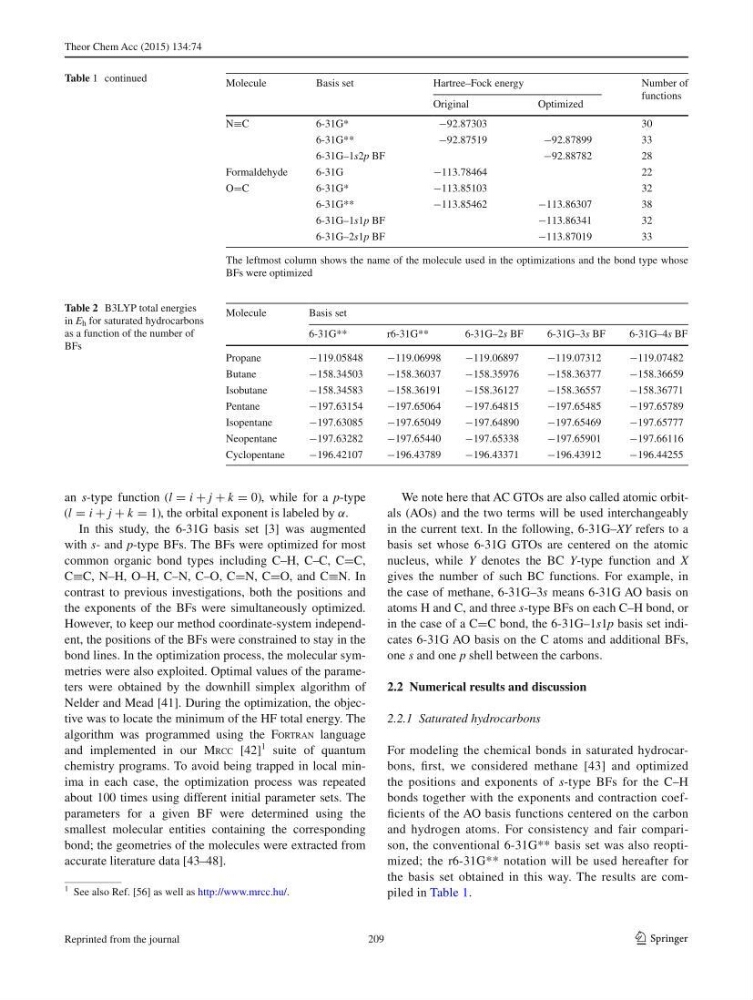
the basis set obtained in this way. The results are compiled in Table 1 .
The leftmost column shows the name of the molecule used in the optimizations and the bond type whose
BFs were optimized
Table 1 continued
Molecule
Basis set
Hartree–Fock energy
Number of
functions
Original
Optimized
N≡C
6-31G*
−92.87303
30
6-31G**
−92.87519
−92.87899
33
6-31G–1 s 2 p BF
−92.88782
28
Formaldehyde
6-31G
−113.78464
22
O=C
6-31G*
−113.85103
32
6-31G**
−113.85462
−113.86307
38
6-31G–1 s 1 p BF
−113.86341
32
6-31G–2 s 1 p BF
−113.87019
33
Table 2 B3LYP total energies
in E h for saturated hydrocarbons
as a function of the number of
BFs
Molecule
Basis set
6-31G**
r6-31G**
6-31G–2 s BF
6-31G–3 s BF
6-31G–4 s BF
Propane
−119.05848
−119.06998
−119.06897
−119.07312
−119.07482
Butane
−158.34503
−158.36037
−158.35976
−158.36377
−158.36659
Isobutane
−158.34583
−158.36191
−158.36127
−158.36557
−158.36771
Pentane
−197.63154
−197.65064
−197.64815
−197.65485
−197.65789
Isopentane
−197.63085
−197.65049
−197.64890
−197.65469
−197.65777
Neopentane
−197.63282
−197.65440
−197.65338
−197.65901
−197.66116
Cyclopentane
−196.42107
−196.43789
−196.43371
−196.43912
−196.44255
209
Reprinted from the journal
1 3
an s -type function (l = i + j + k = 0) , while for a p -type
(l = i + j + k = 1) , the orbital exponent is labeled by α .
In this study, the 6-31G basis set [ 3 ] was augmented
with s - and p -type BFs. The BFs were optimized for most
common organic bond types including C–H, C–C, C=C,
C≡C, N–H, O–H, C–N, C–O, C=N, C=O, and C≡N. In
contrast to previous investigations, both the positions and
the exponents of the BFs were simultaneously optimized.
However, to keep our method coordinate-system independent, the positions of the BFs were constrained to stay in the
bond lines. In the optimization process, the molecular symmetries were also exploited. Optimal values of the parameters were obtained by the downhill simplex algorithm of
Nelder and Mead [ 41 ]. During the optimization, the objective was to locate the minimum of the HF total energy. The
algorithm was programmed using the FORTRAN language
and implemented in our MRCC [ 42 ]
1 suite of quantum
chemistry programs. To avoid being trapped in local minima in each case, the optimization process was repeated
about 100 times using different initial parameter sets. The
parameters for a given BF were determined using the
smallest molecular entities containing the corresponding
bond; the geometries of the molecules were extracted from
accurate literature data [ 43 – 48 ].
1 See also Ref. [ 56 ] as well as http://www.mrcc.hu/.
We note here that AC GTOs are also called atomic orbitals (AOs) and the two terms will be used interchangeably
in the current text. In the following, 6-31G– XY refers to a
basis set whose 6-31G GTOs are centered on the atomic
nucleus, while Y denotes the BC Y -type function and X
gives the number of such BC functions. For example, in
the case of methane, 6-31G–3 s means 6-31G AO basis on
atoms H and C, and three s -type BFs on each C–H bond, or
in the case of a C=C bond, the 6-31G–1 s 1 p basis set indicates 6-31G AO basis on the C atoms and additional BFs,
one s and one p shell between the carbons.
2.2 Numerical results and discussion
2.2.1 Saturated hydrocarbons
For modeling the chemical bonds in saturated hydrocarbons, fi rst, we considered methane [ 43 ] and optimized
the positions and exponents of s -type BFs for the C–H
bonds together with the exponents and contraction coeffi cients of the AO basis functions centered on the carbon
and hydrogen atoms. For consistency and fair comparison, the conventional 6-31G** basis set was also reoptimized; the r6-31G** notation will be used hereafter for
the basis set obtained in this way. The results are compiled in Table 1 .
The leftmost column shows the name of the molecule used in the optimizations and the bond type whose
BFs were optimized
Table 1 continued
Molecule
Basis set
Hartree–Fock energy
Number of
functions
Original
Optimized
N≡C
6-31G*
−92.87303
30
6-31G**
−92.87519
−92.87899
33
6-31G–1 s 2 p BF
−92.88782
28
Formaldehyde
6-31G
−113.78464
22
O=C
6-31G*
−113.85103
32
6-31G**
−113.85462
−113.86307
38
6-31G–1 s 1 p BF
−113.86341
32
6-31G–2 s 1 p BF
−113.87019
33
Table 2 B3LYP total energies
in E h for saturated hydrocarbons
as a function of the number of
BFs
Molecule
Basis set
6-31G**
r6-31G**
6-31G–2 s BF
6-31G–3 s BF
6-31G–4 s BF
Propane
−119.05848
−119.06998
−119.06897
−119.07312
−119.07482
Butane
−158.34503
−158.36037
−158.35976
−158.36377
−158.36659
Isobutane
−158.34583
−158.36191
−158.36127
−158.36557
−158.36771
Pentane
−197.63154
−197.65064
−197.64815
−197.65485
−197.65789
Isopentane
−197.63085
−197.65049
−197.64890
−197.65469
−197.65777
Neopentane
−197.63282
−197.65440
−197.65338
−197.65901
−197.66116
Cyclopentane
−196.42107
−196.43789
−196.43371
−196.43912
−196.44255
209
Reprinted from the journal