

Theor Chem Acc (2015) 134:109
1 3
semiconductors with ≈ 1.6 eV band gaps. Furthermore,
the bands of the I4/mmm packed linear polymers cross
the Fermi level in intervals that are directions parallel
to the chains and close to boundaries of intervals that are
directions perpendicular to the chains, also indicating that
metallicity is primarily an intrinsic property of the linear
polymers, instead of being due to interchain interactions.
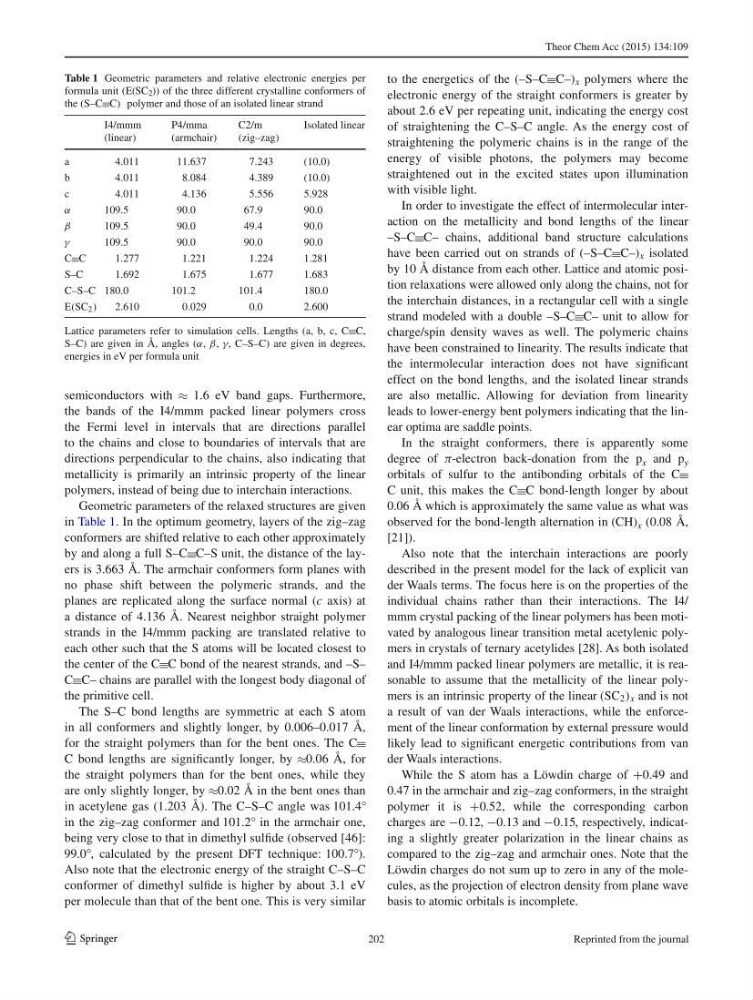
Geometric parameters of the relaxed structures are given
in Table 1 . In the optimum geometry, layers of the zig–zag
conformers are shifted relative to each other approximately
by and along a full S–C ≡ C–S unit, the distance of the layers is 3.663 Å. The armchair conformers form planes with
no phase shift between the polymeric strands, and the
planes are replicated along the surface normal ( c axis) at
a distance of 4.136 Å. Nearest neighbor straight polymer
strands in the I4/mmm packing are translated relative to
each other such that the S atoms will be located closest to
the center of the C ≡ C bond of the nearest strands, and –S–
C ≡ C– chains are parallel with the longest body diagonal of
the primitive cell.
The S–C bond lengths are symmetric at each S atom
in all conformers and slightly longer, by 0.006–0.017 Å,
for the straight polymers than for the bent ones. The C ≡
C bond lengths are signifi cantly longer, by ≈ 0.06 Å, for
the straight polymers than for the bent ones, while they
are only slightly longer, by ≈ 0.02 Å in the bent ones than
in acetylene gas (1.203 Å). The C–S–C angle was 101.4 ◦
in the zig–zag conformer and 101.2 ◦ in the armchair one,
being very close to that in dimethyl sulfi de (observed [ 46 ]:
99.0 ◦ , calculated by the present DFT technique: 100.7 ◦ ).
Also note that the electronic energy of the straight C–S–C
conformer of dimethyl sulfi de is higher by about 3.1 eV
per molecule than that of the bent one. This is very similar
to the energetics of the (–S–C ≡ C–) x polymers where the
electronic energy of the straight conformers is greater by
about 2.6 eV per repeating unit, indicating the energy cost
of straightening the C–S–C angle. As the energy cost of
straightening the polymeric chains is in the range of the
energy of visible photons, the polymers may become
straightened out in the excited states upon illumination
with visible light.
In order to investigate the effect of intermolecular interaction on the metallicity and bond lengths of the linear
–S–C ≡ C– chains, additional band structure calculations
have been carried out on strands of (–S–C ≡ C–) x isolated
by 10 Å distance from each other. Lattice and atomic position relaxations were allowed only along the chains, not for
the interchain distances, in a rectangular cell with a single
strand modeled with a double –S–C ≡ C– unit to allow for
charge/spin density waves as well. The polymeric chains
have been constrained to linearity. The results indicate that
the intermolecular interaction does not have signifi cant
effect on the bond lengths, and the isolated linear strands
are also metallic. Allowing for deviation from linearity
leads to lower-energy bent polymers indicating that the linear optima are saddle points.
In the straight conformers, there is apparently some
degree of π -electron back-donation from the p x and p y
orbitals of sulfur to the antibonding orbitals of the C ≡
C unit, this makes the C ≡ C bond-length longer by about
0.06 Å which is approximately the same value as what was
observed for the bond-length alternation in (CH) x (0.08 Å,
[ 21 ]).
Also note that the interchain interactions are poorly
described in the present model for the lack of explicit van
der Waals terms. The focus here is on the properties of the
individual chains rather than their interactions. The I4/
mmm crystal packing of the linear polymers has been motivated by analogous linear transition metal acetylenic polymers in crystals of ternary acetylides [ 28 ]. As both isolated
and I4/mmm packed linear polymers are metallic, it is reasonable to assume that the metallicity of the linear polymers is an intrinsic property of the linear (SC 2 ) x and is not
a result of van der Waals interactions, while the enforcement of the linear conformation by external pressure would
likely lead to signifi cant energetic contributions from van
der Waals interactions.
While the S atom has a Löwdin charge of +0.49 and
0.47 in the armchair and zig–zag conformers, in the straight
polymer it is +0.52, while the corresponding carbon
charges are −0.12 , −0.13 and −0.15 , respectively, indicating a slightly greater polarization in the linear chains as
compared to the zig–zag and armchair ones. Note that the
Löwdin charges do not sum up to zero in any of the molecules, as the projection of electron density from plane wave
basis to atomic orbitals is incomplete.
Table 1 Geometric parameters and relative electronic energies per
formula unit (E( SC 2 )) of the three different crystalline conformers of
the (S–C ≡ C) polymer and those of an isolated linear strand
Lattice parameters refer to simulation cells. Lengths (a, b, c, C ≡ C,
S–C) are given in Å, angles ( α, β, γ , C–S–C) are given in degrees,
energies in eV per formula unit
I4/mmm
(linear)
P4/mma
(armchair)
C2/m
(zig–zag)
Isolated linear
a
4.011
11.637
7.243
(10.0)
b
4.011
8.084
4.389
(10.0)
c
4.011
4.136
5.556
5.928
α
109.5
90.0
67.9
90.0
β
109.5
90.0
49.4
90.0
γ
109.5
90.0
90.0
90.0
C ≡ C
1.277
1.221
1.224
1.281
S–C
1.692
1.675
1.677
1.683
C–S–C 180.0
101.2
101.4
180.0
E(SC 2 )
2.610
0.029
0.0
2.600
202
Reprinted from the journal
1 3
semiconductors with ≈ 1.6 eV band gaps. Furthermore,
the bands of the I4/mmm packed linear polymers cross
the Fermi level in intervals that are directions parallel
to the chains and close to boundaries of intervals that are
directions perpendicular to the chains, also indicating that
metallicity is primarily an intrinsic property of the linear
polymers, instead of being due to interchain interactions.
Geometric parameters of the relaxed structures are given
in Table 1 . In the optimum geometry, layers of the zig–zag
conformers are shifted relative to each other approximately
by and along a full S–C ≡ C–S unit, the distance of the layers is 3.663 Å. The armchair conformers form planes with
no phase shift between the polymeric strands, and the
planes are replicated along the surface normal ( c axis) at
a distance of 4.136 Å. Nearest neighbor straight polymer
strands in the I4/mmm packing are translated relative to
each other such that the S atoms will be located closest to
the center of the C ≡ C bond of the nearest strands, and –S–
C ≡ C– chains are parallel with the longest body diagonal of
the primitive cell.
The S–C bond lengths are symmetric at each S atom
in all conformers and slightly longer, by 0.006–0.017 Å,
for the straight polymers than for the bent ones. The C ≡
C bond lengths are signifi cantly longer, by ≈ 0.06 Å, for
the straight polymers than for the bent ones, while they
are only slightly longer, by ≈ 0.02 Å in the bent ones than
in acetylene gas (1.203 Å). The C–S–C angle was 101.4 ◦
in the zig–zag conformer and 101.2 ◦ in the armchair one,
being very close to that in dimethyl sulfi de (observed [ 46 ]:
99.0 ◦ , calculated by the present DFT technique: 100.7 ◦ ).
Also note that the electronic energy of the straight C–S–C
conformer of dimethyl sulfi de is higher by about 3.1 eV
per molecule than that of the bent one. This is very similar
to the energetics of the (–S–C ≡ C–) x polymers where the
electronic energy of the straight conformers is greater by
about 2.6 eV per repeating unit, indicating the energy cost
of straightening the C–S–C angle. As the energy cost of
straightening the polymeric chains is in the range of the
energy of visible photons, the polymers may become
straightened out in the excited states upon illumination
with visible light.
In order to investigate the effect of intermolecular interaction on the metallicity and bond lengths of the linear
–S–C ≡ C– chains, additional band structure calculations
have been carried out on strands of (–S–C ≡ C–) x isolated
by 10 Å distance from each other. Lattice and atomic position relaxations were allowed only along the chains, not for
the interchain distances, in a rectangular cell with a single
strand modeled with a double –S–C ≡ C– unit to allow for
charge/spin density waves as well. The polymeric chains
have been constrained to linearity. The results indicate that
the intermolecular interaction does not have signifi cant
effect on the bond lengths, and the isolated linear strands
are also metallic. Allowing for deviation from linearity
leads to lower-energy bent polymers indicating that the linear optima are saddle points.
In the straight conformers, there is apparently some
degree of π -electron back-donation from the p x and p y
orbitals of sulfur to the antibonding orbitals of the C ≡
C unit, this makes the C ≡ C bond-length longer by about
0.06 Å which is approximately the same value as what was
observed for the bond-length alternation in (CH) x (0.08 Å,
[ 21 ]).
Also note that the interchain interactions are poorly
described in the present model for the lack of explicit van
der Waals terms. The focus here is on the properties of the
individual chains rather than their interactions. The I4/
mmm crystal packing of the linear polymers has been motivated by analogous linear transition metal acetylenic polymers in crystals of ternary acetylides [ 28 ]. As both isolated
and I4/mmm packed linear polymers are metallic, it is reasonable to assume that the metallicity of the linear polymers is an intrinsic property of the linear (SC 2 ) x and is not
a result of van der Waals interactions, while the enforcement of the linear conformation by external pressure would
likely lead to signifi cant energetic contributions from van
der Waals interactions.
While the S atom has a Löwdin charge of +0.49 and
0.47 in the armchair and zig–zag conformers, in the straight
polymer it is +0.52, while the corresponding carbon
charges are −0.12 , −0.13 and −0.15 , respectively, indicating a slightly greater polarization in the linear chains as
compared to the zig–zag and armchair ones. Note that the
Löwdin charges do not sum up to zero in any of the molecules, as the projection of electron density from plane wave
basis to atomic orbitals is incomplete.
Table 1 Geometric parameters and relative electronic energies per
formula unit (E( SC 2 )) of the three different crystalline conformers of
the (S–C ≡ C) polymer and those of an isolated linear strand
Lattice parameters refer to simulation cells. Lengths (a, b, c, C ≡ C,
S–C) are given in Å, angles ( α, β, γ , C–S–C) are given in degrees,
energies in eV per formula unit
I4/mmm
(linear)
P4/mma
(armchair)
C2/m
(zig–zag)
Isolated linear
a
4.011
11.637
7.243
(10.0)
b
4.011
8.084
4.389
(10.0)
c
4.011
4.136
5.556
5.928
α
109.5
90.0
67.9
90.0
β
109.5
90.0
49.4
90.0
γ
109.5
90.0
90.0
90.0
C ≡ C
1.277
1.221
1.224
1.281
S–C
1.692
1.675
1.677
1.683
C–S–C 180.0
101.2
101.4
180.0
E(SC 2 )
2.610
0.029
0.0
2.600
202
Reprinted from the journal