

Theor Chem Acc (2015) 134:109
1 3
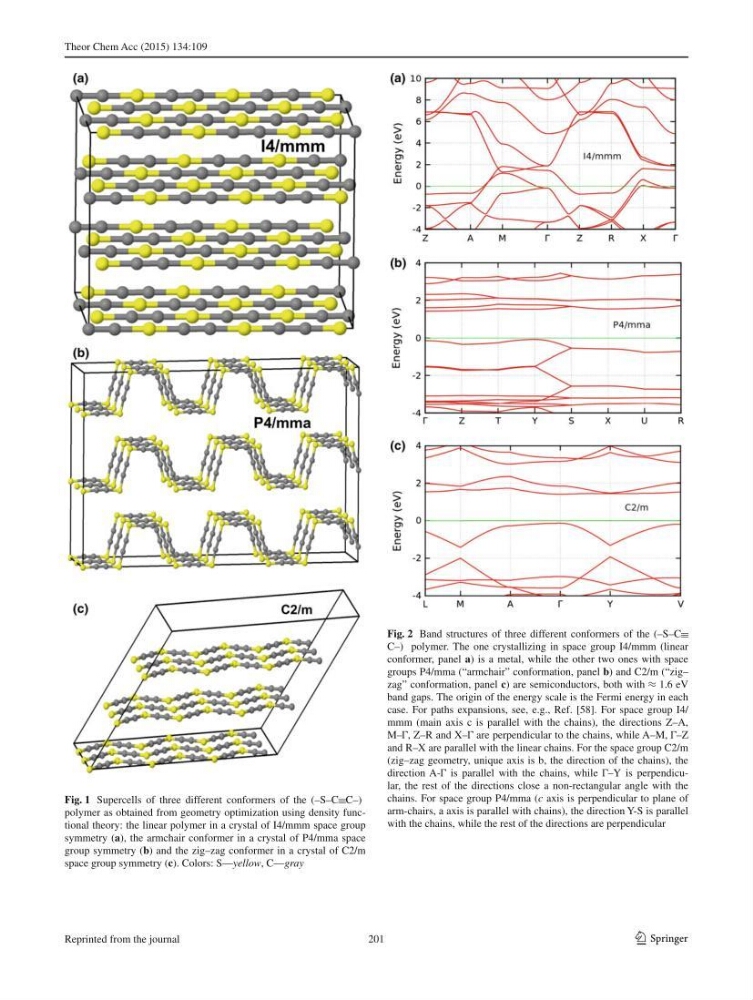
Fig. 1 Supercells of three different conformers of the (–S–C ≡ C–)
polymer as obtained from geometry optimization using density functional theory: the linear polymer in a crystal of I4/mmm space group
symmetry ( a ), the armchair conformer in a crystal of P4/mma space
group symmetry ( b ) and the zig–zag conformer in a crystal of C2/m
space group symmetry ( c ). Colors: S— yellow , C— gray
Fig. 2 Band structures of three different conformers of the (–S–C ≡
C–) polymer. The one crystallizing in space group I4/mmm (linear
conformer, panel a ) is a metal, while the other two ones with space
groups P4/mma (“armchair” conformation, panel b ) and C2/m (“zig–
zag” conformation, panel c ) are semiconductors, both with ≈ 1.6 eV
band gaps. The origin of the energy scale is the Fermi energy in each
case. For paths expansions, see, e.g., Ref. [ 58 ]. For space group I4/
mmm (main axis c is parallel with the chains), the directions Z–A,
M– , Z–R and X– are perpendicular to the chains, while A–M, –Z
and R–X are parallel with the linear chains. For the space group C2/m
(zig–zag geometry, unique axis is b, the direction of the chains), the
direction A- is parallel with the chains, while –Y is perpendicular, the rest of the directions close a non-rectangular angle with the
chains. For space group P4/mma ( c axis is perpendicular to plane of
arm-chairs, a axis is parallel with chains), the direction Y-S is parallel
with the chains, while the rest of the directions are perpendicular
201
Reprinted from the journal
1 3
Fig. 1 Supercells of three different conformers of the (–S–C ≡ C–)
polymer as obtained from geometry optimization using density functional theory: the linear polymer in a crystal of I4/mmm space group
symmetry ( a ), the armchair conformer in a crystal of P4/mma space
group symmetry ( b ) and the zig–zag conformer in a crystal of C2/m
space group symmetry ( c ). Colors: S— yellow , C— gray
Fig. 2 Band structures of three different conformers of the (–S–C ≡
C–) polymer. The one crystallizing in space group I4/mmm (linear
conformer, panel a ) is a metal, while the other two ones with space
groups P4/mma (“armchair” conformation, panel b ) and C2/m (“zig–
zag” conformation, panel c ) are semiconductors, both with ≈ 1.6 eV
band gaps. The origin of the energy scale is the Fermi energy in each
case. For paths expansions, see, e.g., Ref. [ 58 ]. For space group I4/
mmm (main axis c is parallel with the chains), the directions Z–A,
M– , Z–R and X– are perpendicular to the chains, while A–M, –Z
and R–X are parallel with the linear chains. For the space group C2/m
(zig–zag geometry, unique axis is b, the direction of the chains), the
direction A- is parallel with the chains, while –Y is perpendicular, the rest of the directions close a non-rectangular angle with the
chains. For space group P4/mma ( c axis is perpendicular to plane of
arm-chairs, a axis is parallel with chains), the direction Y-S is parallel
with the chains, while the rest of the directions are perpendicular
201
Reprinted from the journal