

Theor Chem Acc (2016) 135:3
1 3
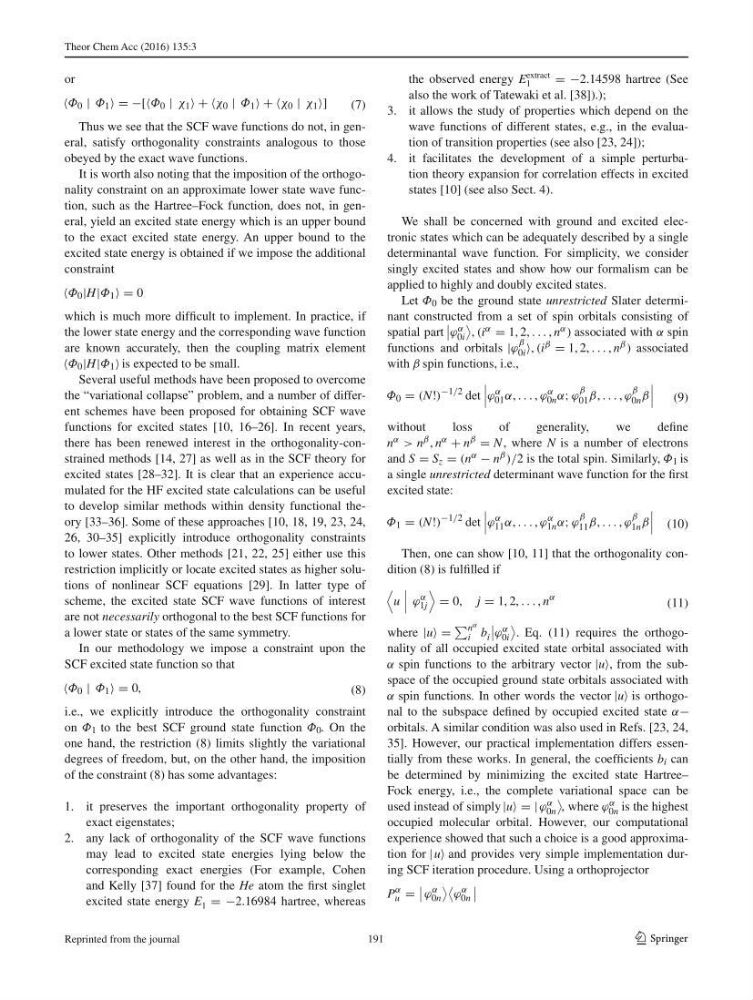
or
Thus we see that the SCF wave functions do not, in general, satisfy orthogonality constraints analogous to those
obeyed by the exact wave functions.
It is worth also noting that the imposition of the orthogonality constraint on an approximate lower state wave function, such as the Hartree–Fock function, does not, in general, yield an excited state energy which is an upper bound
to the exact excited state energy. An upper bound to the
excited state energy is obtained if we impose the additional
constraint
which is much more diffi cult to implement. In practice, if
the lower state energy and the corresponding wave function
are known accurately, then the coupling matrix element
Φ 0 |H|Φ 1 is expected to be small.
Several useful methods have been proposed to overcome
the “variational collapse” problem, and a number of different schemes have been proposed for obtaining SCF wave
functions for excited states [ 10 , 16 – 26 ]. In recent years,
there has been renewed interest in the orthogonality-constrained methods [ 14 , 27 ] as well as in the SCF theory for
excited states [ 28 – 32 ]. It is clear that an experience accumulated for the HF excited state calculations can be useful
to develop similar methods within density functional theory [ 33 – 36 ]. Some of these approaches [ 10 , 18 , 19 , 23 , 24 ,
26 , 30 – 35 ] explicitly introduce orthogonality constraints
to lower states. Other methods [ 21 , 22 , 25 ] either use this
restriction implicitly or locate excited states as higher solutions of nonlinear SCF equations [ 29 ]. In latter type of
scheme, the excited state SCF wave functions of interest
are not necessarily orthogonal to the best SCF functions for
a lower state or states of the same symmetry.
In our methodology we impose a constraint upon the
SCF excited state function so that
i.e., we explicitly introduce the orthogonality constraint
on Φ 1 to the best SCF ground state function Φ 0 . On the
one hand, the restriction ( 8 ) limits slightly the variational
degrees of freedom, but, on the other hand, the imposition
of the constraint ( 8 ) has some advantages:
1. it preserves the important orthogonality property of
exact eigenstates;
2. any lack of orthogonality of the SCF wave functions
may lead to excited state energies lying below the
corresponding exact energies (For example, Cohen
and Kelly [ 37 ] found for the He atom the fi rst singlet
excited state energy E 1 = −2.16984 hartree, whereas
(7)
Φ 0 | Φ 1 = −[Φ 0 | χ 1 + χ 0 | Φ 1 + χ 0 | χ 1 ]
Φ 0 |H|Φ 1 = 0
(8)
Φ 0 | Φ 1 = 0,
the observed energy E 1
extract
= −2.14598 hartree (See
also the work of Tatewaki et al. [ 38 ]).);
3. it allows the study of properties which depend on the
wave functions of different states, e.g., in the evaluation of transition properties (see also [ 23 , 24 ]);
4. it facilitates the development of a simple perturbation theory expansion for correlation effects in excited
states [ 10 ] (see also Sect. 4 ).
We shall be concerned with ground and excited electronic states which can be adequately described by a single
determinantal wave function. For simplicity, we consider
singly excited states and show how our formalism can be
applied to highly and doubly excited states.
Let Φ 0 be the ground state unrestricted Slater determinant constructed from a set of spin orbitals consisting of
spatial part
ϕ α
0i
, (i α = 1, 2, . . . , n α ) associated with α spin
functions and orbitals |ϕ
β
0i , (i β = 1, 2, . . . , n β ) associated
with β spin functions, i.e.,
without
loss
of
generality,
we
defi ne
n α > n β , n α + n β = N , where N is a number of electrons
and S = S z = (n α − n β )/2 is the total spin. Similarly, Φ 1 is
a single unrestricted determinant wave function for the fi rst
excited state:
Then, one can show [ 10 , 11 ] that the orthogonality condition ( 8 ) is fulfi lled if
where |u =
n α
i b i
ϕ α
0i
. Eq. ( 11 ) requires the orthogonality of all occupied excited state orbital associated with
α spin functions to the arbitrary vector |u, from the subspace of the occupied ground state orbitals associated with
α spin functions. In other words the vector |u is orthogonal to the subspace defi ned by occupied excited state α−
orbitals. A similar condition was also used in Refs. [ 23 , 24 ,
35 ]. However, our practical implementation differs essentially from these works. In general, the coeffi cients b i can
be determined by minimizing the excited state Hartree–
Fock energy, i.e., the complete variational space can be
used instead of simply |u = |ϕ α
0n
, where ϕ α
0n is the highest
occupied molecular orbital. However, our computational
experience showed that such a choice is a good approximation for | u and provides very simple implementation during SCF iteration procedure. Using a orthoprojector
(9)
Φ 0 = (N!)
−1/2 det
ϕ
α
01 α, . . . , ϕ
α
0n α; ϕ
β
01 β, . . . , ϕ
β
0n β
(10)
Φ 1 = (N!)
−1/2 det
ϕ
α
11 α, . . . , ϕ
α
1n α; ϕ
β
11 β, . . . , ϕ
β
1n β
(11)
u
ϕ
α
1j
= 0, j = 1, 2, . . . , n
α
P
α
u =
ϕ
α
0n
ϕ
α
0n
191
Reprinted from the journal
1 3
or
Thus we see that the SCF wave functions do not, in general, satisfy orthogonality constraints analogous to those
obeyed by the exact wave functions.
It is worth also noting that the imposition of the orthogonality constraint on an approximate lower state wave function, such as the Hartree–Fock function, does not, in general, yield an excited state energy which is an upper bound
to the exact excited state energy. An upper bound to the
excited state energy is obtained if we impose the additional
constraint
which is much more diffi cult to implement. In practice, if
the lower state energy and the corresponding wave function
are known accurately, then the coupling matrix element
Φ 0 |H|Φ 1 is expected to be small.
Several useful methods have been proposed to overcome
the “variational collapse” problem, and a number of different schemes have been proposed for obtaining SCF wave
functions for excited states [ 10 , 16 – 26 ]. In recent years,
there has been renewed interest in the orthogonality-constrained methods [ 14 , 27 ] as well as in the SCF theory for
excited states [ 28 – 32 ]. It is clear that an experience accumulated for the HF excited state calculations can be useful
to develop similar methods within density functional theory [ 33 – 36 ]. Some of these approaches [ 10 , 18 , 19 , 23 , 24 ,
26 , 30 – 35 ] explicitly introduce orthogonality constraints
to lower states. Other methods [ 21 , 22 , 25 ] either use this
restriction implicitly or locate excited states as higher solutions of nonlinear SCF equations [ 29 ]. In latter type of
scheme, the excited state SCF wave functions of interest
are not necessarily orthogonal to the best SCF functions for
a lower state or states of the same symmetry.
In our methodology we impose a constraint upon the
SCF excited state function so that
i.e., we explicitly introduce the orthogonality constraint
on Φ 1 to the best SCF ground state function Φ 0 . On the
one hand, the restriction ( 8 ) limits slightly the variational
degrees of freedom, but, on the other hand, the imposition
of the constraint ( 8 ) has some advantages:
1. it preserves the important orthogonality property of
exact eigenstates;
2. any lack of orthogonality of the SCF wave functions
may lead to excited state energies lying below the
corresponding exact energies (For example, Cohen
and Kelly [ 37 ] found for the He atom the fi rst singlet
excited state energy E 1 = −2.16984 hartree, whereas
(7)
Φ 0 | Φ 1 = −[Φ 0 | χ 1 + χ 0 | Φ 1 + χ 0 | χ 1 ]
Φ 0 |H|Φ 1 = 0
(8)
Φ 0 | Φ 1 = 0,
the observed energy E 1
extract
= −2.14598 hartree (See
also the work of Tatewaki et al. [ 38 ]).);
3. it allows the study of properties which depend on the
wave functions of different states, e.g., in the evaluation of transition properties (see also [ 23 , 24 ]);
4. it facilitates the development of a simple perturbation theory expansion for correlation effects in excited
states [ 10 ] (see also Sect. 4 ).
We shall be concerned with ground and excited electronic states which can be adequately described by a single
determinantal wave function. For simplicity, we consider
singly excited states and show how our formalism can be
applied to highly and doubly excited states.
Let Φ 0 be the ground state unrestricted Slater determinant constructed from a set of spin orbitals consisting of
spatial part
ϕ α
0i
, (i α = 1, 2, . . . , n α ) associated with α spin
functions and orbitals |ϕ
β
0i , (i β = 1, 2, . . . , n β ) associated
with β spin functions, i.e.,
without
loss
of
generality,
we
defi ne
n α > n β , n α + n β = N , where N is a number of electrons
and S = S z = (n α − n β )/2 is the total spin. Similarly, Φ 1 is
a single unrestricted determinant wave function for the fi rst
excited state:
Then, one can show [ 10 , 11 ] that the orthogonality condition ( 8 ) is fulfi lled if
where |u =
n α
i b i
ϕ α
0i
. Eq. ( 11 ) requires the orthogonality of all occupied excited state orbital associated with
α spin functions to the arbitrary vector |u, from the subspace of the occupied ground state orbitals associated with
α spin functions. In other words the vector |u is orthogonal to the subspace defi ned by occupied excited state α−
orbitals. A similar condition was also used in Refs. [ 23 , 24 ,
35 ]. However, our practical implementation differs essentially from these works. In general, the coeffi cients b i can
be determined by minimizing the excited state Hartree–
Fock energy, i.e., the complete variational space can be
used instead of simply |u = |ϕ α
0n
, where ϕ α
0n is the highest
occupied molecular orbital. However, our computational
experience showed that such a choice is a good approximation for | u and provides very simple implementation during SCF iteration procedure. Using a orthoprojector
(9)
Φ 0 = (N!)
−1/2 det
ϕ
α
01 α, . . . , ϕ
α
0n α; ϕ
β
01 β, . . . , ϕ
β
0n β
(10)
Φ 1 = (N!)
−1/2 det
ϕ
α
11 α, . . . , ϕ
α
1n α; ϕ
β
11 β, . . . , ϕ
β
1n β
(11)
u
ϕ
α
1j
= 0, j = 1, 2, . . . , n
α
P
α
u =
ϕ
α
0n
ϕ
α
0n
191
Reprinted from the journal