

Theor Chem Acc (2015) 134:151
1 3
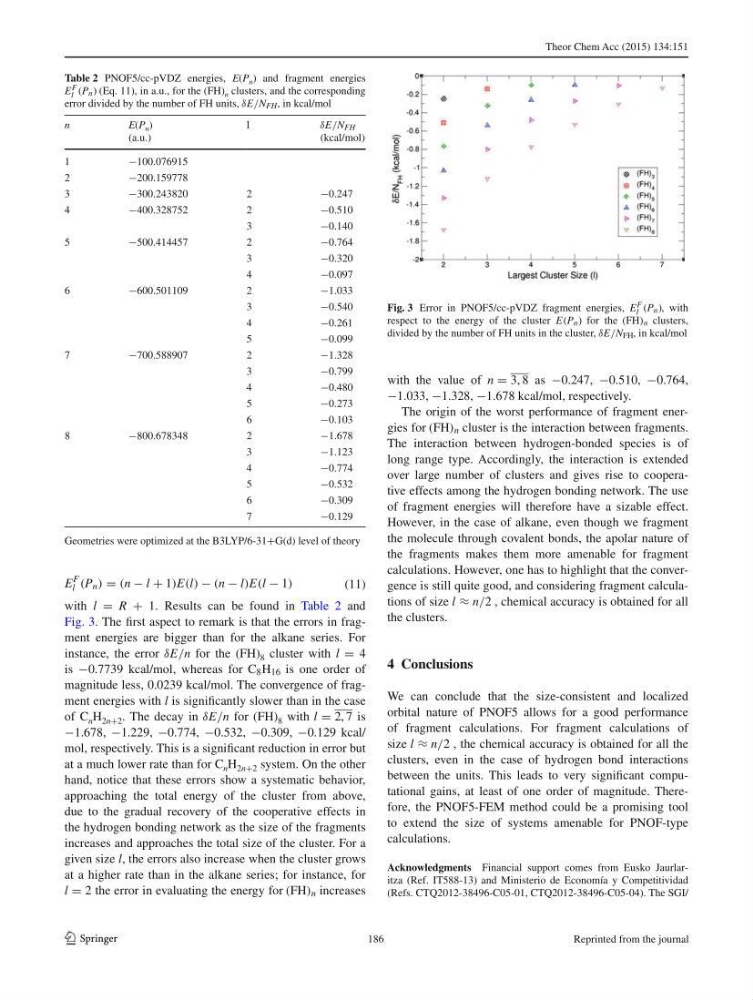
with l = R + 1. Results can be found in Table 2 and
Fig. 3 . The fi rst aspect to remark is that the errors in fragment energies are bigger than for the alkane series. For
instance, the error δE/n for the (FH) 8 cluster with l = 4
is −0.7739 kcal/mol, whereas for C 8 H 16 is one order of
magnitude less, 0.0239 kcal/mol. The convergence of fragment energies with l is signifi cantly slower than in the case
of C n H 2 n +2 . The decay in δE/n for (FH) 8 with l = 2, 7 is
−1.678, −1.229, −0.774, −0.532, −0.309, −0.129 kcal/
mol, respectively. This is a signifi cant reduction in error but
at a much lower rate than for C n H 2 n +2 system. On the other
hand, notice that these errors show a systematic behavior,
approaching the total energy of the cluster from above,
due to the gradual recovery of the cooperative effects in
the hydrogen bonding network as the size of the fragments
increases and approaches the total size of the cluster. For a
given size l , the errors also increase when the cluster grows
at a higher rate than in the alkane series; for instance, for
l = 2 the error in evaluating the energy for (FH) n increases
(11)
E
F
l (P n ) = (n − l + 1)E(l) − (n − l)E(l − 1)
with the value of n = 3, 8 as −0.247, −0.510, −0.764,
−1.033, −1.328, −1.678 kcal/mol, respectively.
The origin of the worst performance of fragment energies for (FH) n cluster is the interaction between fragments.
The interaction between hydrogen-bonded species is of
long range type. Accordingly, the interaction is extended
over large number of clusters and gives rise to cooperative effects among the hydrogen bonding network. The use
of fragment energies will therefore have a sizable effect.
However, in the case of alkane, even though we fragment
the molecule through covalent bonds, the apolar nature of
the fragments makes them more amenable for fragment
calculations. However, one has to highlight that the convergence is still quite good, and considering fragment calculations of size l ≈ n/2 , chemical accuracy is obtained for all
the clusters.
4 Conclusions
We can conclude that the size-consistent and localized
orbital nature of PNOF5 allows for a good performance
of fragment calculations. For fragment calculations of
size l ≈ n/2 , the chemical accuracy is obtained for all the
clusters, even in the case of hydrogen bond interactions
between the units. This leads to very signifi cant computational gains, at least of one order of magnitude. Therefore, the PNOF5-FEM method could be a promising tool
to extend the size of systems amenable for PNOF-type
calculations.
Acknowledgments Financial support comes from Eusko Jaurlaritza (Ref. IT588-13) and Ministerio de Economía y Competitividad
(Refs. CTQ2012-38496-C05-01, CTQ2012-38496-C05-04). The SGI/
Table 2 PNOF5/cc-pVDZ energies, E ( P n ) and fragment energies
E F
l (P n ) (Eq. 11 ), in a.u., for the (FH) n clusters, and the corresponding
error divided by the number of FH units, δE/N FH , in kcal/mol
Geometries were optimized at the B3LYP/6-31+G(d) level of theory
n
E ( P n )
(a.u.)
l
δE/N FH
(kcal/mol)
1
−100.076915
2
−200.159778
3
−300.243820
2
−0.247
4
−400.328752
2
−0.510
3
−0.140
5
−500.414457
2
−0.764
3
−0.320
4
−0.097
6
−600.501109
2
−1.033
3
−0.540
4
−0.261
5
−0.099
7
−700.588907
2
−1.328
3
−0.799
4
−0.480
5
−0.273
6
−0.103
8
−800.678348
2
−1.678
3
−1.123
4
−0.774
5
−0.532
6
−0.309
7
−0.129
Fig. 3 Error in PNOF5/cc-pVDZ fragment energies, E F
l (P n ) , with
respect to the energy of the cluster E(P n ) for the (FH) n clusters,
divided by the number of FH units in the cluster, δE/N FH , in kcal/mol
186
Reprinted from the journal
1 3
with l = R + 1. Results can be found in Table 2 and
Fig. 3 . The fi rst aspect to remark is that the errors in fragment energies are bigger than for the alkane series. For
instance, the error δE/n for the (FH) 8 cluster with l = 4
is −0.7739 kcal/mol, whereas for C 8 H 16 is one order of
magnitude less, 0.0239 kcal/mol. The convergence of fragment energies with l is signifi cantly slower than in the case
of C n H 2 n +2 . The decay in δE/n for (FH) 8 with l = 2, 7 is
−1.678, −1.229, −0.774, −0.532, −0.309, −0.129 kcal/
mol, respectively. This is a signifi cant reduction in error but
at a much lower rate than for C n H 2 n +2 system. On the other
hand, notice that these errors show a systematic behavior,
approaching the total energy of the cluster from above,
due to the gradual recovery of the cooperative effects in
the hydrogen bonding network as the size of the fragments
increases and approaches the total size of the cluster. For a
given size l , the errors also increase when the cluster grows
at a higher rate than in the alkane series; for instance, for
l = 2 the error in evaluating the energy for (FH) n increases
(11)
E
F
l (P n ) = (n − l + 1)E(l) − (n − l)E(l − 1)
with the value of n = 3, 8 as −0.247, −0.510, −0.764,
−1.033, −1.328, −1.678 kcal/mol, respectively.
The origin of the worst performance of fragment energies for (FH) n cluster is the interaction between fragments.
The interaction between hydrogen-bonded species is of
long range type. Accordingly, the interaction is extended
over large number of clusters and gives rise to cooperative effects among the hydrogen bonding network. The use
of fragment energies will therefore have a sizable effect.
However, in the case of alkane, even though we fragment
the molecule through covalent bonds, the apolar nature of
the fragments makes them more amenable for fragment
calculations. However, one has to highlight that the convergence is still quite good, and considering fragment calculations of size l ≈ n/2 , chemical accuracy is obtained for all
the clusters.
4 Conclusions
We can conclude that the size-consistent and localized
orbital nature of PNOF5 allows for a good performance
of fragment calculations. For fragment calculations of
size l ≈ n/2 , the chemical accuracy is obtained for all the
clusters, even in the case of hydrogen bond interactions
between the units. This leads to very signifi cant computational gains, at least of one order of magnitude. Therefore, the PNOF5-FEM method could be a promising tool
to extend the size of systems amenable for PNOF-type
calculations.
Acknowledgments Financial support comes from Eusko Jaurlaritza (Ref. IT588-13) and Ministerio de Economía y Competitividad
(Refs. CTQ2012-38496-C05-01, CTQ2012-38496-C05-04). The SGI/
Table 2 PNOF5/cc-pVDZ energies, E ( P n ) and fragment energies
E F
l (P n ) (Eq. 11 ), in a.u., for the (FH) n clusters, and the corresponding
error divided by the number of FH units, δE/N FH , in kcal/mol
Geometries were optimized at the B3LYP/6-31+G(d) level of theory
n
E ( P n )
(a.u.)
l
δE/N FH
(kcal/mol)
1
−100.076915
2
−200.159778
3
−300.243820
2
−0.247
4
−400.328752
2
−0.510
3
−0.140
5
−500.414457
2
−0.764
3
−0.320
4
−0.097
6
−600.501109
2
−1.033
3
−0.540
4
−0.261
5
−0.099
7
−700.588907
2
−1.328
3
−0.799
4
−0.480
5
−0.273
6
−0.103
8
−800.678348
2
−1.678
3
−1.123
4
−0.774
5
−0.532
6
−0.309
7
−0.129
Fig. 3 Error in PNOF5/cc-pVDZ fragment energies, E F
l (P n ) , with
respect to the energy of the cluster E(P n ) for the (FH) n clusters,
divided by the number of FH units in the cluster, δE/N FH , in kcal/mol
186
Reprinted from the journal