

Theor Chem Acc (2015) 134:151
1 3
for ( n = 3, 6), obtaining similar results. Therefore, we will
analyze the PNOF5/6-31G results for which a larger dataset of oligomers was calculated.
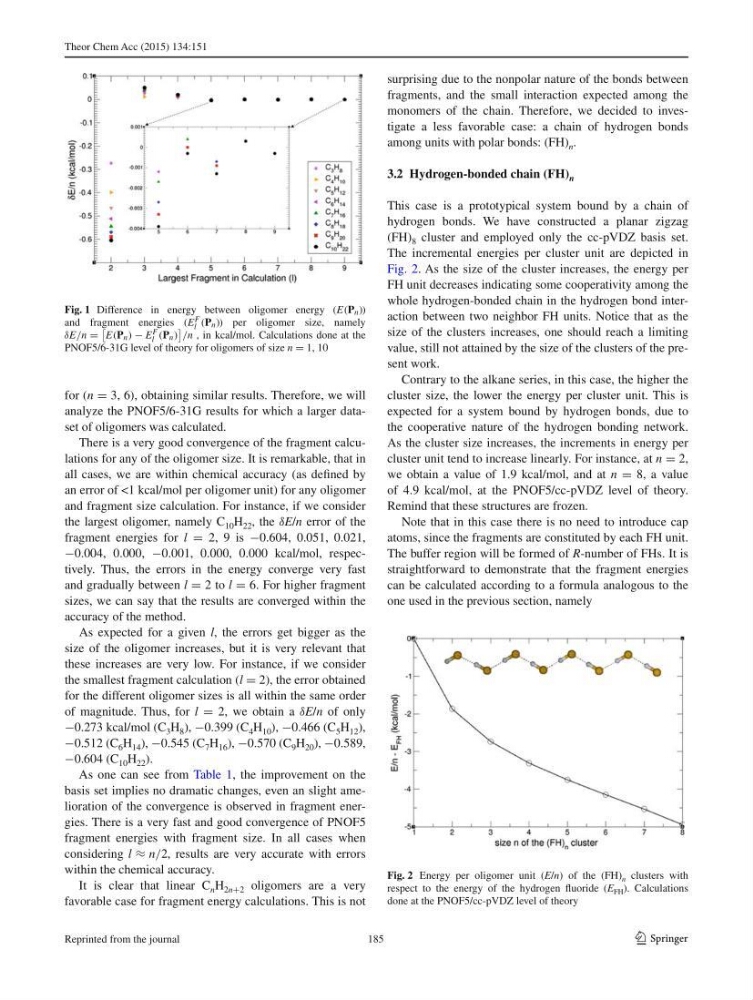
There is a very good convergence of the fragment calculations for any of the oligomer size. It is remarkable, that in
all cases, we are within chemical accuracy (as defi ned by
an error of < 1 kcal/mol per oligomer unit) for any oligomer
and fragment size calculation. For instance, if we consider
the largest oligomer, namely C 10 H 22 , the δ E / n error of the
fragment energies for l = 2, 9 is −0.604, 0.051, 0.021,
−0.004, 0.000, −0.001, 0.000, 0.000 kcal/mol, respectively. Thus, the errors in the energy converge very fast
and gradually between l = 2 to l = 6. For higher fragment
sizes, we can say that the results are converged within the
accuracy of the method.
As expected for a given l , the errors get bigger as the
size of the oligomer increases, but it is very relevant that
these increases are very low. For instance, if we consider
the smallest fragment calculation ( l = 2), the error obtained
for the different oligomer sizes is all within the same order
of magnitude. Thus, for l = 2, we obtain a δ E / n of only
−0.273 kcal/mol (C 3 H 8 ), −0.399 (C 4 H 10 ), −0.466 (C 5 H 12 ),
−0.512 (C 6 H 14 ), −0.545 (C 7 H 16 ), −0.570 (C 9 H 20 ), −0.589,
−0.604 (C 10 H 22 ).
As one can see from Table 1 , the improvement on the
basis set implies no dramatic changes, even an slight amelioration of the convergence is observed in fragment energies. There is a very fast and good convergence of PNOF5
fragment energies with fragment size. In all cases when
considering l ≈ n/2 , results are very accurate with errors
within the chemical accuracy.
It is clear that linear C n H 2 n +2 oligomers are a very
favorable case for fragment energy calculations. This is not
surprising due to the nonpolar nature of the bonds between
fragments, and the small interaction expected among the
monomers of the chain. Therefore, we decided to investigate a less favorable case: a chain of hydrogen bonds
among units with polar bonds: (FH) n .
3.2 Hydrogen-bonded chain (FH) n
This case is a prototypical system bound by a chain of
hydrogen bonds. We have constructed a planar zigzag
(FH) 8 cluster and employed only the cc-pVDZ basis set.
The incremental energies per cluster unit are depicted in
Fig. 2 . As the size of the cluster increases, the energy per
FH unit decreases indicating some cooperativity among the
whole hydrogen-bonded chain in the hydrogen bond interaction between two neighbor FH units. Notice that as the
size of the clusters increases, one should reach a limiting
value, still not attained by the size of the clusters of the present work.
Contrary to the alkane series, in this case, the higher the
cluster size, the lower the energy per cluster unit. This is
expected for a system bound by hydrogen bonds, due to
the cooperative nature of the hydrogen bonding network.
As the cluster size increases, the increments in energy per
cluster unit tend to increase linearly. For instance, at n = 2,
we obtain a value of 1.9 kcal/mol, and at n = 8, a value
of 4.9 kcal/mol, at the PNOF5/cc-pVDZ level of theory.
Remind that these structures are frozen.
Note that in this case there is no need to introduce cap
atoms, since the fragments are constituted by each FH unit.
The buffer region will be formed of R -number of FHs. It is
straightforward to demonstrate that the fragment energies
can be calculated according to a formula analogous to the
one used in the previous section, namely
Fig. 1 Difference in energy between oligomer energy ( E(P n ) )
and fragment energies ( E F
l (P n ) ) per oligomer size, namely
δE/n =
E(P n ) − E F
l (P n )
/n , in kcal/mol. Calculations done at the
PNOF5/6-31G level of theory for oligomers of size n = 1, 10
Fig. 2 Energy per oligomer unit ( E / n ) of the (FH) n clusters with
respect to the energy of the hydrogen fl uoride ( E FH ). Calculations
done at the PNOF5/cc-pVDZ level of theory
185
Reprinted from the journal
1 3
for ( n = 3, 6), obtaining similar results. Therefore, we will
analyze the PNOF5/6-31G results for which a larger dataset of oligomers was calculated.
There is a very good convergence of the fragment calculations for any of the oligomer size. It is remarkable, that in
all cases, we are within chemical accuracy (as defi ned by
an error of < 1 kcal/mol per oligomer unit) for any oligomer
and fragment size calculation. For instance, if we consider
the largest oligomer, namely C 10 H 22 , the δ E / n error of the
fragment energies for l = 2, 9 is −0.604, 0.051, 0.021,
−0.004, 0.000, −0.001, 0.000, 0.000 kcal/mol, respectively. Thus, the errors in the energy converge very fast
and gradually between l = 2 to l = 6. For higher fragment
sizes, we can say that the results are converged within the
accuracy of the method.
As expected for a given l , the errors get bigger as the
size of the oligomer increases, but it is very relevant that
these increases are very low. For instance, if we consider
the smallest fragment calculation ( l = 2), the error obtained
for the different oligomer sizes is all within the same order
of magnitude. Thus, for l = 2, we obtain a δ E / n of only
−0.273 kcal/mol (C 3 H 8 ), −0.399 (C 4 H 10 ), −0.466 (C 5 H 12 ),
−0.512 (C 6 H 14 ), −0.545 (C 7 H 16 ), −0.570 (C 9 H 20 ), −0.589,
−0.604 (C 10 H 22 ).
As one can see from Table 1 , the improvement on the
basis set implies no dramatic changes, even an slight amelioration of the convergence is observed in fragment energies. There is a very fast and good convergence of PNOF5
fragment energies with fragment size. In all cases when
considering l ≈ n/2 , results are very accurate with errors
within the chemical accuracy.
It is clear that linear C n H 2 n +2 oligomers are a very
favorable case for fragment energy calculations. This is not
surprising due to the nonpolar nature of the bonds between
fragments, and the small interaction expected among the
monomers of the chain. Therefore, we decided to investigate a less favorable case: a chain of hydrogen bonds
among units with polar bonds: (FH) n .
3.2 Hydrogen-bonded chain (FH) n
This case is a prototypical system bound by a chain of
hydrogen bonds. We have constructed a planar zigzag
(FH) 8 cluster and employed only the cc-pVDZ basis set.
The incremental energies per cluster unit are depicted in
Fig. 2 . As the size of the cluster increases, the energy per
FH unit decreases indicating some cooperativity among the
whole hydrogen-bonded chain in the hydrogen bond interaction between two neighbor FH units. Notice that as the
size of the clusters increases, one should reach a limiting
value, still not attained by the size of the clusters of the present work.
Contrary to the alkane series, in this case, the higher the
cluster size, the lower the energy per cluster unit. This is
expected for a system bound by hydrogen bonds, due to
the cooperative nature of the hydrogen bonding network.
As the cluster size increases, the increments in energy per
cluster unit tend to increase linearly. For instance, at n = 2,
we obtain a value of 1.9 kcal/mol, and at n = 8, a value
of 4.9 kcal/mol, at the PNOF5/cc-pVDZ level of theory.
Remind that these structures are frozen.
Note that in this case there is no need to introduce cap
atoms, since the fragments are constituted by each FH unit.
The buffer region will be formed of R -number of FHs. It is
straightforward to demonstrate that the fragment energies
can be calculated according to a formula analogous to the
one used in the previous section, namely
Fig. 1 Difference in energy between oligomer energy ( E(P n ) )
and fragment energies ( E F
l (P n ) ) per oligomer size, namely
δE/n =
E(P n ) − E F
l (P n )
/n , in kcal/mol. Calculations done at the
PNOF5/6-31G level of theory for oligomers of size n = 1, 10
Fig. 2 Energy per oligomer unit ( E / n ) of the (FH) n clusters with
respect to the energy of the hydrogen fl uoride ( E FH ). Calculations
done at the PNOF5/cc-pVDZ level of theory
185
Reprinted from the journal