

Theor Chem Acc (2015) 134:113
1 3
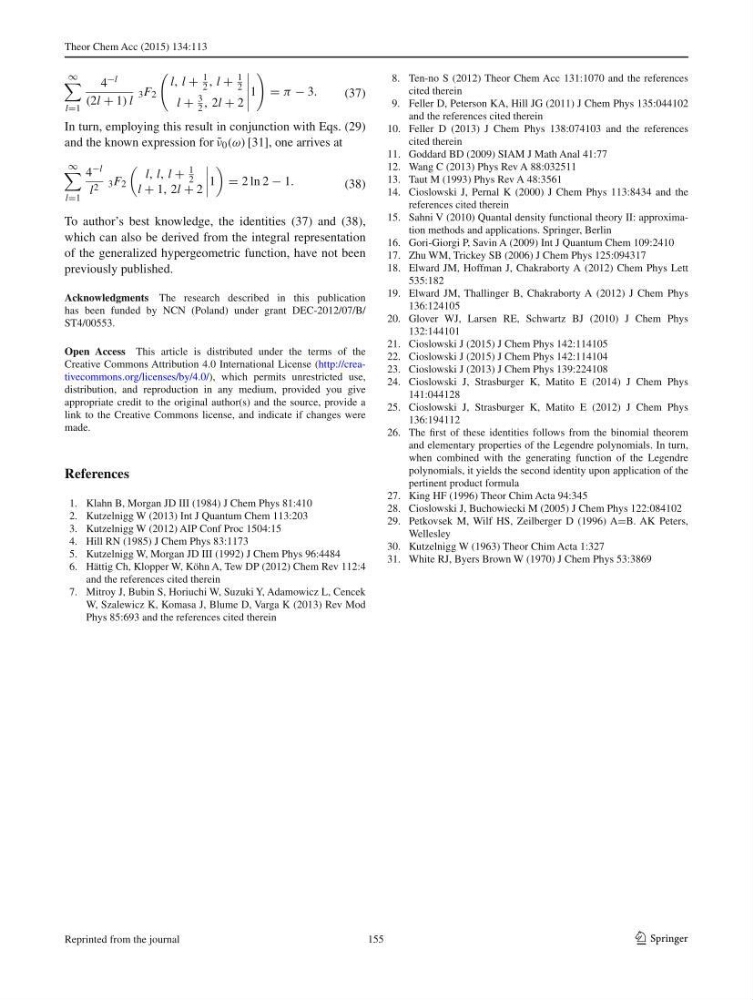
In turn, employing this result in conjunction with Eqs. ( 29 )
and the known expression for ˜
ν 0 (ω) [ 31 ], one arrives at
To author’s best knowledge, the identities ( 37 ) and ( 38 ),
which can also be derived from the integral representation
of the generalized hypergeometric function, have not been
previously published.
Acknowledgments The research described in this publication
has been funded by NCN (Poland) under grant DEC-2012/07/B/
ST4/00553.
Open Access This article is distributed under the terms of the
Creative Commons Attribution 4.0 International License ( http://creativecommons.org/licenses/by/4.0/ ), which permits unrestricted use,
distribution, and reproduction in any medium, provided you give
appropriate credit to the original author(s) and the source, provide a
link to the Creative Commons license, and indicate if changes were
made.
References
1. Klahn B, Morgan JD III (1984) J Chem Phys 81:410
2. Kutzelnigg W (2013) Int J Quantum Chem 113:203
3. Kutzelnigg W (2012) AIP Conf Proc 1504:15
4. Hill RN (1985) J Chem Phys 83:1173
5. Kutzelnigg W, Morgan JD III (1992) J Chem Phys 96:4484
6. Hättig Ch, Klopper W, Köhn A, Tew DP (2012) Chem Rev 112:4
and the references cited therein
7. Mitroy J, Bubin S, Horiuchi W, Suzuki Y, Adamowicz L, Cencek
W, Szalewicz K, Komasa J, Blume D, Varga K (2013) Rev Mod
Phys 85:693 and the references cited therein
(37)
∞
l=1
4 −l
(2l + 1) l
3 F 2
l, l +
1
2 , l +
1
2
l +
3
2 , 2l + 2
1
= π − 3.
(38)
∞
l=1
4 −l
l 2 3 F 2
l, l, l +
1
2
l + 1, 2l + 2
1
= 2 ln 2 − 1.
8. Ten-no S (2012) Theor Chem Acc 131:1070 and the references
cited therein
9. Feller D, Peterson KA, Hill JG (2011) J Chem Phys 135:044102
and the references cited therein
10. Feller D (2013) J Chem Phys 138:074103 and the references
cited therein
11. Goddard BD (2009) SIAM J Math Anal 41:77
12. Wang C (2013) Phys Rev A 88:032511
13. Taut M (1993) Phys Rev A 48:3561
14. Cioslowski J, Pernal K (2000) J Chem Phys 113:8434 and the
references cited therein
15. Sahni V (2010) Quantal density functional theory II: approximation methods and applications. Springer, Berlin
16. Gori-Giorgi P, Savin A (2009) Int J Quantum Chem 109:2410
17. Zhu WM, Trickey SB (2006) J Chem Phys 125:094317
18. Elward JM, Hoffman J, Chakraborty A (2012) Chem Phys Lett
535:182
19. Elward JM, Thallinger B, Chakraborty A (2012) J Chem Phys
136:124105
20. Glover WJ, Larsen RE, Schwartz BJ (2010) J Chem Phys
132:144101
21. Cioslowski J (2015) J Chem Phys 142:114105
22. Cioslowski J (2015) J Chem Phys 142:114104
23. Cioslowski J (2013) J Chem Phys 139:224108
24. Cioslowski J, Strasburger K, Matito E (2014) J Chem Phys
141:044128
25. Cioslowski J, Strasburger K, Matito E (2012) J Chem Phys
136:194112
26. The fi rst of these identities follows from the binomial theorem
and elementary properties of the Legendre polynomials. In turn,
when combined with the generating function of the Legendre
polynomials, it yields the second identity upon application of the
pertinent product formula
27. King HF (1996) Theor Chim Acta 94:345
28. Cioslowski J, Buchowiecki M (2005) J Chem Phys 122:084102
29. Petkovsek M, Wilf HS, Zeilberger D (1996) A=B. AK Peters,
Wellesley
30. Kutzelnigg W (1963) Theor Chim Acta 1:327
31. White RJ, Byers Brown W (1970) J Chem Phys 53:3869
155
Reprinted from the journal
1 3
In turn, employing this result in conjunction with Eqs. ( 29 )
and the known expression for ˜
ν 0 (ω) [ 31 ], one arrives at
To author’s best knowledge, the identities ( 37 ) and ( 38 ),
which can also be derived from the integral representation
of the generalized hypergeometric function, have not been
previously published.
Acknowledgments The research described in this publication
has been funded by NCN (Poland) under grant DEC-2012/07/B/
ST4/00553.
Open Access This article is distributed under the terms of the
Creative Commons Attribution 4.0 International License ( http://creativecommons.org/licenses/by/4.0/ ), which permits unrestricted use,
distribution, and reproduction in any medium, provided you give
appropriate credit to the original author(s) and the source, provide a
link to the Creative Commons license, and indicate if changes were
made.
References
1. Klahn B, Morgan JD III (1984) J Chem Phys 81:410
2. Kutzelnigg W (2013) Int J Quantum Chem 113:203
3. Kutzelnigg W (2012) AIP Conf Proc 1504:15
4. Hill RN (1985) J Chem Phys 83:1173
5. Kutzelnigg W, Morgan JD III (1992) J Chem Phys 96:4484
6. Hättig Ch, Klopper W, Köhn A, Tew DP (2012) Chem Rev 112:4
and the references cited therein
7. Mitroy J, Bubin S, Horiuchi W, Suzuki Y, Adamowicz L, Cencek
W, Szalewicz K, Komasa J, Blume D, Varga K (2013) Rev Mod
Phys 85:693 and the references cited therein
(37)
∞
l=1
4 −l
(2l + 1) l
3 F 2
l, l +
1
2 , l +
1
2
l +
3
2 , 2l + 2
1
= π − 3.
(38)
∞
l=1
4 −l
l 2 3 F 2
l, l, l +
1
2
l + 1, 2l + 2
1
= 2 ln 2 − 1.
8. Ten-no S (2012) Theor Chem Acc 131:1070 and the references
cited therein
9. Feller D, Peterson KA, Hill JG (2011) J Chem Phys 135:044102
and the references cited therein
10. Feller D (2013) J Chem Phys 138:074103 and the references
cited therein
11. Goddard BD (2009) SIAM J Math Anal 41:77
12. Wang C (2013) Phys Rev A 88:032511
13. Taut M (1993) Phys Rev A 48:3561
14. Cioslowski J, Pernal K (2000) J Chem Phys 113:8434 and the
references cited therein
15. Sahni V (2010) Quantal density functional theory II: approximation methods and applications. Springer, Berlin
16. Gori-Giorgi P, Savin A (2009) Int J Quantum Chem 109:2410
17. Zhu WM, Trickey SB (2006) J Chem Phys 125:094317
18. Elward JM, Hoffman J, Chakraborty A (2012) Chem Phys Lett
535:182
19. Elward JM, Thallinger B, Chakraborty A (2012) J Chem Phys
136:124105
20. Glover WJ, Larsen RE, Schwartz BJ (2010) J Chem Phys
132:144101
21. Cioslowski J (2015) J Chem Phys 142:114105
22. Cioslowski J (2015) J Chem Phys 142:114104
23. Cioslowski J (2013) J Chem Phys 139:224108
24. Cioslowski J, Strasburger K, Matito E (2014) J Chem Phys
141:044128
25. Cioslowski J, Strasburger K, Matito E (2012) J Chem Phys
136:194112
26. The fi rst of these identities follows from the binomial theorem
and elementary properties of the Legendre polynomials. In turn,
when combined with the generating function of the Legendre
polynomials, it yields the second identity upon application of the
pertinent product formula
27. King HF (1996) Theor Chim Acta 94:345
28. Cioslowski J, Buchowiecki M (2005) J Chem Phys 122:084102
29. Petkovsek M, Wilf HS, Zeilberger D (1996) A=B. AK Peters,
Wellesley
30. Kutzelnigg W (1963) Theor Chim Acta 1:327
31. White RJ, Byers Brown W (1970) J Chem Phys 53:3869
155
Reprinted from the journal