

Theor Chem Acc (2015) 134:113
1 3
The integrals that enter Eq. ( 31 ) can be evaluated (in the
asymptotic sense) with Laplace’s method, yielding [ 22 ]
These collective occupancies properly sum to the number
of electrons,
but obviously do not conform to Hill’s asymptotic formula
3 Discussion and conclusions
The collective occupancies of natural orbitals pertaining to
ground states of two-electron harmonium atoms with the
four largest confi nement strengths that give rise to polynomial correlation factors are listed in Table 1 . As expected,
the values of ν 0 (ω K ) gradually decrease with K as weakening of the confi nement (note that ∀ K ω K+1 < ω K ) gives rise
to stronger electron correlation. Interestingly, this depopulation of the s -type orbitals does not translate into uniform increases in the collective occupancies of NOs with
nonzero angular momenta l . The key to understanding of
this phenomenon lies in the behavior of the even/even, odd/
even, and odd/odd terms in Eq. ( 15 ), namely the vanishing
(32)
˜
ν l (ω) = 2
7/3
(2l + 1) ω
1/3 exp
−(2 ω)
1/3
(2l + 1)
2
.
(33)
lim
ω→0
∞
l=0
˜
ν l (ω) = lim
ω→0
∞
0
˜
ν l (ω) dl = 1
(34)
lim
l→∞
l +
1
2
6
˜
ν l (ω) =
5 3 5/4
2 17/3 π
ω
−2/3 exp
−
3 1/2
2 1/3 ω 1/3
.
of the fi rst two types of contributions for l > 2
K−1
2
. Thus,
at least for ω ∈ {ω K } , decreasing ω results in predominant
enhancement of the collective occupancies of NOs with
low values of l . The range of the angular momenta at which
this mechanism is operative steadily increases with the
extent of electron correlation.
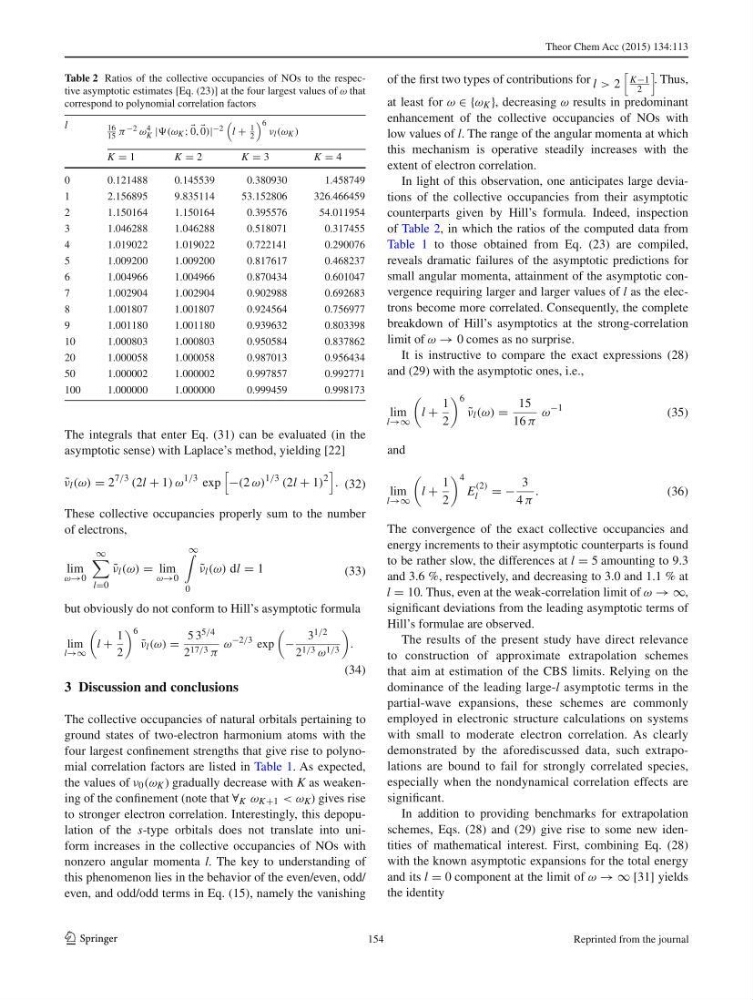
In light of this observation, one anticipates large deviations of the collective occupancies from their asymptotic
counterparts given by Hill’s formula. Indeed, inspection
of Table 2 , in which the ratios of the computed data from
Table 1 to those obtained from Eq. ( 23 ) are compiled,
reveals dramatic failures of the asymptotic predictions for
small angular momenta, attainment of the asymptotic convergence requiring larger and larger values of l as the electrons become more correlated. Consequently, the complete
breakdown of Hill’s asymptotics at the strong-correlation
limit of ω → 0 comes as no surprise.
It is instructive to compare the exact expressions ( 28 )
and ( 29 ) with the asymptotic ones, i.e.,
and
The convergence of the exact collective occupancies and
energy increments to their asymptotic counterparts is found
to be rather slow, the differences at l = 5 amounting to 9.3
and 3.6 %, respectively, and decreasing to 3.0 and 1.1 % at
l = 10 . Thus, even at the weak-correlation limit of ω → ∞ ,
signifi cant deviations from the leading asymptotic terms of
Hill’s formulae are observed.
The results of the present study have direct relevance
to construction of approximate extrapolation schemes
that aim at estimation of the CBS limits. Relying on the
dominance of the leading large- l asymptotic terms in the
partial-wave expansions, these schemes are commonly
employed in electronic structure calculations on systems
with small to moderate electron correlation. As clearly
demonstrated by the aforediscussed data, such extrapolations are bound to fail for strongly correlated species,
especially when the nondynamical correlation effects are
signifi cant.
In addition to providing benchmarks for extrapolation
schemes, Eqs. ( 28 ) and ( 29 ) give rise to some new identities of mathematical interest. First, combining Eq. ( 28 )
with the known asymptotic expansions for the total energy
and its l = 0 component at the limit of ω → ∞ [ 31 ] yields
the identity
(35)
lim
l→∞
l +
1
2
6
˜
ν l (ω) =
15
16 π
ω
−1
(36)
lim
l→∞
l +
1
2
4
E
(2)
l = −
3
4 π
.
Table 2 Ratios of the collective occupancies of NOs to the respective asymptotic estimates [Eq. ( 23 )] at the four largest values of ω that
correspond to polynomial correlation factors
l
16
15 π −2 ω 4
K | K ;
0,
0)| −2
l +
1
2
6 ν l (ω K )
K = 1
K = 2
K = 3
K = 4
0
0.121488
0.145539
0.380930
1.458749
1
2.156895
9.835114
53.152806
326.466459
2
1.150164
1.150164
0.395576
54.011954
3
1.046288
1.046288
0.518071
0.317455
4
1.019022
1.019022
0.722141
0.290076
5
1.009200
1.009200
0.817617
0.468237
6
1.004966
1.004966
0.870434
0.601047
7
1.002904
1.002904
0.902988
0.692683
8
1.001807
1.001807
0.924564
0.756977
9
1.001180
1.001180
0.939632
0.803398
10
1.000803
1.000803
0.950584
0.837862
20
1.000058
1.000058
0.987013
0.956434
50
1.000002
1.000002
0.997857
0.992771
100
1.000000
1.000000
0.999459
0.998173
154
Reprinted from the journal
1 3
The integrals that enter Eq. ( 31 ) can be evaluated (in the
asymptotic sense) with Laplace’s method, yielding [ 22 ]
These collective occupancies properly sum to the number
of electrons,
but obviously do not conform to Hill’s asymptotic formula
3 Discussion and conclusions
The collective occupancies of natural orbitals pertaining to
ground states of two-electron harmonium atoms with the
four largest confi nement strengths that give rise to polynomial correlation factors are listed in Table 1 . As expected,
the values of ν 0 (ω K ) gradually decrease with K as weakening of the confi nement (note that ∀ K ω K+1 < ω K ) gives rise
to stronger electron correlation. Interestingly, this depopulation of the s -type orbitals does not translate into uniform increases in the collective occupancies of NOs with
nonzero angular momenta l . The key to understanding of
this phenomenon lies in the behavior of the even/even, odd/
even, and odd/odd terms in Eq. ( 15 ), namely the vanishing
(32)
˜
ν l (ω) = 2
7/3
(2l + 1) ω
1/3 exp
−(2 ω)
1/3
(2l + 1)
2
.
(33)
lim
ω→0
∞
l=0
˜
ν l (ω) = lim
ω→0
∞
0
˜
ν l (ω) dl = 1
(34)
lim
l→∞
l +
1
2
6
˜
ν l (ω) =
5 3 5/4
2 17/3 π
ω
−2/3 exp
−
3 1/2
2 1/3 ω 1/3
.
of the fi rst two types of contributions for l > 2
K−1
2
. Thus,
at least for ω ∈ {ω K } , decreasing ω results in predominant
enhancement of the collective occupancies of NOs with
low values of l . The range of the angular momenta at which
this mechanism is operative steadily increases with the
extent of electron correlation.
In light of this observation, one anticipates large deviations of the collective occupancies from their asymptotic
counterparts given by Hill’s formula. Indeed, inspection
of Table 2 , in which the ratios of the computed data from
Table 1 to those obtained from Eq. ( 23 ) are compiled,
reveals dramatic failures of the asymptotic predictions for
small angular momenta, attainment of the asymptotic convergence requiring larger and larger values of l as the electrons become more correlated. Consequently, the complete
breakdown of Hill’s asymptotics at the strong-correlation
limit of ω → 0 comes as no surprise.
It is instructive to compare the exact expressions ( 28 )
and ( 29 ) with the asymptotic ones, i.e.,
and
The convergence of the exact collective occupancies and
energy increments to their asymptotic counterparts is found
to be rather slow, the differences at l = 5 amounting to 9.3
and 3.6 %, respectively, and decreasing to 3.0 and 1.1 % at
l = 10 . Thus, even at the weak-correlation limit of ω → ∞ ,
signifi cant deviations from the leading asymptotic terms of
Hill’s formulae are observed.
The results of the present study have direct relevance
to construction of approximate extrapolation schemes
that aim at estimation of the CBS limits. Relying on the
dominance of the leading large- l asymptotic terms in the
partial-wave expansions, these schemes are commonly
employed in electronic structure calculations on systems
with small to moderate electron correlation. As clearly
demonstrated by the aforediscussed data, such extrapolations are bound to fail for strongly correlated species,
especially when the nondynamical correlation effects are
signifi cant.
In addition to providing benchmarks for extrapolation
schemes, Eqs. ( 28 ) and ( 29 ) give rise to some new identities of mathematical interest. First, combining Eq. ( 28 )
with the known asymptotic expansions for the total energy
and its l = 0 component at the limit of ω → ∞ [ 31 ] yields
the identity
(35)
lim
l→∞
l +
1
2
6
˜
ν l (ω) =
15
16 π
ω
−1
(36)
lim
l→∞
l +
1
2
4
E
(2)
l = −
3
4 π
.
Table 2 Ratios of the collective occupancies of NOs to the respective asymptotic estimates [Eq. ( 23 )] at the four largest values of ω that
correspond to polynomial correlation factors
l
16
15 π −2 ω 4
K | K ;
0,
0)| −2
l +
1
2
6 ν l (ω K )
K = 1
K = 2
K = 3
K = 4
0
0.121488
0.145539
0.380930
1.458749
1
2.156895
9.835114
53.152806
326.466459
2
1.150164
1.150164
0.395576
54.011954
3
1.046288
1.046288
0.518071
0.317455
4
1.019022
1.019022
0.722141
0.290076
5
1.009200
1.009200
0.817617
0.468237
6
1.004966
1.004966
0.870434
0.601047
7
1.002904
1.002904
0.902988
0.692683
8
1.001807
1.001807
0.924564
0.756977
9
1.001180
1.001180
0.939632
0.803398
10
1.000803
1.000803
0.950584
0.837862
20
1.000058
1.000058
0.987013
0.956434
50
1.000002
1.000002
0.997857
0.992771
100
1.000000
1.000000
0.999459
0.998173
154
Reprinted from the journal