

Theor Chem Acc (2015) 134:149
1 3
in the explanation of EPR measurements. The square of the
total spin operator S 2 = (S N + S c 60 ) 2 commutes with the
Hamiltonian of the full system H = H N + H C 60 + H int , and
consequently, its eigenvalue is a good quantum number.
Expressing the interaction in terms of the spin of the subsystems and the spin of the whole molecule:
the energy can be simply given as:
where E 0 denotes the energy of the separated systems and
the subscript S indicates the explicit dependence of the
energy on the multiplicity.
In the case of N@C
−1
60 S N = 3/2 and S C 60 = 1/2 spanning an eight-dimensional direct product space. The total
spin can have the values of S = 1 or S = 2 with the corresponding energies
Comparing the energy of the triplet and quintet states, one
can easily extract the exchange coupling as:
The results of the MCSCF calculations using 631g and
DH basis are summarized in Table 2 . Although the application of the double-zeta basis resulted in considerably
deeper total energy, the deviation of the exchange couplings is small.
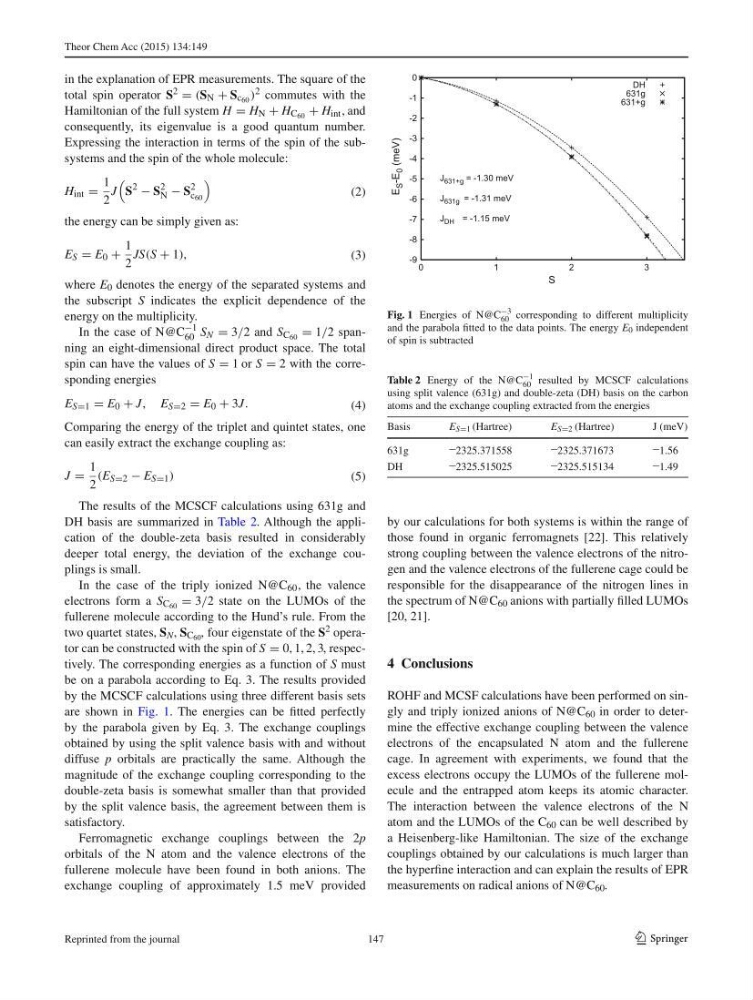
In the case of the triply ionized N@C 60 , the valence
electrons form a S C 60 = 3/2 state on the LUMOs of the
fullerene molecule according to the Hund’s rule. From the
two quartet states, S N , S C 60 , four eigenstate of the S 2 operator can be constructed with the spin of S = 0, 1, 2, 3 , respectively. The corresponding energies as a function of S must
be on a parabola according to Eq. 3 . The results provided
by the MCSCF calculations using three different basis sets
are shown in Fig. 1 . The energies can be fi tted perfectly
by the parabola given by Eq. 3 . The exchange couplings
obtained by using the split valence basis with and without
diffuse p orbitals are practically the same. Although the
magnitude of the exchange coupling corresponding to the
double-zeta basis is somewhat smaller than that provided
by the split valence basis, the agreement between them is
satisfactory.
Ferromagnetic exchange couplings between the 2 p
orbitals of the N atom and the valence electrons of the
fullerene molecule have been found in both anions. The
exchange coupling of approximately 1.5 meV provided
(2)
H int =
1
2
J
S
2
− S
2
N − S
2
c 60
(3)
E S = E 0 +
1
2
JS(S + 1),
(4)
E S=1 = E 0 + J, E S=2 = E 0 + 3J.
(5)
J =
1
2
(E S=2 − E S=1 )
by our calculations for both systems is within the range of
those found in organic ferromagnets [ 22 ]. This relatively
strong coupling between the valence electrons of the nitrogen and the valence electrons of the fullerene cage could be
responsible for the disappearance of the nitrogen lines in
the spectrum of N@C 60 anions with partially fi lled LUMOs
[ 20 , 21 ].
4 Conclusions
ROHF and MCSF calculations have been performed on singly and triply ionized anions of N@C 60 in order to determine the effective exchange coupling between the valence
electrons of the encapsulated N atom and the fullerene
cage. In agreement with experiments, we found that the
excess electrons occupy the LUMOs of the fullerene molecule and the entrapped atom keeps its atomic character.
The interaction between the valence electrons of the N
atom and the LUMOs of the C 60 can be well described by
a Heisenberg-like Hamiltonian. The size of the exchange
couplings obtained by our calculations is much larger than
the hyperfi ne interaction and can explain the results of EPR
measurements on radical anions of N@C 60 .
-9
-8
-7
-6
-5
-4
-3
-2
-1
0
0
1
2
3
E
S -E
0 (meV)
S
J DH = -1.15 meV
J 631g = -1.31 meV
J 631+g = -1.30 meV
DH
631g
631+g
Fig. 1 Energies of N@C
−3
60 corresponding to different multiplicity
and the parabola fi tted to the data points. The energy E 0 independent
of spin is subtracted
Table 2 Energy of the N@C
−1
60 resulted by MCSCF calculations
using split valence (631g) and double-zeta (DH) basis on the carbon
atoms and the exchange coupling extracted from the energies
Basis
E S=1 (Hartree)
E S=2 (Hartree)
J (meV)
631g
− 2325.371558
− 2325.371673
− 1.56
DH
− 2325.515025
− 2325.515134
− 1.49
147
Reprinted from the journal
1 3
in the explanation of EPR measurements. The square of the
total spin operator S 2 = (S N + S c 60 ) 2 commutes with the
Hamiltonian of the full system H = H N + H C 60 + H int , and
consequently, its eigenvalue is a good quantum number.
Expressing the interaction in terms of the spin of the subsystems and the spin of the whole molecule:
the energy can be simply given as:
where E 0 denotes the energy of the separated systems and
the subscript S indicates the explicit dependence of the
energy on the multiplicity.
In the case of N@C
−1
60 S N = 3/2 and S C 60 = 1/2 spanning an eight-dimensional direct product space. The total
spin can have the values of S = 1 or S = 2 with the corresponding energies
Comparing the energy of the triplet and quintet states, one
can easily extract the exchange coupling as:
The results of the MCSCF calculations using 631g and
DH basis are summarized in Table 2 . Although the application of the double-zeta basis resulted in considerably
deeper total energy, the deviation of the exchange couplings is small.
In the case of the triply ionized N@C 60 , the valence
electrons form a S C 60 = 3/2 state on the LUMOs of the
fullerene molecule according to the Hund’s rule. From the
two quartet states, S N , S C 60 , four eigenstate of the S 2 operator can be constructed with the spin of S = 0, 1, 2, 3 , respectively. The corresponding energies as a function of S must
be on a parabola according to Eq. 3 . The results provided
by the MCSCF calculations using three different basis sets
are shown in Fig. 1 . The energies can be fi tted perfectly
by the parabola given by Eq. 3 . The exchange couplings
obtained by using the split valence basis with and without
diffuse p orbitals are practically the same. Although the
magnitude of the exchange coupling corresponding to the
double-zeta basis is somewhat smaller than that provided
by the split valence basis, the agreement between them is
satisfactory.
Ferromagnetic exchange couplings between the 2 p
orbitals of the N atom and the valence electrons of the
fullerene molecule have been found in both anions. The
exchange coupling of approximately 1.5 meV provided
(2)
H int =
1
2
J
S
2
− S
2
N − S
2
c 60
(3)
E S = E 0 +
1
2
JS(S + 1),
(4)
E S=1 = E 0 + J, E S=2 = E 0 + 3J.
(5)
J =
1
2
(E S=2 − E S=1 )
by our calculations for both systems is within the range of
those found in organic ferromagnets [ 22 ]. This relatively
strong coupling between the valence electrons of the nitrogen and the valence electrons of the fullerene cage could be
responsible for the disappearance of the nitrogen lines in
the spectrum of N@C 60 anions with partially fi lled LUMOs
[ 20 , 21 ].
4 Conclusions
ROHF and MCSF calculations have been performed on singly and triply ionized anions of N@C 60 in order to determine the effective exchange coupling between the valence
electrons of the encapsulated N atom and the fullerene
cage. In agreement with experiments, we found that the
excess electrons occupy the LUMOs of the fullerene molecule and the entrapped atom keeps its atomic character.
The interaction between the valence electrons of the N
atom and the LUMOs of the C 60 can be well described by
a Heisenberg-like Hamiltonian. The size of the exchange
couplings obtained by our calculations is much larger than
the hyperfi ne interaction and can explain the results of EPR
measurements on radical anions of N@C 60 .
-9
-8
-7
-6
-5
-4
-3
-2
-1
0
0
1
2
3
E
S -E
0 (meV)
S
J DH = -1.15 meV
J 631g = -1.31 meV
J 631+g = -1.30 meV
DH
631g
631+g
Fig. 1 Energies of N@C
−3
60 corresponding to different multiplicity
and the parabola fi tted to the data points. The energy E 0 independent
of spin is subtracted
Table 2 Energy of the N@C
−1
60 resulted by MCSCF calculations
using split valence (631g) and double-zeta (DH) basis on the carbon
atoms and the exchange coupling extracted from the energies
Basis
E S=1 (Hartree)
E S=2 (Hartree)
J (meV)
631g
− 2325.371558
− 2325.371673
− 1.56
DH
− 2325.515025
− 2325.515134
− 1.49
147
Reprinted from the journal