

Theor Chem Acc (2015) 134:149
1 3
view of spintronics. Recent developments in nanotechnology permit the investigation of tunneling spectra of individual magnetic endofullerene molecules [ 14 ].
2 Computational details
The calculations have been performed using the Gamess
quantum chemical program package [ 15 ]. The proper
description of the open-shell N@C
−1
60 and N@C
−3
60 anions
requires multi-determinant wave functions. The restricted
open-shell (ROHF) calculations in the Gamess package are
accessible via the generalized valence bond (GVB) or the
multi-confi gurational self-consistent fi eld (MCSCF) methods using an appropriate active space. The energy of the
anions of N@C 60 with different multiplicity has been determined by means of CAS SCF calculations where the active
space is confi ned to the 2 p orbitals of the nitrogen atom and
the threefold degenerate LUMOs of the fullerene molecule.
In order to improve the convergence of the MCSCF orbitals, the excitations from the orbitals of the nitrogen to the
LUMOs of the cage were excluded from the active space
applying the occupation restricted multiple active space
[ 16 ] technique, and vice versa. However, expanding the
active space with charge transfer excitations changed the
energy of the different states with a negligible amount. The
MCSCF treatment of the open-shell systems using such a
small active space is practically equivalent to the ROHF
level of calculations. The calculation has been performed
using split valence 631g basis on the carbon atoms. For
the better description of the week interaction between the
encapsulated atom and the fullerene molecule [ 17 ], the
basis on the N atom is extended by additional diffuse p
orbitals and two d polarization functions (631+g(dd)). The
proper description of the electronic structure of negatively
charged species requires application of diffuse basis functions. However, in the present case, the excess charge is
distributed uniformly among the 60 carbon atoms, and the
lack of diffuse basis on the carbon atoms does not affect
dramatically our results. In order to check the sensitivity
of the exchange coupling to the applied basis, the calculations have also been performed with the Dunning’s double
zeta [ 18 ] and the split valence 631+g basis sets on the carbon atoms. Although the N@C
−1
60 anion undergoes a JahnTeller distortion [ 19 ] in the present study, the I h point group
symmetry is kept during the optimization of the geometry
by averaging the three degenerate states corresponding to
S = 2 . The same molecular structure has been used to fi nd
the energy of the S = 1 states. For the triple anion N@C
−3
60 ,
the geometry has been optimized at ROHF level in the high
spin S = 3 state and it is retained during the calculations of
the energy of the systems with different S 2 eigenstates.
3 Results and discussions
It has been shown experimentally that in the highly reduced
states of the N@C 60 the excess electrons occupy the
LUMOs of the fullerene and the N atom inside the cage
remains in spin quartet state [ 20 , 21 ]. In an EPR experiment, the N@C 60 was stepwise reduced with lithium.
Among the spectra of the anions the well-known three-line
signal characteristic for the nitrogen nuclear spin I = 1
appeared only for the hexa-anion, indicating that the excess
charges occupy the threefold degenerate t 1u orbitals of the
fullerene cage [ 10 ]. In order to check the consistency of our
calculations to the experimental fi ndings, we performed a
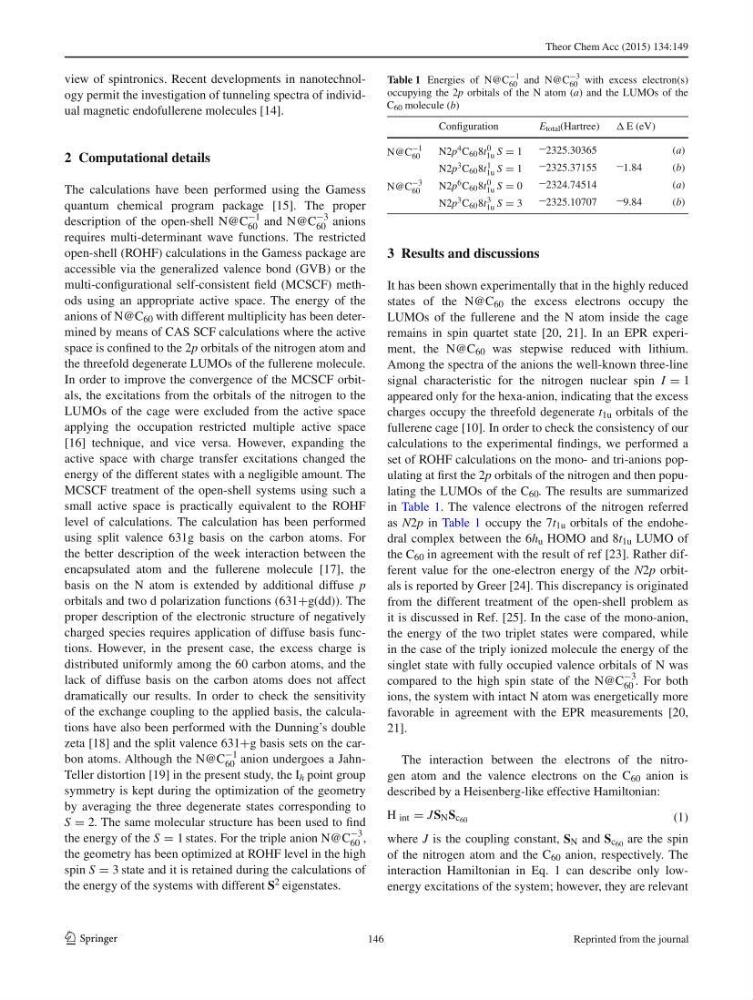
set of ROHF calculations on the mono- and tri-anions populating at fi rst the 2 p orbitals of the nitrogen and then populating the LUMOs of the C 60 . The results are summarized
in Table 1 . The valence electrons of the nitrogen referred
as N 2 p in Table 1 occupy the 7t 1u orbitals of the endohedral complex between the 6h u HOMO and 8t 1u LUMO of
the C 60 in agreement with the result of ref [ 23 ]. Rather different value for the one-electron energy of the N 2 p orbitals is reported by Greer [ 24 ]. This discrepancy is originated
from the different treatment of the open-shell problem as
it is discussed in Ref. [ 25 ]. In the case of the mono-anion,
the energy of the two triplet states were compared, while
in the case of the triply ionized molecule the energy of the
singlet state with fully occupied valence orbitals of N was
compared to the high spin state of the N@C
−3
60 . For both
ions, the system with intact N atom was energetically more
favorable in agreement with the EPR measurements [ 20 ,
21 ].
The interaction between the electrons of the nitrogen atom and the valence electrons on the C 60 anion is
described by a Heisenberg-like effective Hamiltonian:
where J is the coupling constant, S N and S c 60 are the spin
of the nitrogen atom and the C 60 anion, respectively. The
interaction Hamiltonian in Eq. 1 can describe only lowenergy excitations of the system; however, they are relevant
(1)
H int = JS N S c 60
Table 1 Energies of N@C
−1
60 and N@C
−3
60 with excess electron(s)
occupying the 2 p orbitals of the N atom ( a ) and the LUMOs of the
C 60 molecule ( b )
Confi guration
E total (Hartree)
E (eV)
N@C
−1
60
N2p 4 C 60 8t 0
1u S = 1 − 2325.30365
( a )
N2p 3 C 60 8t 1
1u S = 1 − 2325.37155
− 1.84
( b )
N@C
−3
60
N2p 6 C 60 8t 0
1u S = 0 − 2324.74514
( a )
N2p 3 C 60 8t 3
1u S = 3 − 2325.10707
− 9.84
( b )
146
Reprinted from the journal
1 3
view of spintronics. Recent developments in nanotechnology permit the investigation of tunneling spectra of individual magnetic endofullerene molecules [ 14 ].
2 Computational details
The calculations have been performed using the Gamess
quantum chemical program package [ 15 ]. The proper
description of the open-shell N@C
−1
60 and N@C
−3
60 anions
requires multi-determinant wave functions. The restricted
open-shell (ROHF) calculations in the Gamess package are
accessible via the generalized valence bond (GVB) or the
multi-confi gurational self-consistent fi eld (MCSCF) methods using an appropriate active space. The energy of the
anions of N@C 60 with different multiplicity has been determined by means of CAS SCF calculations where the active
space is confi ned to the 2 p orbitals of the nitrogen atom and
the threefold degenerate LUMOs of the fullerene molecule.
In order to improve the convergence of the MCSCF orbitals, the excitations from the orbitals of the nitrogen to the
LUMOs of the cage were excluded from the active space
applying the occupation restricted multiple active space
[ 16 ] technique, and vice versa. However, expanding the
active space with charge transfer excitations changed the
energy of the different states with a negligible amount. The
MCSCF treatment of the open-shell systems using such a
small active space is practically equivalent to the ROHF
level of calculations. The calculation has been performed
using split valence 631g basis on the carbon atoms. For
the better description of the week interaction between the
encapsulated atom and the fullerene molecule [ 17 ], the
basis on the N atom is extended by additional diffuse p
orbitals and two d polarization functions (631+g(dd)). The
proper description of the electronic structure of negatively
charged species requires application of diffuse basis functions. However, in the present case, the excess charge is
distributed uniformly among the 60 carbon atoms, and the
lack of diffuse basis on the carbon atoms does not affect
dramatically our results. In order to check the sensitivity
of the exchange coupling to the applied basis, the calculations have also been performed with the Dunning’s double
zeta [ 18 ] and the split valence 631+g basis sets on the carbon atoms. Although the N@C
−1
60 anion undergoes a JahnTeller distortion [ 19 ] in the present study, the I h point group
symmetry is kept during the optimization of the geometry
by averaging the three degenerate states corresponding to
S = 2 . The same molecular structure has been used to fi nd
the energy of the S = 1 states. For the triple anion N@C
−3
60 ,
the geometry has been optimized at ROHF level in the high
spin S = 3 state and it is retained during the calculations of
the energy of the systems with different S 2 eigenstates.
3 Results and discussions
It has been shown experimentally that in the highly reduced
states of the N@C 60 the excess electrons occupy the
LUMOs of the fullerene and the N atom inside the cage
remains in spin quartet state [ 20 , 21 ]. In an EPR experiment, the N@C 60 was stepwise reduced with lithium.
Among the spectra of the anions the well-known three-line
signal characteristic for the nitrogen nuclear spin I = 1
appeared only for the hexa-anion, indicating that the excess
charges occupy the threefold degenerate t 1u orbitals of the
fullerene cage [ 10 ]. In order to check the consistency of our
calculations to the experimental fi ndings, we performed a
set of ROHF calculations on the mono- and tri-anions populating at fi rst the 2 p orbitals of the nitrogen and then populating the LUMOs of the C 60 . The results are summarized
in Table 1 . The valence electrons of the nitrogen referred
as N 2 p in Table 1 occupy the 7t 1u orbitals of the endohedral complex between the 6h u HOMO and 8t 1u LUMO of
the C 60 in agreement with the result of ref [ 23 ]. Rather different value for the one-electron energy of the N 2 p orbitals is reported by Greer [ 24 ]. This discrepancy is originated
from the different treatment of the open-shell problem as
it is discussed in Ref. [ 25 ]. In the case of the mono-anion,
the energy of the two triplet states were compared, while
in the case of the triply ionized molecule the energy of the
singlet state with fully occupied valence orbitals of N was
compared to the high spin state of the N@C
−3
60 . For both
ions, the system with intact N atom was energetically more
favorable in agreement with the EPR measurements [ 20 ,
21 ].
The interaction between the electrons of the nitrogen atom and the valence electrons on the C 60 anion is
described by a Heisenberg-like effective Hamiltonian:
where J is the coupling constant, S N and S c 60 are the spin
of the nitrogen atom and the C 60 anion, respectively. The
interaction Hamiltonian in Eq. 1 can describe only lowenergy excitations of the system; however, they are relevant
(1)
H int = JS N S c 60
Table 1 Energies of N@C
−1
60 and N@C
−3
60 with excess electron(s)
occupying the 2 p orbitals of the N atom ( a ) and the LUMOs of the
C 60 molecule ( b )
Confi guration
E total (Hartree)
E (eV)
N@C
−1
60
N2p 4 C 60 8t 0
1u S = 1 − 2325.30365
( a )
N2p 3 C 60 8t 1
1u S = 1 − 2325.37155
− 1.84
( b )
N@C
−3
60
N2p 6 C 60 8t 0
1u S = 0 − 2324.74514
( a )
N2p 3 C 60 8t 3
1u S = 3 − 2325.10707
− 9.84
( b )
146
Reprinted from the journal