

Theor Chem Acc (2015) 134:116
1 3
reported in [ 16 , 17 ]. We show the calculated harmonic vibrational frequencies obtained with BP86 and B3LYP functionals in WI basis as fairly well coinciding with the measured
spectra. Computed vibrational modes have been analyzed in
terms of potential energy distribution (PED) contributions
[ 41 ], as displayed together with the B3LYP values. Let us
recall that the differences in the main features of the spectra recorded in solid state and/or solutions were rather small
[ 16 ], which supports justifi cation for confronting the solidstate experiment with the gas-phase data calculated here.
Yet, one has to be aware of the fact that some discrepancies
due to this fact are naturally inherent.
It is well known that the harmonic vibrational frequencies calculated by DFT methods are usually systematically
overestimated with respect to experimental fundamentals,
which was the case for most of our results, too. This systematic overestimation used to be corrected by rescaling
the spectrum using scaling factors that are well tuned to
specifi c functionals and basis sets. Such factors are available, e.g., for B3LYP/6-311G* [ 56 ]. For our schemes with
combined basis sets, however, we have not found any suitable scaling factors. Hence, we display the unscaled values.
Even in that case, the performance of BP86 is more than
satisfactory, apparently due to a lucky cancellation of different biases. This fact has been stressed earlier and using
the BP86 functional recommended as a pragmatic and costeffective approach to calculating vibrational frequencies for
large molecules [ 57 , 58 ].
Involvement of the individual vibrations in different
wave number ranges follows from the PED as given in
Tables S2–S4 of the supplementary material, where contributions under 10 % are disregarded. From our point of
view, the vibrations involving the vanadium atom are most
relevant (Table 3 ), in particular those that distinguish the
different coordination spheres. For 2 , the IR and Raman
spectra are exclusively complementary for asymmetric
and symmetric skeletal vibrations, respectively, due to its
C i symmetry. The stretching V–O t vibrations are shifted to
somewhat higher energies than in 1 or 3 . While in 2 , there
is one active mode for this vibration in IR and one in the
0
1
2
3
−2
−1
0
1
2
Δ r (%)
Non−H bonds
0
1
2
3
−2
−1
0
1
2
CC, CO bonds
0
1
2
3
−2
−1
0
1
2
VO bonds
BP86/WI
BP86/WII
BLYP/WI
B3LYP/WI
B3LYP/WII
BHHLYP/WI
HF/WI
−2
−1
0
1
2
0
1
2
3
Δ r (%)
Non−H bonds
−2
−1
0
1
2
0
1
2
3
CC, CO bonds
−2
−1
0
1
2
0
1
2
3
VO bonds
M06−L/WI
M06/WI
M06−2X/WI
M06−HF/WI
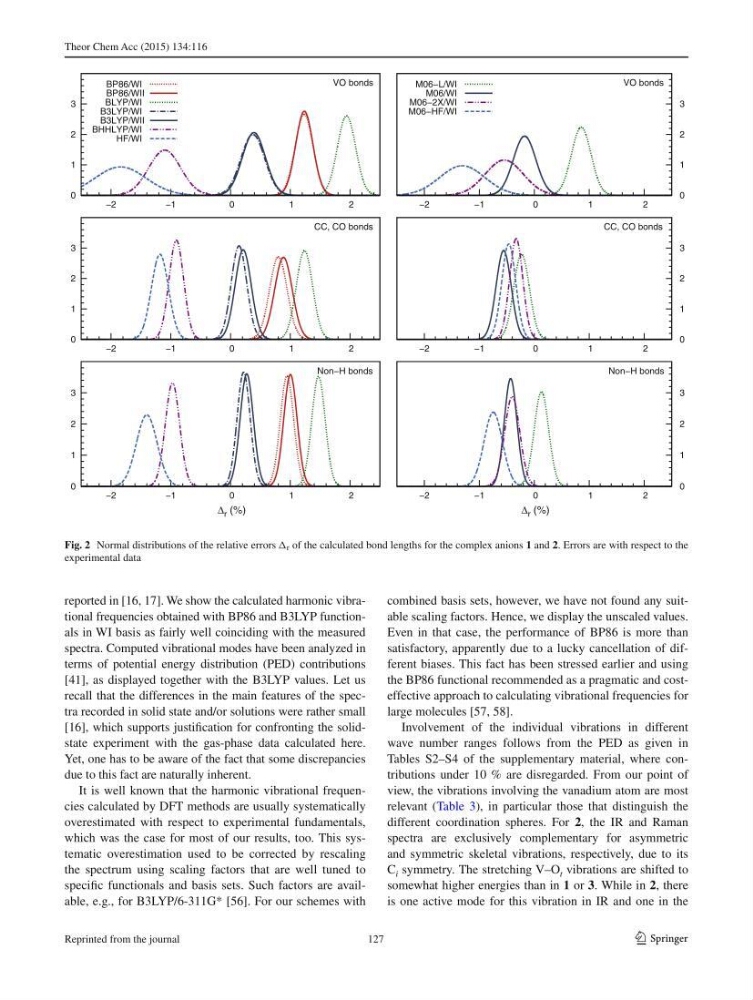
Fig. 2 Normal distributions of the relative errors r of the calculated bond lengths for the complex anions 1 and 2 . Errors are with respect to the
experimental data
127
Reprinted from the journal
1 3
reported in [ 16 , 17 ]. We show the calculated harmonic vibrational frequencies obtained with BP86 and B3LYP functionals in WI basis as fairly well coinciding with the measured
spectra. Computed vibrational modes have been analyzed in
terms of potential energy distribution (PED) contributions
[ 41 ], as displayed together with the B3LYP values. Let us
recall that the differences in the main features of the spectra recorded in solid state and/or solutions were rather small
[ 16 ], which supports justifi cation for confronting the solidstate experiment with the gas-phase data calculated here.
Yet, one has to be aware of the fact that some discrepancies
due to this fact are naturally inherent.
It is well known that the harmonic vibrational frequencies calculated by DFT methods are usually systematically
overestimated with respect to experimental fundamentals,
which was the case for most of our results, too. This systematic overestimation used to be corrected by rescaling
the spectrum using scaling factors that are well tuned to
specifi c functionals and basis sets. Such factors are available, e.g., for B3LYP/6-311G* [ 56 ]. For our schemes with
combined basis sets, however, we have not found any suitable scaling factors. Hence, we display the unscaled values.
Even in that case, the performance of BP86 is more than
satisfactory, apparently due to a lucky cancellation of different biases. This fact has been stressed earlier and using
the BP86 functional recommended as a pragmatic and costeffective approach to calculating vibrational frequencies for
large molecules [ 57 , 58 ].
Involvement of the individual vibrations in different
wave number ranges follows from the PED as given in
Tables S2–S4 of the supplementary material, where contributions under 10 % are disregarded. From our point of
view, the vibrations involving the vanadium atom are most
relevant (Table 3 ), in particular those that distinguish the
different coordination spheres. For 2 , the IR and Raman
spectra are exclusively complementary for asymmetric
and symmetric skeletal vibrations, respectively, due to its
C i symmetry. The stretching V–O t vibrations are shifted to
somewhat higher energies than in 1 or 3 . While in 2 , there
is one active mode for this vibration in IR and one in the
0
1
2
3
−2
−1
0
1
2
Δ r (%)
Non−H bonds
0
1
2
3
−2
−1
0
1
2
CC, CO bonds
0
1
2
3
−2
−1
0
1
2
VO bonds
BP86/WI
BP86/WII
BLYP/WI
B3LYP/WI
B3LYP/WII
BHHLYP/WI
HF/WI
−2
−1
0
1
2
0
1
2
3
Δ r (%)
Non−H bonds
−2
−1
0
1
2
0
1
2
3
CC, CO bonds
−2
−1
0
1
2
0
1
2
3
VO bonds
M06−L/WI
M06/WI
M06−2X/WI
M06−HF/WI
Fig. 2 Normal distributions of the relative errors r of the calculated bond lengths for the complex anions 1 and 2 . Errors are with respect to the
experimental data
127
Reprinted from the journal