

Theor Chem Acc (2015) 134:148
1 3
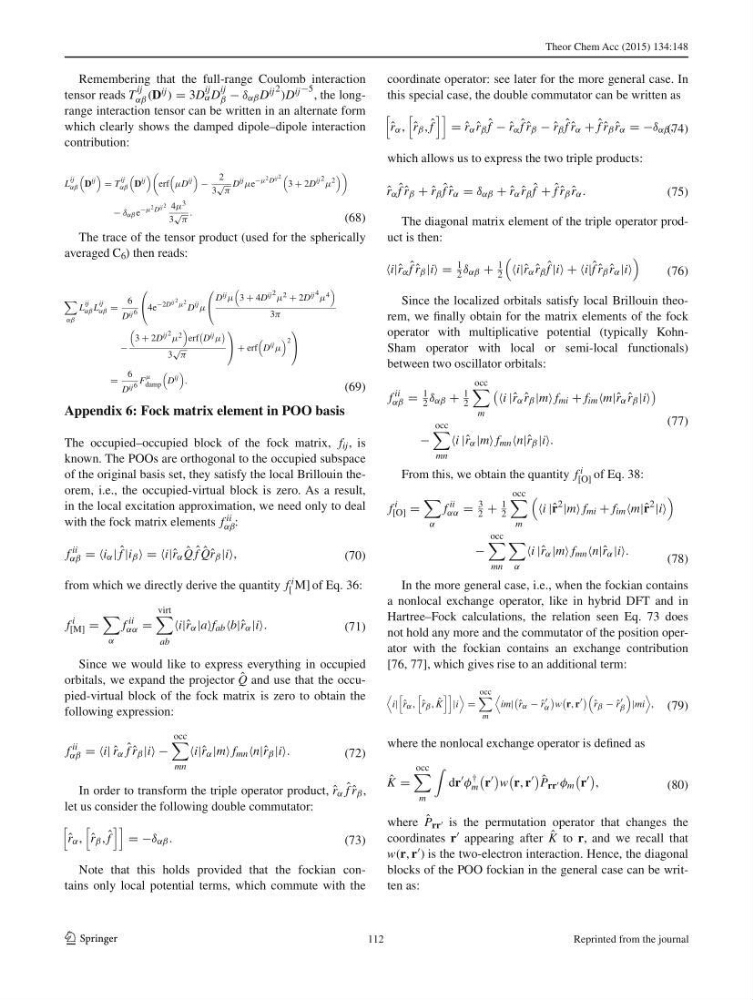
Remembering that the full-range Coulomb interaction
tensor reads T
ij
αβ (D ij ) = 3D
ij
α D
ij
β − δ αβ D ij 2 )D ij −5 , the longrange interaction tensor can be written in an alternate form
which clearly shows the damped dipole–dipole interaction
contribution:
The trace of the tensor product (used for the spherically
averaged C 6 ) then reads:
Appendix 6: Fock matrix element in POO basis
The occupied–occupied block of the fock matrix, f ij , is
known. The POOs are orthogonal to the occupied subspace
of the original basis set, they satisfy the local Brillouin theorem, i.e., the occupied-virtual block is zero. As a result,
in the local excitation approximation, we need only to deal
with the fock matrix elements f ii
αβ :
from which we directly derive the quantity f i
[ M] of Eq. 36 :
Since we would like to express everything in occupied
orbitals, we expand the projector ˆ
Q and use that the occupied-virtual block of the fock matrix is zero to obtain the
following expression:
In order to transform the triple operator product, ˆ
r α ˆ
f ˆ
r β ,
let us consider the following double commutator:
Note that this holds provided that the fockian contains only local potential terms, which commute with the
(68)
L
ij
αβ
D
ij
= T
ij
αβ
D
ij
erf
μD
ij
−
2
3
√
π
D
ij μe
−μ 2 D ij 2
3 + 2D
ij 2 μ
2
− δ αβ e
−μ 2 D ij 2 4μ 3
3
√
π
.
(69)
αβ
L
ij
αβ L
ij
αβ =
6
D ij 6
⎛
⎝ 4e
−2D ij 2 μ 2 D
ij μ
⎛
⎝
D ij μ
3 + 4D ij 2 μ 2 + 2D ij 4 μ 4
3π
−
3 + 2D ij 2 μ 2
erf
D ij μ
3
√ π
⎞
⎠ + erf
D
ij μ
2
⎞
⎠
=
6
D ij 6 F
μ
damp
D
ij
.
(70)
f
ii
αβ = =i α | ˆ
f |i β = =i|ˆ r α ˆ
Q ˆ
f ˆ
Qˆ r β |i,
(71)
f
i
[M] =
α
f
ii
αα =
virt
ab
r α |a ab r α |i
(72)
f
ii
αβ = =i| ˆ
r α ˆ
f ˆ
r β |i −
occ
mn
i|ˆ r α |m f mn n|ˆ r β |i.
(73)
ˆ
r α ,
ˆ
r β , ˆ
f
= −δ αβ .
coordinate operator: see later for the more general case. In
this special case, the double commutator can be written as
which allows us to express the two triple products:
The diagonal matrix element of the triple operator product is then:
Since the localized orbitals satisfy local Brillouin theorem, we fi nally obtain for the matrix elements of the fock
operator with multiplicative potential (typically KohnSham operator with local or semi-local functionals)
between two oscillator orbitals:
From this, we obtain the quantity f i
[O] of Eq. 38 :
In the more general case, i.e., when the fockian contains
a nonlocal exchange operator, like in hybrid DFT and in
Hartree–Fock calculations, the relation seen Eq. 73 does
not hold any more and the commutator of the position operator with the fockian contains an exchange contribution
[ 76 , 77 ], which gives rise to an additional term:
where the nonlocal exchange operator is defi ned as
where ˆ
P rr is the permutation operator that changes the
coordinates r appearing after ˆ
K to r, and we recall that
w(r, r ) is the two-electron interaction. Hence, the diagonal
blocks of the POO fockian in the general case can be written as:
(74)
ˆ
r α ,
ˆ
r β , ˆ
f
= ˆ
r α ˆ
r β ˆ
f − ˆ
r α ˆ
f ˆ
r β − ˆ
r β ˆ
f ˆ
r α + ˆ
f ˆ
r β ˆ
r α = −δ αβ ,
(75)
ˆ
r α ˆ
f ˆ
r β + ˆ
r β ˆ
f ˆ
r α = δ αβ + ˆ
r α ˆ
r β ˆ
f + ˆ
f ˆ
r β ˆ
r α .
(76)
i|ˆ r α ˆ
f ˆ
r β |i =
1
2 δ αβ +
1
2
i|ˆ r α ˆ
r β ˆ
f |i + +i| ˆ
f ˆ
r β ˆ
r α |i
(77)
f
ii
αβ =
1
2 δ αβ +
1
2
occ
m
i |ˆ r α ˆ
r β |m f mi + f im m|ˆ r α ˆ
r β |i
−
occ
mn
i |ˆ r α |m f mn n|ˆ r β |i.
(78)
f
i
[O] =
α
f
ii
αα =
3
2 +
1
2
occ
m
i |ˆ r
2
|m f mi + f im m|ˆ r
2
|i
−
occ
mn
α
i |ˆ r α |m f mn n|ˆ r α |i.
(79)
i|
ˆ
r α ,
ˆ
r β , ˆ
K
|i
=
occ
m
im|
ˆ
r α − ˆ
r
α
w
r, r
ˆ
r β − ˆ
r
β
|mi
,
(80)
ˆ
K =
occ
m
dr
φ
†
m
r
w
r, r
ˆ
P rr φ m
r
,
112
Reprinted from the journal
1 3
Remembering that the full-range Coulomb interaction
tensor reads T
ij
αβ (D ij ) = 3D
ij
α D
ij
β − δ αβ D ij 2 )D ij −5 , the longrange interaction tensor can be written in an alternate form
which clearly shows the damped dipole–dipole interaction
contribution:
The trace of the tensor product (used for the spherically
averaged C 6 ) then reads:
Appendix 6: Fock matrix element in POO basis
The occupied–occupied block of the fock matrix, f ij , is
known. The POOs are orthogonal to the occupied subspace
of the original basis set, they satisfy the local Brillouin theorem, i.e., the occupied-virtual block is zero. As a result,
in the local excitation approximation, we need only to deal
with the fock matrix elements f ii
αβ :
from which we directly derive the quantity f i
[ M] of Eq. 36 :
Since we would like to express everything in occupied
orbitals, we expand the projector ˆ
Q and use that the occupied-virtual block of the fock matrix is zero to obtain the
following expression:
In order to transform the triple operator product, ˆ
r α ˆ
f ˆ
r β ,
let us consider the following double commutator:
Note that this holds provided that the fockian contains only local potential terms, which commute with the
(68)
L
ij
αβ
D
ij
= T
ij
αβ
D
ij
erf
μD
ij
−
2
3
√
π
D
ij μe
−μ 2 D ij 2
3 + 2D
ij 2 μ
2
− δ αβ e
−μ 2 D ij 2 4μ 3
3
√
π
.
(69)
αβ
L
ij
αβ L
ij
αβ =
6
D ij 6
⎛
⎝ 4e
−2D ij 2 μ 2 D
ij μ
⎛
⎝
D ij μ
3 + 4D ij 2 μ 2 + 2D ij 4 μ 4
3π
−
3 + 2D ij 2 μ 2
erf
D ij μ
3
√ π
⎞
⎠ + erf
D
ij μ
2
⎞
⎠
=
6
D ij 6 F
μ
damp
D
ij
.
(70)
f
ii
αβ = =i α | ˆ
f |i β = =i|ˆ r α ˆ
Q ˆ
f ˆ
Qˆ r β |i,
(71)
f
i
[M] =
α
f
ii
αα =
virt
ab
r α |a ab r α |i
(72)
f
ii
αβ = =i| ˆ
r α ˆ
f ˆ
r β |i −
occ
mn
i|ˆ r α |m f mn n|ˆ r β |i.
(73)
ˆ
r α ,
ˆ
r β , ˆ
f
= −δ αβ .
coordinate operator: see later for the more general case. In
this special case, the double commutator can be written as
which allows us to express the two triple products:
The diagonal matrix element of the triple operator product is then:
Since the localized orbitals satisfy local Brillouin theorem, we fi nally obtain for the matrix elements of the fock
operator with multiplicative potential (typically KohnSham operator with local or semi-local functionals)
between two oscillator orbitals:
From this, we obtain the quantity f i
[O] of Eq. 38 :
In the more general case, i.e., when the fockian contains
a nonlocal exchange operator, like in hybrid DFT and in
Hartree–Fock calculations, the relation seen Eq. 73 does
not hold any more and the commutator of the position operator with the fockian contains an exchange contribution
[ 76 , 77 ], which gives rise to an additional term:
where the nonlocal exchange operator is defi ned as
where ˆ
P rr is the permutation operator that changes the
coordinates r appearing after ˆ
K to r, and we recall that
w(r, r ) is the two-electron interaction. Hence, the diagonal
blocks of the POO fockian in the general case can be written as:
(74)
ˆ
r α ,
ˆ
r β , ˆ
f
= ˆ
r α ˆ
r β ˆ
f − ˆ
r α ˆ
f ˆ
r β − ˆ
r β ˆ
f ˆ
r α + ˆ
f ˆ
r β ˆ
r α = −δ αβ ,
(75)
ˆ
r α ˆ
f ˆ
r β + ˆ
r β ˆ
f ˆ
r α = δ αβ + ˆ
r α ˆ
r β ˆ
f + ˆ
f ˆ
r β ˆ
r α .
(76)
i|ˆ r α ˆ
f ˆ
r β |i =
1
2 δ αβ +
1
2
i|ˆ r α ˆ
r β ˆ
f |i + +i| ˆ
f ˆ
r β ˆ
r α |i
(77)
f
ii
αβ =
1
2 δ αβ +
1
2
occ
m
i |ˆ r α ˆ
r β |m f mi + f im m|ˆ r α ˆ
r β |i
−
occ
mn
i |ˆ r α |m f mn n|ˆ r β |i.
(78)
f
i
[O] =
α
f
ii
αα =
3
2 +
1
2
occ
m
i |ˆ r
2
|m f mi + f im m|ˆ r
2
|i
−
occ
mn
α
i |ˆ r α |m f mn n|ˆ r α |i.
(79)
i|
ˆ
r α ,
ˆ
r β , ˆ
K
|i
=
occ
m
im|
ˆ
r α − ˆ
r
α
w
r, r
ˆ
r β − ˆ
r
β
|mi
,
(80)
ˆ
K =
occ
m
dr
φ
†
m
r
w
r, r
ˆ
P rr φ m
r
,
112
Reprinted from the journal