

Theor Chem Acc (2015) 134:148
1 3
wave function is a determinant with fi rst-order orbitals
ψ
(1)
i
which are taken in the following product form [ 36 ]
ψ
(1)
i
= g i ψ i −
k ψ k |g i ψ i ψ k , where g i are linear combination of some analytically defi ned functions, like polynomials. As we shall see, the principal difference of this
Ansatz and the POOs is that in the former case one multiplies the occupied canonical orbitals with the function g i ,
while the oscillator orbitals are constructed from localized
orbitals.
As mentioned previously, our main focus is the modeling of London dispersion forces. It has been demonstrated
in our earlier works [ 37 – 39 ] that the essential physical
ingredients of London dispersion forces are contained in
the range-separated hybrid RPA method, where the shortrange correlation effects are described within a DFA and
the long-range exchange and correlation are handled at
the long-range Hartree–Fock and long-range RPA levels,
respectively. Among numerous possible formulations of the
RPA [ 39 , 40 ], we have chosen to adopt the variant based
on the ring-diagram approximation to the coupled cluster
doubles theory. The relevant amplitude equations will be
rewritten with the help of POOs leading to simplifi ed working equations, which do not refer to virtual orbitals explicitly. For the sake of comparison we are going to study the
case where the POOs are expanded in the virtual orbital
space. The long-range electron repulsion integrals, appearing in the range-separated correlation energy expression,
can be reasonably approximated by a truncated multipole
expansion. It means that in addition to the well-known
improved convergence properties of the correlation energy
with respect to the size of the basis set, one is able to control the convergence through the selection of the multipolar
nature of the excitations, leading to a possibility of further
computational gain.
The exploitation of localized orbitals for dispersion
energy calculations has already been proposed since the
early works on local correlation methods [ 41 – 45 ]. In classical and semiclassical models most often the atoms are
selected as force centers; only a few works exploit the
advantages related to the use of two-center localized orbitals and lone pairs. A notable exception is the recent work
of Silvestrelli and coworkers [ 46 – 50 ], who adapted the
Tkatchenko–Scheffl er model [ 16 ] for maximally localized
Wannier functions (MLWF), which are essentially Boys’
localized orbitals for solids. It is worthwhile to mention
that one of the very fi rst use of the bond polarizabilities as
interacting units for the description of London dispersion
forces has been suggested as early as in 1969 by Claverie
and Rein [ 51 ]; see also [ 52 ].
Our approach, at least in its simplest form, is situated
somewhere between classical models and fully quantum local correlation methods and can be considered
(practically in all its forms) as a coarse-grained nonlocal
dispersion functional formulated exclusively on the basis
of ground state densities and occupied orbitals. It will be
shown how the various matrix elements can be expressed
from occupied orbital quantities only. As a numerical illustration, molecular C 6 dispersion coeffi cients will be calculated from localized orbital contributions and compared to
experimental reference data. The paper will be closed by a
discussion of possible future developments.
2 Theory
2.1 Projected oscillator orbitals
The a posteriori localization of the subspace of the occupied orbitals is a relatively standard procedure, which
can be achieved following a large variety of localization
criteria (for a succinct overview, see Ref. [ 53 ]). In the
context of correlation energy calculations, i.e., in various “local correlation approaches”, the most widely used
localization methods are based either on the criterion
of Foster and Boys [ 24 ] or that proposed by Pipek and
Mezey [ 54 ]. For reasons which become clearer below, in
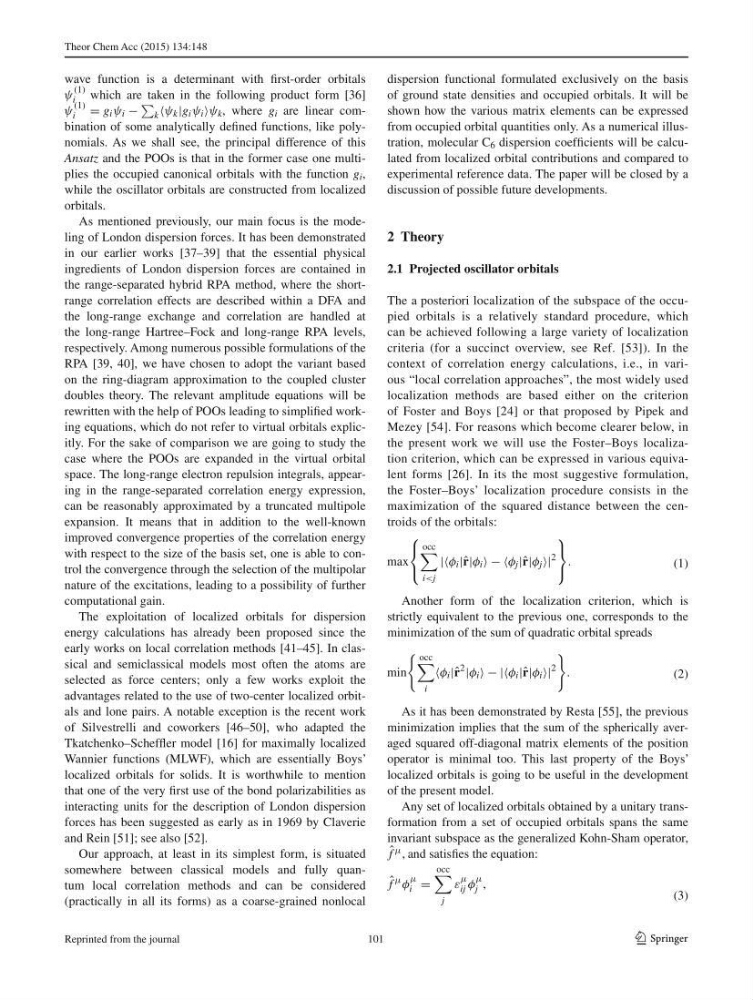
the present work we will use the Foster–Boys localization criterion, which can be expressed in various equivalent forms [ 26 ]. In its the most suggestive formulation,
the Foster–Boys’ localization procedure consists in the
maximization of the squared distance between the centroids of the orbitals:
Another form of the localization criterion, which is
strictly equivalent to the previous one, corresponds to the
minimization of the sum of quadratic orbital spreads
As it has been demonstrated by Resta [ 55 ], the previous
minimization implies that the sum of the spherically averaged squared off-diagonal matrix elements of the position
operator is minimal too. This last property of the Boys’
localized orbitals is going to be useful in the development
of the present model.
Any set of localized orbitals obtained by a unitary transformation from a set of occupied orbitals spans the same
invariant subspace as the generalized Kohn-Sham operator,
ˆ
f μ , and satisfi es the equation:
(1)
max
⎧
⎨
⎩
occ
i
2
⎫
⎬
⎭
.
(2)
min
occ
i
φ i |ˆ r
2
|φ i − ||φ i |ˆ r|φ i |
2
.
(3)
ˆ
f
μ
φ
μ
i =
occ
j
ε
μ
ij φ
μ
j ,
101
Reprinted from the journal
1 3
wave function is a determinant with fi rst-order orbitals
ψ
(1)
i
which are taken in the following product form [ 36 ]
ψ
(1)
i
= g i ψ i −
k ψ k |g i ψ i ψ k , where g i are linear combination of some analytically defi ned functions, like polynomials. As we shall see, the principal difference of this
Ansatz and the POOs is that in the former case one multiplies the occupied canonical orbitals with the function g i ,
while the oscillator orbitals are constructed from localized
orbitals.
As mentioned previously, our main focus is the modeling of London dispersion forces. It has been demonstrated
in our earlier works [ 37 – 39 ] that the essential physical
ingredients of London dispersion forces are contained in
the range-separated hybrid RPA method, where the shortrange correlation effects are described within a DFA and
the long-range exchange and correlation are handled at
the long-range Hartree–Fock and long-range RPA levels,
respectively. Among numerous possible formulations of the
RPA [ 39 , 40 ], we have chosen to adopt the variant based
on the ring-diagram approximation to the coupled cluster
doubles theory. The relevant amplitude equations will be
rewritten with the help of POOs leading to simplifi ed working equations, which do not refer to virtual orbitals explicitly. For the sake of comparison we are going to study the
case where the POOs are expanded in the virtual orbital
space. The long-range electron repulsion integrals, appearing in the range-separated correlation energy expression,
can be reasonably approximated by a truncated multipole
expansion. It means that in addition to the well-known
improved convergence properties of the correlation energy
with respect to the size of the basis set, one is able to control the convergence through the selection of the multipolar
nature of the excitations, leading to a possibility of further
computational gain.
The exploitation of localized orbitals for dispersion
energy calculations has already been proposed since the
early works on local correlation methods [ 41 – 45 ]. In classical and semiclassical models most often the atoms are
selected as force centers; only a few works exploit the
advantages related to the use of two-center localized orbitals and lone pairs. A notable exception is the recent work
of Silvestrelli and coworkers [ 46 – 50 ], who adapted the
Tkatchenko–Scheffl er model [ 16 ] for maximally localized
Wannier functions (MLWF), which are essentially Boys’
localized orbitals for solids. It is worthwhile to mention
that one of the very fi rst use of the bond polarizabilities as
interacting units for the description of London dispersion
forces has been suggested as early as in 1969 by Claverie
and Rein [ 51 ]; see also [ 52 ].
Our approach, at least in its simplest form, is situated
somewhere between classical models and fully quantum local correlation methods and can be considered
(practically in all its forms) as a coarse-grained nonlocal
dispersion functional formulated exclusively on the basis
of ground state densities and occupied orbitals. It will be
shown how the various matrix elements can be expressed
from occupied orbital quantities only. As a numerical illustration, molecular C 6 dispersion coeffi cients will be calculated from localized orbital contributions and compared to
experimental reference data. The paper will be closed by a
discussion of possible future developments.
2 Theory
2.1 Projected oscillator orbitals
The a posteriori localization of the subspace of the occupied orbitals is a relatively standard procedure, which
can be achieved following a large variety of localization
criteria (for a succinct overview, see Ref. [ 53 ]). In the
context of correlation energy calculations, i.e., in various “local correlation approaches”, the most widely used
localization methods are based either on the criterion
of Foster and Boys [ 24 ] or that proposed by Pipek and
Mezey [ 54 ]. For reasons which become clearer below, in
the present work we will use the Foster–Boys localization criterion, which can be expressed in various equivalent forms [ 26 ]. In its the most suggestive formulation,
the Foster–Boys’ localization procedure consists in the
maximization of the squared distance between the centroids of the orbitals:
Another form of the localization criterion, which is
strictly equivalent to the previous one, corresponds to the
minimization of the sum of quadratic orbital spreads
As it has been demonstrated by Resta [ 55 ], the previous
minimization implies that the sum of the spherically averaged squared off-diagonal matrix elements of the position
operator is minimal too. This last property of the Boys’
localized orbitals is going to be useful in the development
of the present model.
Any set of localized orbitals obtained by a unitary transformation from a set of occupied orbitals spans the same
invariant subspace as the generalized Kohn-Sham operator,
ˆ
f μ , and satisfi es the equation:
(1)
max
⎧
⎨
⎩
occ
i
2
⎫
⎬
⎭
.
(2)
min
occ
i
φ i |ˆ r
2
|φ i − ||φ i |ˆ r|φ i |
2
.
(3)
ˆ
f
μ
φ
μ
i =
occ
j
ε
μ
ij φ
μ
j ,
101
Reprinted from the journal