

yields and higher turnover frequencies compared to all diruthenium catalysts
studied. The diruthenium catalysts follow an order of decreasing reactivity with
respect to β-lactam formation: 63 > 1 > 69 ~ 60 > 70, 71, 72. Complex 63 having an
electron-withdrawing sulfonamide ligand is most electrophilic among them, and
thus, this sequence is electronically well justified. In terms of yield, 63 is comparable to 37 [233] while 70–72 are least reactive.
Substrates with aryl substitutions were also studied (Scheme 44). N,N-dibenzyldiazoacetamide (77) gave γ-lactam as major product with different catalysts. Here,
the γ-lactam has a fused-ring structure formed by intramolecular cyclopropanation
of the phenyl ring followed by norcaradiene-to-cycloheptatriene ring expansion.
N-benzyl-N-isopropyldiazoacetamide (78) gave four different products by intramolecular carbenoid pathways: carbenoid insertion into an isopropyl CH 3 bond
(γ-lactam 79), the isopropyl CH bond (β-lactam 80), benzylic CH bond (β-lactam 81),
and carbenoid reaction at the phenyl ring yielding γ-lactam 82. Using rhodium
catalysts 37 and 73, reaction at the N-isopropyl site is favored (79, 80) whereas all
diruthenium catalysts favored reactions at the N-benzyl substituent (81, 82). However, irrespective of the catalyst used, γ-lactams are preferred over β-lactam. This
sharp contrast between 76 and 78 is explained on the basis of the nitrogen substituents. In case of 76, the methine C–H bond is properly aligned to interact with
the metal center, whereas in 78 the methyl C–H bond is in the right position to
interact.
The substrate scope was extended to N,N-disubstituted 2-diazo-acetoacetamides
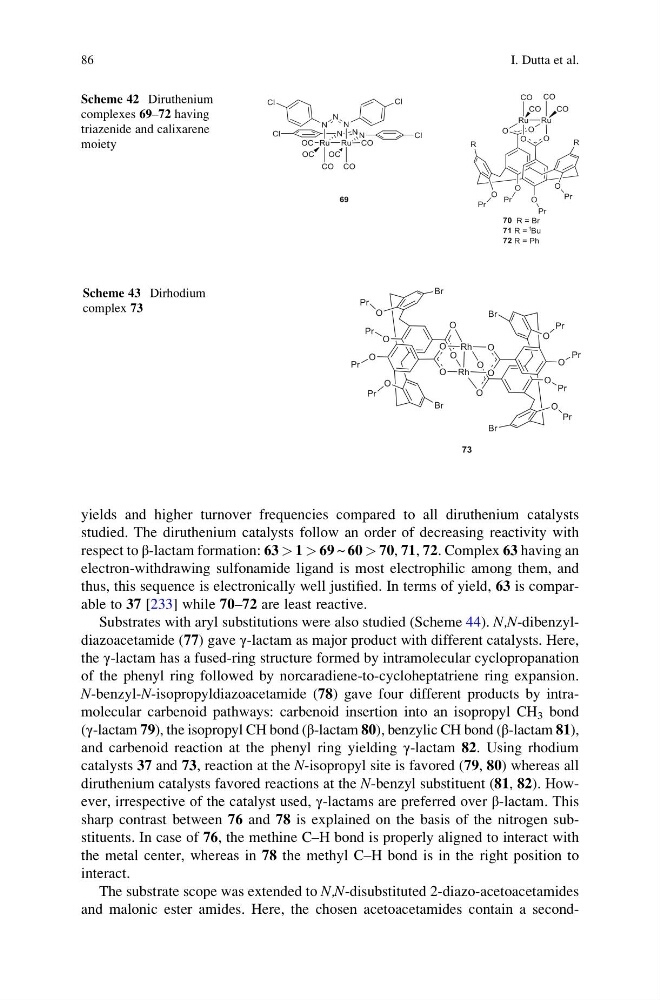
and malonic ester amides. Here, the chosen acetoacetamides contain a secondScheme 42 Diruthenium
complexes 69–72 having
triazenide and calixarene
moiety
Scheme 43 Dirhodium
complex 73
86
I. Dutta et al.
studied. The diruthenium catalysts follow an order of decreasing reactivity with
respect to β-lactam formation: 63 > 1 > 69 ~ 60 > 70, 71, 72. Complex 63 having an
electron-withdrawing sulfonamide ligand is most electrophilic among them, and
thus, this sequence is electronically well justified. In terms of yield, 63 is comparable to 37 [233] while 70–72 are least reactive.
Substrates with aryl substitutions were also studied (Scheme 44). N,N-dibenzyldiazoacetamide (77) gave γ-lactam as major product with different catalysts. Here,
the γ-lactam has a fused-ring structure formed by intramolecular cyclopropanation
of the phenyl ring followed by norcaradiene-to-cycloheptatriene ring expansion.
N-benzyl-N-isopropyldiazoacetamide (78) gave four different products by intramolecular carbenoid pathways: carbenoid insertion into an isopropyl CH 3 bond
(γ-lactam 79), the isopropyl CH bond (β-lactam 80), benzylic CH bond (β-lactam 81),
and carbenoid reaction at the phenyl ring yielding γ-lactam 82. Using rhodium
catalysts 37 and 73, reaction at the N-isopropyl site is favored (79, 80) whereas all
diruthenium catalysts favored reactions at the N-benzyl substituent (81, 82). However, irrespective of the catalyst used, γ-lactams are preferred over β-lactam. This
sharp contrast between 76 and 78 is explained on the basis of the nitrogen substituents. In case of 76, the methine C–H bond is properly aligned to interact with
the metal center, whereas in 78 the methyl C–H bond is in the right position to
interact.
The substrate scope was extended to N,N-disubstituted 2-diazo-acetoacetamides
and malonic ester amides. Here, the chosen acetoacetamides contain a secondScheme 42 Diruthenium
complexes 69–72 having
triazenide and calixarene
moiety
Scheme 43 Dirhodium
complex 73
86
I. Dutta et al.