

The third chapter, entitled “Reactivity and Catalysis at Sites Trans to the [Ru–
Ru] Bond” is from Jitendra K. Bera and two co-workers. After analyzing the effects
of the various axial donors on the paddlewheel [Ru 2 (CO) 4 ]
2+ core of σ
2
π
4
δ
2
δ*
2
π*
4
electronic configuration, the authors exploit the axial reactivity for stoichiometric
C–H bond activation and C–C bond formation.
Ru
Ru
CO
N
N
N
N
O
O
O
OC
CO
OC
Ru
Ru
CO
N
N
N
N
O
O
O
OC
CO
OC
H
H
R 1 CHO
R1
N
R2CH2NH2
R 1 CH 2 OH
H 2
Ru
Ru
CO
N
N
N
N
O
O
O
OC
CO
OC
O
CH2R1
H
R
R
R
R2
R'
R'
R'
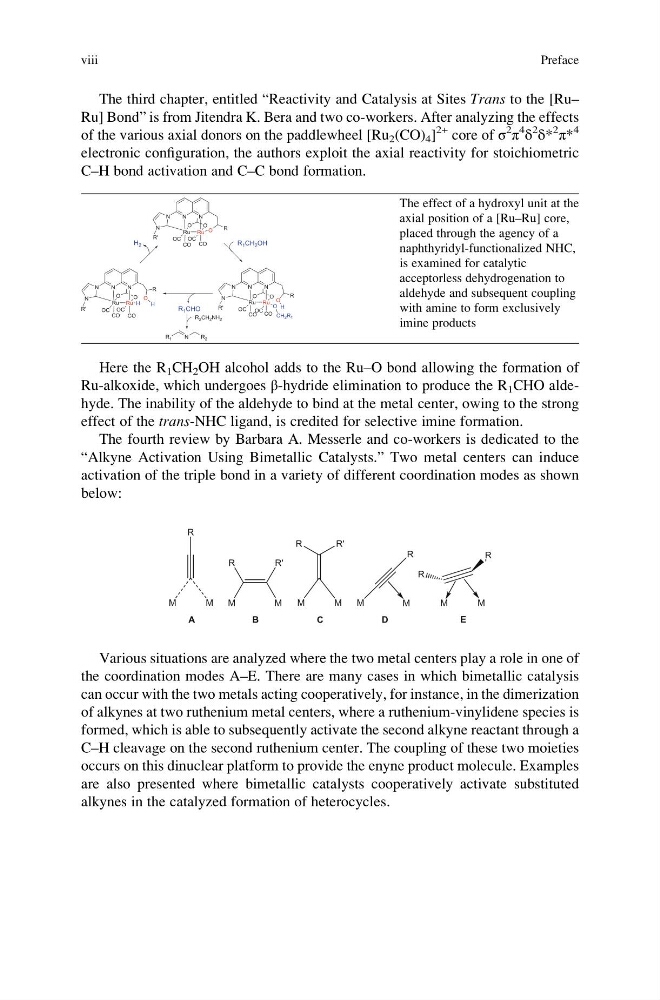
The effect of a hydroxyl unit at the
axial position of a [Ru–Ru] core,
placed through the agency of a
naphthyridyl-functionalized NHC,
is examined for catalytic
acceptorless dehydrogenation to
aldehyde and subsequent coupling
with amine to form exclusively
imine products
Here the R 1 CH 2 OH alcohol adds to the Ru–O bond allowing the formation of
Ru-alkoxide, which undergoes β-hydride elimination to produce the R 1 CHO aldehyde. The inability of the aldehyde to bind at the metal center, owing to the strong
effect of the trans-NHC ligand, is credited for selective imine formation.
The fourth review by Barbara A. Messerle and co-workers is dedicated to the
“Alkyne Activation Using Bimetallic Catalysts.” Two metal centers can induce
activation of the triple bond in a variety of different coordination modes as shown
below:
M
M
R
R
'
M
M
R
M
M
R'
R
R
R'
M
M
M
M
R
A
B
C
D
E
Various situations are analyzed where the two metal centers play a role in one of
the coordination modes A–E. There are many cases in which bimetallic catalysis
can occur with the two metals acting cooperatively, for instance, in the dimerization
of alkynes at two ruthenium metal centers, where a ruthenium-vinylidene species is
formed, which is able to subsequently activate the second alkyne reactant through a
C–H cleavage on the second ruthenium center. The coupling of these two moieties
occurs on this dinuclear platform to provide the enyne product molecule. Examples
are also presented where bimetallic catalysts cooperatively activate substituted
alkynes in the catalyzed formation of heterocycles.
viii
Preface
Ru] Bond” is from Jitendra K. Bera and two co-workers. After analyzing the effects
of the various axial donors on the paddlewheel [Ru 2 (CO) 4 ]
2+ core of σ
2
π
4
δ
2
δ*
2
π*
4
electronic configuration, the authors exploit the axial reactivity for stoichiometric
C–H bond activation and C–C bond formation.
Ru
Ru
CO
N
N
N
N
O
O
O
OC
CO
OC
Ru
Ru
CO
N
N
N
N
O
O
O
OC
CO
OC
H
H
R 1 CHO
R1
N
R2CH2NH2
R 1 CH 2 OH
H 2
Ru
Ru
CO
N
N
N
N
O
O
O
OC
CO
OC
O
CH2R1
H
R
R
R
R2
R'
R'
R'
The effect of a hydroxyl unit at the
axial position of a [Ru–Ru] core,
placed through the agency of a
naphthyridyl-functionalized NHC,
is examined for catalytic
acceptorless dehydrogenation to
aldehyde and subsequent coupling
with amine to form exclusively
imine products
Here the R 1 CH 2 OH alcohol adds to the Ru–O bond allowing the formation of
Ru-alkoxide, which undergoes β-hydride elimination to produce the R 1 CHO aldehyde. The inability of the aldehyde to bind at the metal center, owing to the strong
effect of the trans-NHC ligand, is credited for selective imine formation.
The fourth review by Barbara A. Messerle and co-workers is dedicated to the
“Alkyne Activation Using Bimetallic Catalysts.” Two metal centers can induce
activation of the triple bond in a variety of different coordination modes as shown
below:
M
M
R
R
'
M
M
R
M
M
R'
R
R
R'
M
M
M
M
R
A
B
C
D
E
Various situations are analyzed where the two metal centers play a role in one of
the coordination modes A–E. There are many cases in which bimetallic catalysis
can occur with the two metals acting cooperatively, for instance, in the dimerization
of alkynes at two ruthenium metal centers, where a ruthenium-vinylidene species is
formed, which is able to subsequently activate the second alkyne reactant through a
C–H cleavage on the second ruthenium center. The coupling of these two moieties
occurs on this dinuclear platform to provide the enyne product molecule. Examples
are also presented where bimetallic catalysts cooperatively activate substituted
alkynes in the catalyzed formation of heterocycles.
viii
Preface