

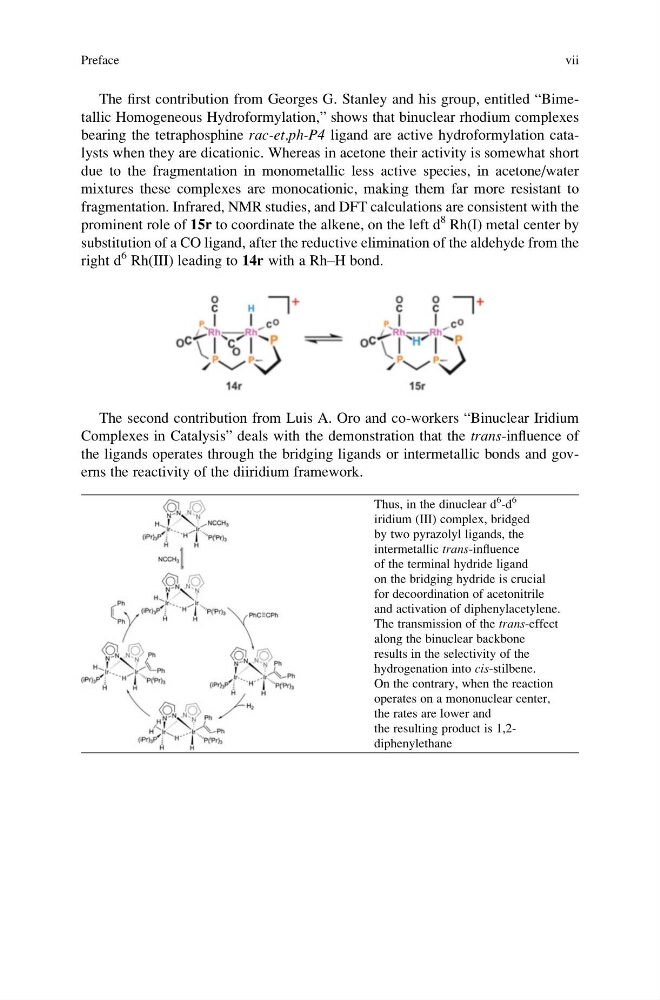
The first contribution from Georges G. Stanley and his group, entitled “Bimetallic Homogeneous Hydroformylation,” shows that binuclear rhodium complexes
bearing the tetraphosphine rac-et,ph-P4 ligand are active hydroformylation catalysts when they are dicationic. Whereas in acetone their activity is somewhat short
due to the fragmentation in monometallic less active species, in acetone/water
mixtures these complexes are monocationic, making them far more resistant to
fragmentation. Infrared, NMR studies, and DFT calculations are consistent with the
prominent role of 15r to coordinate the alkene, on the left d
8 Rh(I) metal center by
substitution of a CO ligand, after the reductive elimination of the aldehyde from the
right d
6 Rh(III) leading to 14r with a Rh–H bond.
The second contribution from Luis A. Oro and co-workers “Binuclear Iridium
Complexes in Catalysis” deals with the demonstration that the trans-influence of
the ligands operates through the bridging ligands or intermetallic bonds and governs the reactivity of the diiridium framework.
Thus, in the dinuclear d
6
-d
6
iridium (III) complex, bridged
by two pyrazolyl ligands, the
intermetallic trans-influence
of the terminal hydride ligand
on the bridging hydride is crucial
for decoordination of acetonitrile
and activation of diphenylacetylene.
The transmission of the trans-effect
along the binuclear backbone
results in the selectivity of the
hydrogenation into cis-stilbene.
On the contrary, when the reaction
operates on a mononuclear center,
the rates are lower and
the resulting product is 1,2diphenylethane
Preface
vii
bearing the tetraphosphine rac-et,ph-P4 ligand are active hydroformylation catalysts when they are dicationic. Whereas in acetone their activity is somewhat short
due to the fragmentation in monometallic less active species, in acetone/water
mixtures these complexes are monocationic, making them far more resistant to
fragmentation. Infrared, NMR studies, and DFT calculations are consistent with the
prominent role of 15r to coordinate the alkene, on the left d
8 Rh(I) metal center by
substitution of a CO ligand, after the reductive elimination of the aldehyde from the
right d
6 Rh(III) leading to 14r with a Rh–H bond.
The second contribution from Luis A. Oro and co-workers “Binuclear Iridium
Complexes in Catalysis” deals with the demonstration that the trans-influence of
the ligands operates through the bridging ligands or intermetallic bonds and governs the reactivity of the diiridium framework.
Thus, in the dinuclear d
6
-d
6
iridium (III) complex, bridged
by two pyrazolyl ligands, the
intermetallic trans-influence
of the terminal hydride ligand
on the bridging hydride is crucial
for decoordination of acetonitrile
and activation of diphenylacetylene.
The transmission of the trans-effect
along the binuclear backbone
results in the selectivity of the
hydrogenation into cis-stilbene.
On the contrary, when the reaction
operates on a mononuclear center,
the rates are lower and
the resulting product is 1,2diphenylethane
Preface
vii