

second (in a higher formal oxidation state). This type of species has been postulated
as intermediates in binuclear catalytic cycles and, what is more, characterized and
isolated [40–48]. Although no conclusive data permits to establish whether the
oxidative addition takes place thanks to metal–metal cooperation or via a single-site
process, the fact that challenging oxidative additions for mononuclear species occur
under relatively mild conditions for binuclear complexes suggests that the latter
may occur at least in these cases [49–53].
2.2 Migratory Insertion, β-Hydrogen Elimination,
and Ligand Migration
Little has been reported on the β-hydrogen elimination [54] or migratory insertion
[41, 55–58] at binuclear systems, and, therefore, no irrefutable reactivity trends or
mechanisms can be established from the available data. Noteworthy, several examples show that the reaction rates for β-hydrogen elimination in binuclear complexes
are higher than those obtained for mononuclear analogues. For instance,
β-hydrogen elimination at (dppe)EtPt–MoCp(CO) 3 , (dppe)EtPt–WCp(CO) 3 , and
(dppe)EtPt–CoCp(CO) 4 takes place significantly faster than that at PtEtCl
(dppe) [54].
Migratory insertion reactions seem to occur at a single site, similar to what
would be expected for a mononuclear complex, although the facile migration of
ligands (including hydrides, alkyl groups, or carbonyl ligands) from one metal to
the other in binuclear complexes contributes to achieve the right ligand disposition
for the insertion to happen. Consequently, the migrating ligand and the vacant
coordination site do not need to reside in the same metal center [41, 57]. Similarly,
the vacancy generated by the migratory insertion may end at the other side of the
bimetallic complex, thus enabling subsequent reactions not possible for mononuclear entities [59].
The extended coordination possibilities offered by the bridging positions may
also turn into reactivity advantages, as proposed for one of the rare examples of
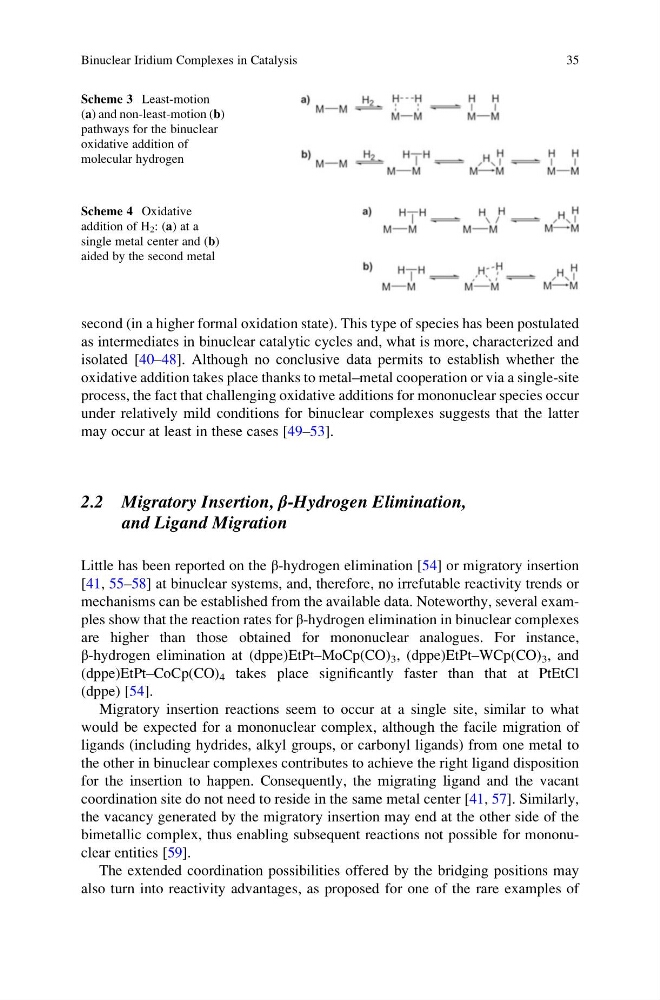
Scheme 3 Least-motion
(a) and non-least-motion (b)
pathways for the binuclear
oxidative addition of
molecular hydrogen
Scheme 4 Oxidative
addition of H 2 : (a) at a
single metal center and (b)
aided by the second metal
Binuclear Iridium Complexes in Catalysis
35
as intermediates in binuclear catalytic cycles and, what is more, characterized and
isolated [40–48]. Although no conclusive data permits to establish whether the
oxidative addition takes place thanks to metal–metal cooperation or via a single-site
process, the fact that challenging oxidative additions for mononuclear species occur
under relatively mild conditions for binuclear complexes suggests that the latter
may occur at least in these cases [49–53].
2.2 Migratory Insertion, β-Hydrogen Elimination,
and Ligand Migration
Little has been reported on the β-hydrogen elimination [54] or migratory insertion
[41, 55–58] at binuclear systems, and, therefore, no irrefutable reactivity trends or
mechanisms can be established from the available data. Noteworthy, several examples show that the reaction rates for β-hydrogen elimination in binuclear complexes
are higher than those obtained for mononuclear analogues. For instance,
β-hydrogen elimination at (dppe)EtPt–MoCp(CO) 3 , (dppe)EtPt–WCp(CO) 3 , and
(dppe)EtPt–CoCp(CO) 4 takes place significantly faster than that at PtEtCl
(dppe) [54].
Migratory insertion reactions seem to occur at a single site, similar to what
would be expected for a mononuclear complex, although the facile migration of
ligands (including hydrides, alkyl groups, or carbonyl ligands) from one metal to
the other in binuclear complexes contributes to achieve the right ligand disposition
for the insertion to happen. Consequently, the migrating ligand and the vacant
coordination site do not need to reside in the same metal center [41, 57]. Similarly,
the vacancy generated by the migratory insertion may end at the other side of the
bimetallic complex, thus enabling subsequent reactions not possible for mononuclear entities [59].
The extended coordination possibilities offered by the bridging positions may
also turn into reactivity advantages, as proposed for one of the rare examples of
Scheme 3 Least-motion
(a) and non-least-motion (b)
pathways for the binuclear
oxidative addition of
molecular hydrogen
Scheme 4 Oxidative
addition of H 2 : (a) at a
single metal center and (b)
aided by the second metal
Binuclear Iridium Complexes in Catalysis
35