

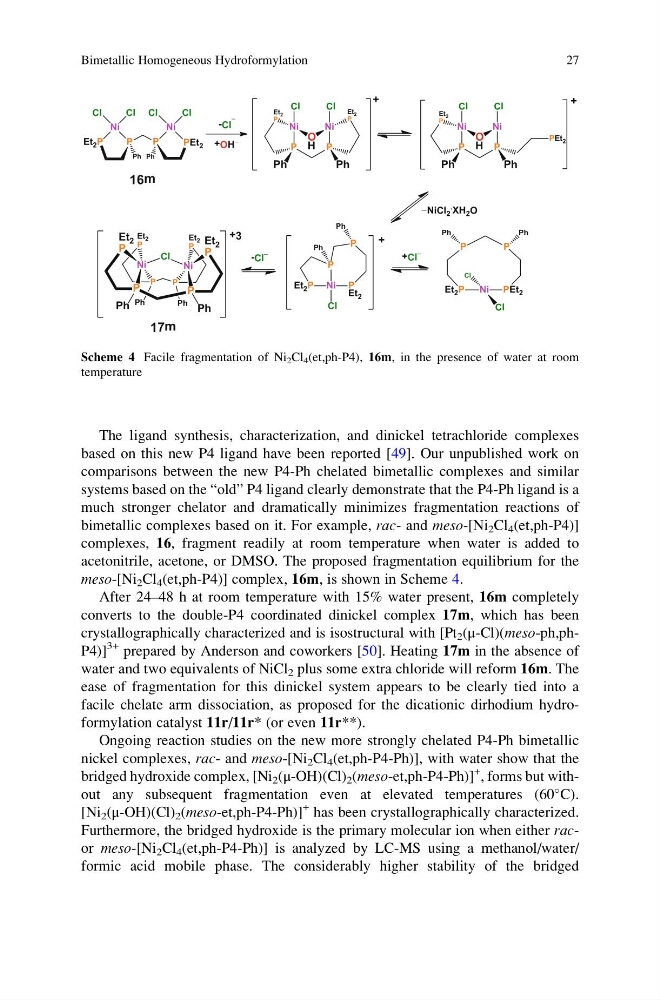
The ligand synthesis, characterization, and dinickel tetrachloride complexes
based on this new P4 ligand have been reported [49]. Our unpublished work on
comparisons between the new P4-Ph chelated bimetallic complexes and similar
systems based on the “old” P4 ligand clearly demonstrate that the P4-Ph ligand is a
much stronger chelator and dramatically minimizes fragmentation reactions of
bimetallic complexes based on it. For example, rac- and meso-[Ni 2 Cl 4 (et,ph-P4)]
complexes, 16, fragment readily at room temperature when water is added to
acetonitrile, acetone, or DMSO. The proposed fragmentation equilibrium for the
meso-[Ni 2 Cl 4 (et,ph-P4)] complex, 16m, is shown in Scheme 4.
After 24–48 h at room temperature with 15% water present, 16m completely
converts to the double-P4 coordinated dinickel complex 17m, which has been
crystallographically characterized and is isostructural with [Pt 2 (μ-Cl)(meso-ph,phP4)]
3+ prepared by Anderson and coworkers [50]. Heating 17m in the absence of
water and two equivalents of NiCl 2 plus some extra chloride will reform 16m. The
ease of fragmentation for this dinickel system appears to be clearly tied into a
facile chelate arm dissociation, as proposed for the dicationic dirhodium hydroformylation catalyst 11r/11r* (or even 11r**).
Ongoing reaction studies on the new more strongly chelated P4-Ph bimetallic
nickel complexes, rac- and meso-[Ni 2 Cl 4 (et,ph-P4-Ph)], with water show that the
bridged hydroxide complex, [Ni 2 (μ-OH)(Cl) 2 (meso-et,ph-P4-Ph)]
+ , forms but without any subsequent fragmentation even at elevated temperatures (60
C).
[Ni 2 (μ-OH)(Cl) 2 (meso-et,ph-P4-Ph)]
+ has been crystallographically characterized.
Furthermore, the bridged hydroxide is the primary molecular ion when either racor meso-[Ni 2 Cl 4 (et,ph-P4-Ph)] is analyzed by LC-MS using a methanol/water/
formic acid mobile phase. The considerably higher stability of the bridged
Ni
Cl
P
O
H
Et 2
P
Ni
Cl
P
Et 2
P
Ph
Ph
+
Ni
Cl
P
O
H
Et 2
P
Ni
Cl
P
PEt 2
Ph
Ph
+
−NiCl 2
.
XH 2 O
Ni
P
Et 2 P
P
Et 2
P
Cl
+
+Cl −
Ni
Et 2 P
PEt 2
Cl
Cl
P
P
Ni
Et 2 P
P
Ni
P
PEt 2
Ph Ph
Cl
Cl Cl
Cl
-Cl
−
Ni
Et 2
P
Et 2
P
P
P
Cl
Ni
P
P
Et 2
P
Et 2
P
Ph
Ph
Ph
Ph
+3
+OH −
-Cl
−
16m
17m
Ph
Ph
Ph
Ph
Scheme 4 Facile fragmentation of Ni 2 Cl 4 (et,ph-P4), 16m, in the presence of water at room
temperature
Bimetallic Homogeneous Hydroformylation
27
based on this new P4 ligand have been reported [49]. Our unpublished work on
comparisons between the new P4-Ph chelated bimetallic complexes and similar
systems based on the “old” P4 ligand clearly demonstrate that the P4-Ph ligand is a
much stronger chelator and dramatically minimizes fragmentation reactions of
bimetallic complexes based on it. For example, rac- and meso-[Ni 2 Cl 4 (et,ph-P4)]
complexes, 16, fragment readily at room temperature when water is added to
acetonitrile, acetone, or DMSO. The proposed fragmentation equilibrium for the
meso-[Ni 2 Cl 4 (et,ph-P4)] complex, 16m, is shown in Scheme 4.
After 24–48 h at room temperature with 15% water present, 16m completely
converts to the double-P4 coordinated dinickel complex 17m, which has been
crystallographically characterized and is isostructural with [Pt 2 (μ-Cl)(meso-ph,phP4)]
3+ prepared by Anderson and coworkers [50]. Heating 17m in the absence of
water and two equivalents of NiCl 2 plus some extra chloride will reform 16m. The
ease of fragmentation for this dinickel system appears to be clearly tied into a
facile chelate arm dissociation, as proposed for the dicationic dirhodium hydroformylation catalyst 11r/11r* (or even 11r**).
Ongoing reaction studies on the new more strongly chelated P4-Ph bimetallic
nickel complexes, rac- and meso-[Ni 2 Cl 4 (et,ph-P4-Ph)], with water show that the
bridged hydroxide complex, [Ni 2 (μ-OH)(Cl) 2 (meso-et,ph-P4-Ph)]
+ , forms but without any subsequent fragmentation even at elevated temperatures (60
C).
[Ni 2 (μ-OH)(Cl) 2 (meso-et,ph-P4-Ph)]
+ has been crystallographically characterized.
Furthermore, the bridged hydroxide is the primary molecular ion when either racor meso-[Ni 2 Cl 4 (et,ph-P4-Ph)] is analyzed by LC-MS using a methanol/water/
formic acid mobile phase. The considerably higher stability of the bridged
Ni
Cl
P
O
H
Et 2
P
Ni
Cl
P
Et 2
P
Ph
Ph
+
Ni
Cl
P
O
H
Et 2
P
Ni
Cl
P
PEt 2
Ph
Ph
+
−NiCl 2
.
XH 2 O
Ni
P
Et 2 P
P
Et 2
P
Cl
+
+Cl −
Ni
Et 2 P
PEt 2
Cl
Cl
P
P
Ni
Et 2 P
P
Ni
P
PEt 2
Ph Ph
Cl
Cl Cl
Cl
-Cl
−
Ni
Et 2
P
Et 2
P
P
P
Cl
Ni
P
P
Et 2
P
Et 2
P
Ph
Ph
Ph
Ph
+3
+OH −
-Cl
−
16m
17m
Ph
Ph
Ph
Ph
Scheme 4 Facile fragmentation of Ni 2 Cl 4 (et,ph-P4), 16m, in the presence of water at room
temperature
Bimetallic Homogeneous Hydroformylation
27