

We believe that the Rh–Rh bond and bridging ligand(s) plays a critical role in
defining and enhancing the steric factors present in our alkene binding site. There
are no regioselective monometallic hydroformylation catalysts with phosphine
ligands that have the small R-groups present in et,ph-P4 (an ethyl and phenyl).
Except for a minor increase at 1-hexene, dicationic 11r/11r* has essentially
constant linear to branched regioselectivity across a fairly broad series of alkenes
in acetone solvent: propylene (20:1), 1-butene (20:1), 1-pentene (23:1), 1-hexene
(28:1), 1-heptene (21:1), and 1-octene (21:1). We haven’t studied this entire series
with monocationic 15r yet, but believe it will exhibit higher regioselectivities with
minimal variations between alkenes as it has a similarly well-defined binding site.
This behavior is quite unusual compared to monometallic hydroformylation catalysts that show a considerably larger regioselectivity range that increases with
longer chain alkene substrates.
6 Future Studies
The facile fragmentation and deactivation of the dicationic dirhodium catalyst in
acetone was disappointing as we specifically designed the et,ph-P4 ligand to be a
strong chelator and to minimize bimetallic fragmentation – a problem that has
plagued multimetallic homogeneous catalysts. Although the monocationic bimetallic hydroformylation catalyst has considerably improved stability relative to the
dicationic dirhodium system, a better binucleating ligand to generate even more
robust but active catalysts was needed. The next-generation binucleating
tetraphosphine has been designed with 1,2-phenylene-linked chelates, one of the
strongest chelators known in transition metal chemistry. The rac- and meso-et,phP4-Ph ligands are shown below.
P
P
Ph
Ph
Et 2 P
PEt 2
rac-et,ph-P4-Ph
P
P
Ph
Ph
Et 2 P
PEt 2
meso-et,ph-P4-Ph
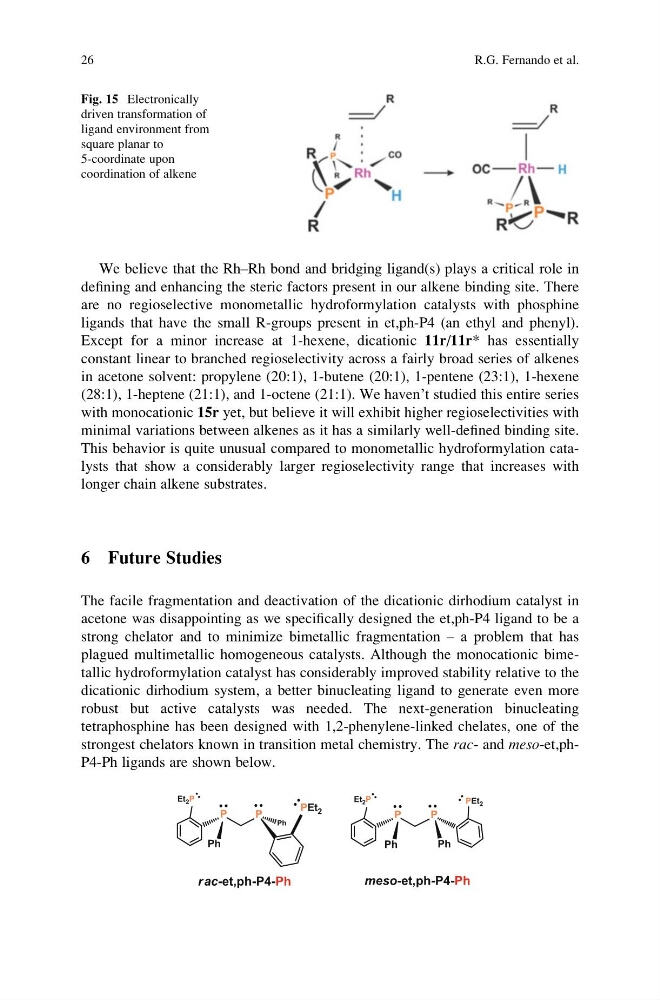
Fig. 15 Electronically
driven transformation of
ligand environment from
square planar to
5-coordinate upon
coordination of alkene
26
R.G. Fernando et al.
defining and enhancing the steric factors present in our alkene binding site. There
are no regioselective monometallic hydroformylation catalysts with phosphine
ligands that have the small R-groups present in et,ph-P4 (an ethyl and phenyl).
Except for a minor increase at 1-hexene, dicationic 11r/11r* has essentially
constant linear to branched regioselectivity across a fairly broad series of alkenes
in acetone solvent: propylene (20:1), 1-butene (20:1), 1-pentene (23:1), 1-hexene
(28:1), 1-heptene (21:1), and 1-octene (21:1). We haven’t studied this entire series
with monocationic 15r yet, but believe it will exhibit higher regioselectivities with
minimal variations between alkenes as it has a similarly well-defined binding site.
This behavior is quite unusual compared to monometallic hydroformylation catalysts that show a considerably larger regioselectivity range that increases with
longer chain alkene substrates.
6 Future Studies
The facile fragmentation and deactivation of the dicationic dirhodium catalyst in
acetone was disappointing as we specifically designed the et,ph-P4 ligand to be a
strong chelator and to minimize bimetallic fragmentation – a problem that has
plagued multimetallic homogeneous catalysts. Although the monocationic bimetallic hydroformylation catalyst has considerably improved stability relative to the
dicationic dirhodium system, a better binucleating ligand to generate even more
robust but active catalysts was needed. The next-generation binucleating
tetraphosphine has been designed with 1,2-phenylene-linked chelates, one of the
strongest chelators known in transition metal chemistry. The rac- and meso-et,phP4-Ph ligands are shown below.
P
P
Ph
Ph
Et 2 P
PEt 2
rac-et,ph-P4-Ph
P
P
Ph
Ph
Et 2 P
PEt 2
meso-et,ph-P4-Ph
Fig. 15 Electronically
driven transformation of
ligand environment from
square planar to
5-coordinate upon
coordination of alkene
26
R.G. Fernando et al.