

keeping the CO partial pressure at 22.5 psig causes dramatic increases in turnover
frequency and aldehyde l:b regioselectivity.
One factor to note is that a constant pressure was maintained in the autoclaves
with the H 2 /CO ratio indicated. But the hydroformylation reaction only consumed
1:1 H 2 /CO. Thus, as the reaction proceeded, the H 2 /CO ratio for experiments with
higher H 2 partial pressures also increased. This is most clearly indicated by the 4:1
H 2 /CO experiment where considerable CO depletion occurred leading to enhanced
alkene isomerization and some hydrogenation of the aldehyde to alcohol. The
remarkably strong inhibitory effect of CO is clearly shown by the last two experiments in Table 3 where 1:4 and 1:3 H 2 /CO experiments did no hydroformylation.
The effect of increased H 2 /CO ratios on monometallic hydroformylation catalysts is similar regarding increases in initial turnover frequency and aldehyde l:b
regioselectivity. Monometallic Rh catalysts based on Naphos, Bisbi, and Xantphos
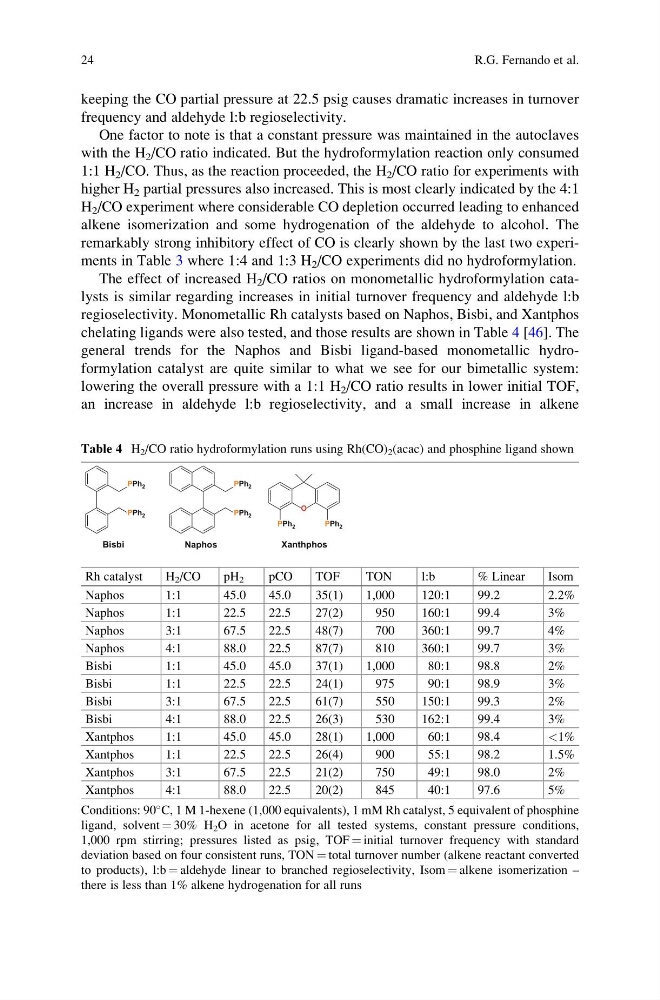
chelating ligands were also tested, and those results are shown in Table 4 [46]. The
general trends for the Naphos and Bisbi ligand-based monometallic hydroformylation catalyst are quite similar to what we see for our bimetallic system:
lowering the overall pressure with a 1:1 H 2 /CO ratio results in lower initial TOF,
an increase in aldehyde l:b regioselectivity, and a small increase in alkene
Table 4 H 2 /CO ratio hydroformylation runs using Rh(CO) 2 (acac) and phosphine ligand shown
O
PPh 2
PPh 2
Xanthphos
PPh 2
PPh 2
Naphos
PPh 2
PPh 2
Bisbi
Rh catalyst
H 2 /CO
pH 2
pCO
TOF
TON
l:b
% Linear
Isom
Naphos
1:1
45.0
45.0
35(1)
1,000
120:1
99.2
2.2%
Naphos
1:1
22.5
22.5
27(2)
950
160:1
99.4
3%
Naphos
3:1
67.5
22.5
48(7)
700
360:1
99.7
4%
Naphos
4:1
88.0
22.5
87(7)
810
360:1
99.7
3%
Bisbi
1:1
45.0
45.0
37(1)
1,000
80:1
98.8
2%
Bisbi
1:1
22.5
22.5
24(1)
975
90:1
98.9
3%
Bisbi
3:1
67.5
22.5
61(7)
550
150:1
99.3
2%
Bisbi
4:1
88.0
22.5
26(3)
530
162:1
99.4
3%
Xantphos
1:1
45.0
45.0
28(1)
1,000
60:1
98.4
<1%
Xantphos
1:1
22.5
22.5
26(4)
900
55:1
98.2
1.5%
Xantphos
3:1
67.5
22.5
21(2)
750
49:1
98.0
2%
Xantphos
4:1
88.0
22.5
20(2)
845
40:1
97.6
5%
Conditions: 90
C, 1 M 1-hexene (1,000 equivalents), 1 mM Rh catalyst, 5 equivalent of phosphine
ligand, solvent ¼ 30% H 2 O in acetone for all tested systems, constant pressure conditions,
1,000 rpm stirring; pressures listed as psig, TOF ¼ initial turnover frequency with standard
deviation based on four consistent runs, TON ¼ total turnover number (alkene reactant converted
to products), l:b ¼ aldehyde linear to branched regioselectivity, Isom ¼ alkene isomerization –
there is less than 1% alkene hydrogenation for all runs
24
R.G. Fernando et al.
frequency and aldehyde l:b regioselectivity.
One factor to note is that a constant pressure was maintained in the autoclaves
with the H 2 /CO ratio indicated. But the hydroformylation reaction only consumed
1:1 H 2 /CO. Thus, as the reaction proceeded, the H 2 /CO ratio for experiments with
higher H 2 partial pressures also increased. This is most clearly indicated by the 4:1
H 2 /CO experiment where considerable CO depletion occurred leading to enhanced
alkene isomerization and some hydrogenation of the aldehyde to alcohol. The
remarkably strong inhibitory effect of CO is clearly shown by the last two experiments in Table 3 where 1:4 and 1:3 H 2 /CO experiments did no hydroformylation.
The effect of increased H 2 /CO ratios on monometallic hydroformylation catalysts is similar regarding increases in initial turnover frequency and aldehyde l:b
regioselectivity. Monometallic Rh catalysts based on Naphos, Bisbi, and Xantphos
chelating ligands were also tested, and those results are shown in Table 4 [46]. The
general trends for the Naphos and Bisbi ligand-based monometallic hydroformylation catalyst are quite similar to what we see for our bimetallic system:
lowering the overall pressure with a 1:1 H 2 /CO ratio results in lower initial TOF,
an increase in aldehyde l:b regioselectivity, and a small increase in alkene
Table 4 H 2 /CO ratio hydroformylation runs using Rh(CO) 2 (acac) and phosphine ligand shown
O
PPh 2
PPh 2
Xanthphos
PPh 2
PPh 2
Naphos
PPh 2
PPh 2
Bisbi
Rh catalyst
H 2 /CO
pH 2
pCO
TOF
TON
l:b
% Linear
Isom
Naphos
1:1
45.0
45.0
35(1)
1,000
120:1
99.2
2.2%
Naphos
1:1
22.5
22.5
27(2)
950
160:1
99.4
3%
Naphos
3:1
67.5
22.5
48(7)
700
360:1
99.7
4%
Naphos
4:1
88.0
22.5
87(7)
810
360:1
99.7
3%
Bisbi
1:1
45.0
45.0
37(1)
1,000
80:1
98.8
2%
Bisbi
1:1
22.5
22.5
24(1)
975
90:1
98.9
3%
Bisbi
3:1
67.5
22.5
61(7)
550
150:1
99.3
2%
Bisbi
4:1
88.0
22.5
26(3)
530
162:1
99.4
3%
Xantphos
1:1
45.0
45.0
28(1)
1,000
60:1
98.4
<1%
Xantphos
1:1
22.5
22.5
26(4)
900
55:1
98.2
1.5%
Xantphos
3:1
67.5
22.5
21(2)
750
49:1
98.0
2%
Xantphos
4:1
88.0
22.5
20(2)
845
40:1
97.6
5%
Conditions: 90
C, 1 M 1-hexene (1,000 equivalents), 1 mM Rh catalyst, 5 equivalent of phosphine
ligand, solvent ¼ 30% H 2 O in acetone for all tested systems, constant pressure conditions,
1,000 rpm stirring; pressures listed as psig, TOF ¼ initial turnover frequency with standard
deviation based on four consistent runs, TON ¼ total turnover number (alkene reactant converted
to products), l:b ¼ aldehyde linear to branched regioselectivity, Isom ¼ alkene isomerization –
there is less than 1% alkene hydrogenation for all runs
24
R.G. Fernando et al.