

it is decreased by 80%. Part of the effect of base, especially with the dramatic effect
on the monocationic system, is to deprotonate 14r/15r to make neutral Rh 2 complexes that are extremely poor hydroformylation catalysts [45]. But we also believe
that the H
+ concentration plays a role in the monocationic system for protonating
the acyl to aldehyde. Addition of 5 equivalents of HBF 4 to the bimetallic catalyst
system in water/acetone, however, also slows the hydroformylation and increases
alkene isomerization. We believe that this generates more dicationic catalyst and
enhances the catalyst fragmentation and deactivation.
Although the monocationic dirhodium catalyst 14r/15r is far more resistant to
fragmentation and deactivation relative to the dicationic species 11r/11r*, the in
situ NMR spectroscopy still shows some fragmentation of 14r/15r to the inactive
monometallic complex, [RhH 2 (κ
4 -et,ph-P4)]
+ , 12r (Fig. 9). This may be via a
reprotonation of 14r/15r to the dicationic system or via a much slower fragmentation directly from 14r/15r also due to phosphine chelate arm dissociation intrinsic
to the monocationic complexes. A variant of the catalyst fragmentation equilibria
shown in Fig. 9 likely affects 14r/15r, most likely via phosphine arm dissociation.
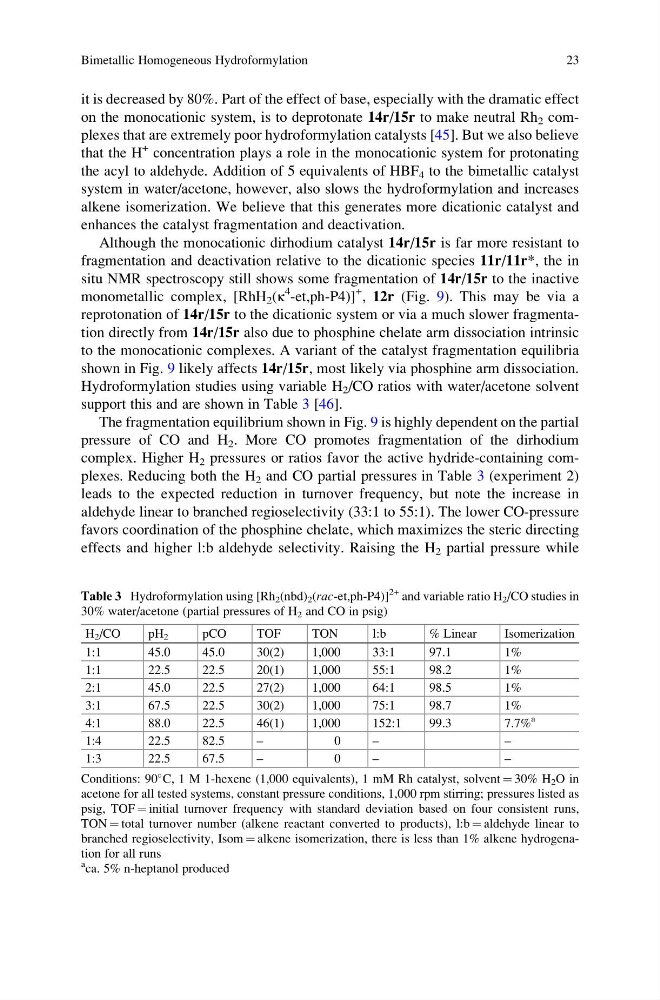
Hydroformylation studies using variable H 2 /CO ratios with water/acetone solvent
support this and are shown in Table 3 [46].
The fragmentation equilibrium shown in Fig. 9 is highly dependent on the partial
pressure of CO and H 2 . More CO promotes fragmentation of the dirhodium
complex. Higher H 2 pressures or ratios favor the active hydride-containing complexes. Reducing both the H 2 and CO partial pressures in Table 3 (experiment 2)
leads to the expected reduction in turnover frequency, but note the increase in
aldehyde linear to branched regioselectivity (33:1 to 55:1). The lower CO-pressure
favors coordination of the phosphine chelate, which maximizes the steric directing
effects and higher l:b aldehyde selectivity. Raising the H 2 partial pressure while
Table 3 Hydroformylation using [Rh 2 (nbd) 2 (rac-et,ph-P4)]
2+ and variable ratio H 2 /CO studies in
30% water/acetone (partial pressures of H 2 and CO in psig)
H 2 /CO
pH 2
pCO
TOF
TON
l:b
% Linear
Isomerization
1:1
45.0
45.0
30(2)
1,000
33:1
97.1
1%
1:1
22.5
22.5
20(1)
1,000
55:1
98.2
1%
2:1
45.0
22.5
27(2)
1,000
64:1
98.5
1%
3:1
67.5
22.5
30(2)
1,000
75:1
98.7
1%
4:1
88.0
22.5
46(1)
1,000
152:1
99.3
7.7%
a
1:4
22.5
82.5
–
0
–
–
1:3
22.5
67.5
–
0
–
–
Conditions: 90
C, 1 M 1-hexene (1,000 equivalents), 1 mM Rh catalyst, solvent ¼ 30% H 2 O in
acetone for all tested systems, constant pressure conditions, 1,000 rpm stirring; pressures listed as
psig, TOF ¼ initial turnover frequency with standard deviation based on four consistent runs,
TON ¼ total turnover number (alkene reactant converted to products), l:b ¼ aldehyde linear to
branched regioselectivity, Isom ¼ alkene isomerization, there is less than 1% alkene hydrogenation for all runs
a
ca. 5% n-heptanol produced
Bimetallic Homogeneous Hydroformylation
23
on the monocationic system, is to deprotonate 14r/15r to make neutral Rh 2 complexes that are extremely poor hydroformylation catalysts [45]. But we also believe
that the H
+ concentration plays a role in the monocationic system for protonating
the acyl to aldehyde. Addition of 5 equivalents of HBF 4 to the bimetallic catalyst
system in water/acetone, however, also slows the hydroformylation and increases
alkene isomerization. We believe that this generates more dicationic catalyst and
enhances the catalyst fragmentation and deactivation.
Although the monocationic dirhodium catalyst 14r/15r is far more resistant to
fragmentation and deactivation relative to the dicationic species 11r/11r*, the in
situ NMR spectroscopy still shows some fragmentation of 14r/15r to the inactive
monometallic complex, [RhH 2 (κ
4 -et,ph-P4)]
+ , 12r (Fig. 9). This may be via a
reprotonation of 14r/15r to the dicationic system or via a much slower fragmentation directly from 14r/15r also due to phosphine chelate arm dissociation intrinsic
to the monocationic complexes. A variant of the catalyst fragmentation equilibria
shown in Fig. 9 likely affects 14r/15r, most likely via phosphine arm dissociation.
Hydroformylation studies using variable H 2 /CO ratios with water/acetone solvent
support this and are shown in Table 3 [46].
The fragmentation equilibrium shown in Fig. 9 is highly dependent on the partial
pressure of CO and H 2 . More CO promotes fragmentation of the dirhodium
complex. Higher H 2 pressures or ratios favor the active hydride-containing complexes. Reducing both the H 2 and CO partial pressures in Table 3 (experiment 2)
leads to the expected reduction in turnover frequency, but note the increase in
aldehyde linear to branched regioselectivity (33:1 to 55:1). The lower CO-pressure
favors coordination of the phosphine chelate, which maximizes the steric directing
effects and higher l:b aldehyde selectivity. Raising the H 2 partial pressure while
Table 3 Hydroformylation using [Rh 2 (nbd) 2 (rac-et,ph-P4)]
2+ and variable ratio H 2 /CO studies in
30% water/acetone (partial pressures of H 2 and CO in psig)
H 2 /CO
pH 2
pCO
TOF
TON
l:b
% Linear
Isomerization
1:1
45.0
45.0
30(2)
1,000
33:1
97.1
1%
1:1
22.5
22.5
20(1)
1,000
55:1
98.2
1%
2:1
45.0
22.5
27(2)
1,000
64:1
98.5
1%
3:1
67.5
22.5
30(2)
1,000
75:1
98.7
1%
4:1
88.0
22.5
46(1)
1,000
152:1
99.3
7.7%
a
1:4
22.5
82.5
–
0
–
–
1:3
22.5
67.5
–
0
–
–
Conditions: 90
C, 1 M 1-hexene (1,000 equivalents), 1 mM Rh catalyst, solvent ¼ 30% H 2 O in
acetone for all tested systems, constant pressure conditions, 1,000 rpm stirring; pressures listed as
psig, TOF ¼ initial turnover frequency with standard deviation based on four consistent runs,
TON ¼ total turnover number (alkene reactant converted to products), l:b ¼ aldehyde linear to
branched regioselectivity, Isom ¼ alkene isomerization, there is less than 1% alkene hydrogenation for all runs
a
ca. 5% n-heptanol produced
Bimetallic Homogeneous Hydroformylation
23