

again plays an important role. One significant difference is that most of this cycle
operates using Rh(+1) oxidation state bimetallic complexes versus the Rh(+2)
oxidation state complexes for the dicationic cycle. DFT indicates an Rh–Rh covalent bond for 15r and most of the species shown in Fig. 12, consistent with the
common electron-counting method where a bridging hydride or CO is considered a
1e- donor to each metal center, leading to odd electron counts on the Rh(+1) d
8
atoms and the formation of a covalent bond between the metal centers. This is
important in stabilizing the bimetallic closed-mode structure.
Another key point is that for most of the complexes shown in Fig. 13, one of the
rhodium centers is formally cationic, which helps labilize the CO ligands to keep
the bimetallic catalyst from becoming saturated. Since 15r is monocationic and
more electron-rich, we believe that on a per molecule basis it is less active
compared to the dicationic catalyst 11r/11r*. But it is far more resistant to
fragmentation reactions, which increases the concentration of the active catalyst
in solution producing higher overall activity.
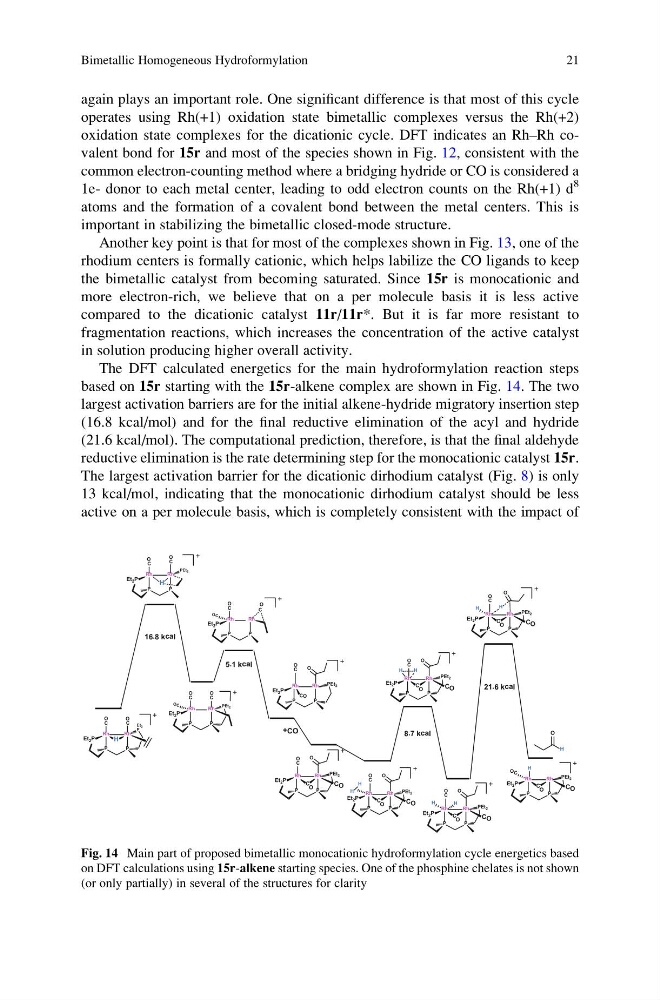
The DFT calculated energetics for the main hydroformylation reaction steps
based on 15r starting with the 15r-alkene complex are shown in Fig. 14. The two
largest activation barriers are for the initial alkene-hydride migratory insertion step
(16.8 kcal/mol) and for the final reductive elimination of the acyl and hydride
(21.6 kcal/mol). The computational prediction, therefore, is that the final aldehyde
reductive elimination is the rate determining step for the monocationic catalyst 15r.
The largest activation barrier for the dicationic dirhodium catalyst (Fig. 8) is only
13 kcal/mol, indicating that the monocationic dirhodium catalyst should be less
active on a per molecule basis, which is completely consistent with the impact of
Rh
Rh
P
P
Et 2 P
Et2
P
H
C
O
+
C
O
Rh
Rh
P
P
Et 2 P
PEt2
+
C
O
C
O
Rh
Rh
P
P
Et 2 P
PEt2
C
O
CO
16.8 kcal
8.7 kcal
5.1 kcal
H
O
Rh
Rh
P
P
Et 2 P
PEt2
H
C
O
+
C
O
C
O
Rh
Rh
P
P
Et 2 P
+
C
O
C
O
C
O
O
Rh
Rh
P
P
Et 2 P
PEt2
C
O
O
O
+
+
C
+CO
Rh
Rh
P
P
Et 2 P
PEt2
C
O
O
O
+
C
H
H
C O
C O
Rh
Rh
P
P
Et 2 P
PEt2
C
O
O
O
+
C
H
C O
H
Rh
Rh
P
P
Et 2 P
PEt2
C
O
O
O
+
C
H
C O
H
Rh
Rh
P
P
Et 2 P
PEt2
C
O
O
O
+
C
H
C O
H
Rh
Rh
P
P
Et 2 P
PEt2
C
O
H
O
+
C
C O
21.6 kcal
Fig. 14 Main part of proposed bimetallic monocationic hydroformylation cycle energetics based
on DFT calculations using 15r-alkene starting species. One of the phosphine chelates is not shown
(or only partially) in several of the structures for clarity
Bimetallic Homogeneous Hydroformylation
21
operates using Rh(+1) oxidation state bimetallic complexes versus the Rh(+2)
oxidation state complexes for the dicationic cycle. DFT indicates an Rh–Rh covalent bond for 15r and most of the species shown in Fig. 12, consistent with the
common electron-counting method where a bridging hydride or CO is considered a
1e- donor to each metal center, leading to odd electron counts on the Rh(+1) d
8
atoms and the formation of a covalent bond between the metal centers. This is
important in stabilizing the bimetallic closed-mode structure.
Another key point is that for most of the complexes shown in Fig. 13, one of the
rhodium centers is formally cationic, which helps labilize the CO ligands to keep
the bimetallic catalyst from becoming saturated. Since 15r is monocationic and
more electron-rich, we believe that on a per molecule basis it is less active
compared to the dicationic catalyst 11r/11r*. But it is far more resistant to
fragmentation reactions, which increases the concentration of the active catalyst
in solution producing higher overall activity.
The DFT calculated energetics for the main hydroformylation reaction steps
based on 15r starting with the 15r-alkene complex are shown in Fig. 14. The two
largest activation barriers are for the initial alkene-hydride migratory insertion step
(16.8 kcal/mol) and for the final reductive elimination of the acyl and hydride
(21.6 kcal/mol). The computational prediction, therefore, is that the final aldehyde
reductive elimination is the rate determining step for the monocationic catalyst 15r.
The largest activation barrier for the dicationic dirhodium catalyst (Fig. 8) is only
13 kcal/mol, indicating that the monocationic dirhodium catalyst should be less
active on a per molecule basis, which is completely consistent with the impact of
Rh
Rh
P
P
Et 2 P
Et2
P
H
C
O
+
C
O
Rh
Rh
P
P
Et 2 P
PEt2
+
C
O
C
O
Rh
Rh
P
P
Et 2 P
PEt2
C
O
CO
16.8 kcal
8.7 kcal
5.1 kcal
H
O
Rh
Rh
P
P
Et 2 P
PEt2
H
C
O
+
C
O
C
O
Rh
Rh
P
P
Et 2 P
+
C
O
C
O
C
O
O
Rh
Rh
P
P
Et 2 P
PEt2
C
O
O
O
+
+
C
+CO
Rh
Rh
P
P
Et 2 P
PEt2
C
O
O
O
+
C
H
H
C O
C O
Rh
Rh
P
P
Et 2 P
PEt2
C
O
O
O
+
C
H
C O
H
Rh
Rh
P
P
Et 2 P
PEt2
C
O
O
O
+
C
H
C O
H
Rh
Rh
P
P
Et 2 P
PEt2
C
O
O
O
+
C
H
C O
H
Rh
Rh
P
P
Et 2 P
PEt2
C
O
H
O
+
C
C O
21.6 kcal
Fig. 14 Main part of proposed bimetallic monocationic hydroformylation cycle energetics based
on DFT calculations using 15r-alkene starting species. One of the phosphine chelates is not shown
(or only partially) in several of the structures for clarity
Bimetallic Homogeneous Hydroformylation
21