

Comparing this spectrum with that of the fragmentation-prone dicationic system in
acetone (Fig. 4) reveals the dramatically improved stability of the monocationic
bimetallic catalyst toward deactivation.
DFT calculations indicate that 15r is the preferred monocationic catalyst for
hydroformylation since it has lower activation barriers and energies relative to
starting with 14r as the catalyst. Additionally, the IR spectrum of the catalyst
solution in water/acetone only shows low-intensity bridging CO bands that we
assign to dicationic 11r/11r* and 11r/11r* with one phosphine dissociated. So
there is clearly some reprotonation of the monocationic catalysts to regenerate the
dicationic catalyst system, as one might expect. The differences in hydroformylation activity and selectivity between the water/acetone and acetone solvent
systems indicate that the monocationic bimetallic system is the primary catalyst in
water/acetone. The bridging CO for 14r is likely to occur at 1,790 cm
À1 , based on
in situ FT-IR studies in THF, but is difficult to observe in water/acetone due to its
low intensity and acetone solvent carbonyl band subtraction artifacts.
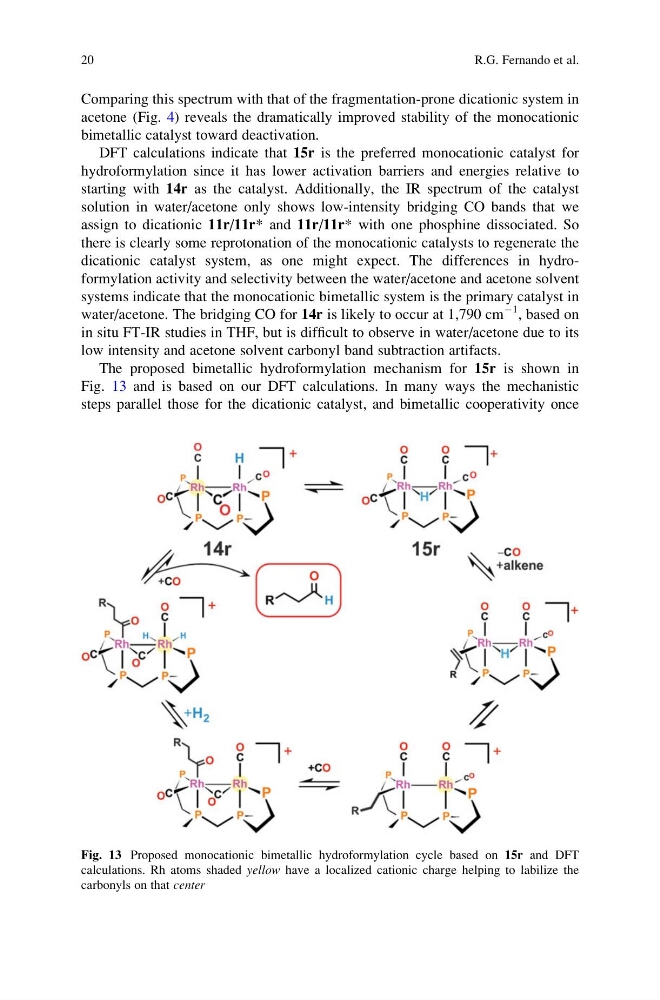
The proposed bimetallic hydroformylation mechanism for 15r is shown in
Fig. 13 and is based on our DFT calculations. In many ways the mechanistic
steps parallel those for the dicationic catalyst, and bimetallic cooperativity once
Fig. 13 Proposed monocationic bimetallic hydroformylation cycle based on 15r and DFT
calculations. Rh atoms shaded yellow have a localized cationic charge helping to labilize the
carbonyls on that center
20
R.G. Fernando et al.
acetone (Fig. 4) reveals the dramatically improved stability of the monocationic
bimetallic catalyst toward deactivation.
DFT calculations indicate that 15r is the preferred monocationic catalyst for
hydroformylation since it has lower activation barriers and energies relative to
starting with 14r as the catalyst. Additionally, the IR spectrum of the catalyst
solution in water/acetone only shows low-intensity bridging CO bands that we
assign to dicationic 11r/11r* and 11r/11r* with one phosphine dissociated. So
there is clearly some reprotonation of the monocationic catalysts to regenerate the
dicationic catalyst system, as one might expect. The differences in hydroformylation activity and selectivity between the water/acetone and acetone solvent
systems indicate that the monocationic bimetallic system is the primary catalyst in
water/acetone. The bridging CO for 14r is likely to occur at 1,790 cm
À1 , based on
in situ FT-IR studies in THF, but is difficult to observe in water/acetone due to its
low intensity and acetone solvent carbonyl band subtraction artifacts.
The proposed bimetallic hydroformylation mechanism for 15r is shown in
Fig. 13 and is based on our DFT calculations. In many ways the mechanistic
steps parallel those for the dicationic catalyst, and bimetallic cooperativity once
Fig. 13 Proposed monocationic bimetallic hydroformylation cycle based on 15r and DFT
calculations. Rh atoms shaded yellow have a localized cationic charge helping to labilize the
carbonyls on that center
20
R.G. Fernando et al.