

5 Conclusions and Outlook
As described herein, metalloenzymes offer blueprints for production of sustainable
molecular catalysts for fuel production. Although substantial progress has been
made toward this goal, several important objectives remain. First, the stability of
catalysts, especially under operating conditions, must be dramatically improved.
Second, catalysts will need to be modified for use in specific electrocatalytic or
photocatalytic applications. This likely means immobilization at electrode surfaces
or tethering to photosensitizers. In both cases, synthetic methods for stable, longterm covalent immobilization must be developed, and studies of catalyst behavior
at interfaces will need to be undertaken. Third, both the turnover numbers and
turnover frequencies of CO 2 reduction catalysts need to be improved. Fourth, the
specificity of CO 2 reduction catalysts must be improved. These last two objectives
will likely require development of new ligand sets, syntheses, and complexes. In
closing, we note that biological systems have solved analogues of all of these
challenges. Thus although our goal is not to recreate biology, we hope that research
in this area will continue to benefit from biological inspiration.
Acknowledgments This work was supported as part of the Biological Electron Transfer and
Catalysis Energy Frontier Research Center funded by the US Department of Energy, Office of
Science, Basic Energy Sciences under Award # DE-SC0012518. Research on hydrogen production
catalysis was funded by the Department of Energy, Office of Basic Energy Sciences under contract
#DE-FG02-12ER16303. JL is supported by an IGERT-SUN fellowship funded by the National
Science Foundation (Award 1144616). AKJ thanks the Institut D’Etudes Avance ´es Exploratoire
Me ´diterrane ´en de l’Interdisciplinarite ´ for sabbatical support in research on carbon dioxide
reduction.
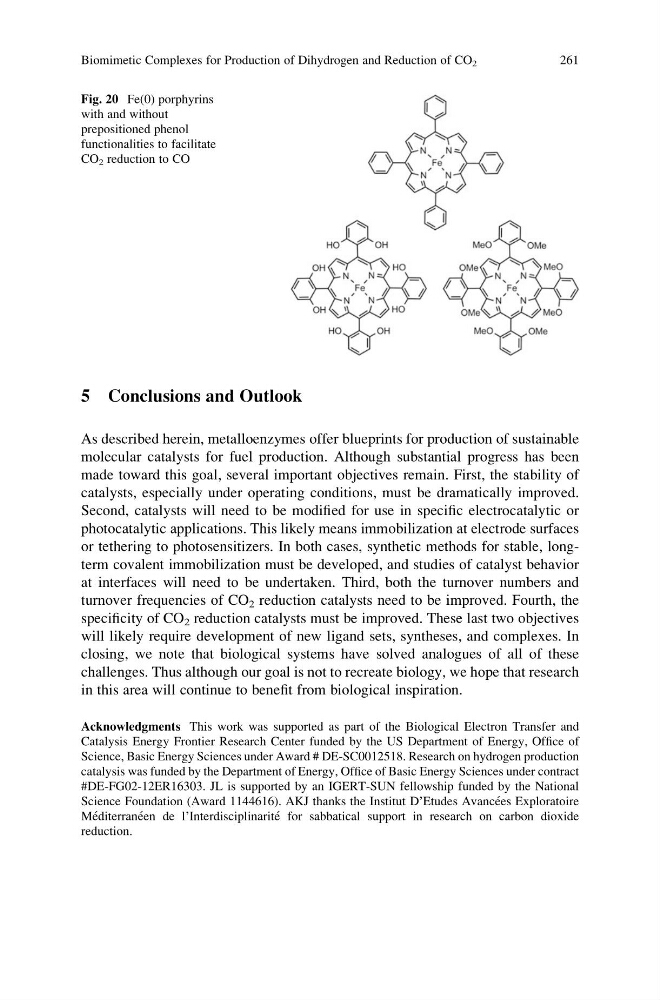
Fig. 20 Fe(0) porphyrins
with and without
prepositioned phenol
functionalities to facilitate
CO 2 reduction to CO
Biomimetic Complexes for Production of Dihydrogen and Reduction of CO 2
261
As described herein, metalloenzymes offer blueprints for production of sustainable
molecular catalysts for fuel production. Although substantial progress has been
made toward this goal, several important objectives remain. First, the stability of
catalysts, especially under operating conditions, must be dramatically improved.
Second, catalysts will need to be modified for use in specific electrocatalytic or
photocatalytic applications. This likely means immobilization at electrode surfaces
or tethering to photosensitizers. In both cases, synthetic methods for stable, longterm covalent immobilization must be developed, and studies of catalyst behavior
at interfaces will need to be undertaken. Third, both the turnover numbers and
turnover frequencies of CO 2 reduction catalysts need to be improved. Fourth, the
specificity of CO 2 reduction catalysts must be improved. These last two objectives
will likely require development of new ligand sets, syntheses, and complexes. In
closing, we note that biological systems have solved analogues of all of these
challenges. Thus although our goal is not to recreate biology, we hope that research
in this area will continue to benefit from biological inspiration.
Acknowledgments This work was supported as part of the Biological Electron Transfer and
Catalysis Energy Frontier Research Center funded by the US Department of Energy, Office of
Science, Basic Energy Sciences under Award # DE-SC0012518. Research on hydrogen production
catalysis was funded by the Department of Energy, Office of Basic Energy Sciences under contract
#DE-FG02-12ER16303. JL is supported by an IGERT-SUN fellowship funded by the National
Science Foundation (Award 1144616). AKJ thanks the Institut D’Etudes Avance ´es Exploratoire
Me ´diterrane ´en de l’Interdisciplinarite ´ for sabbatical support in research on carbon dioxide
reduction.
Fig. 20 Fe(0) porphyrins
with and without
prepositioned phenol
functionalities to facilitate
CO 2 reduction to CO
Biomimetic Complexes for Production of Dihydrogen and Reduction of CO 2
261