

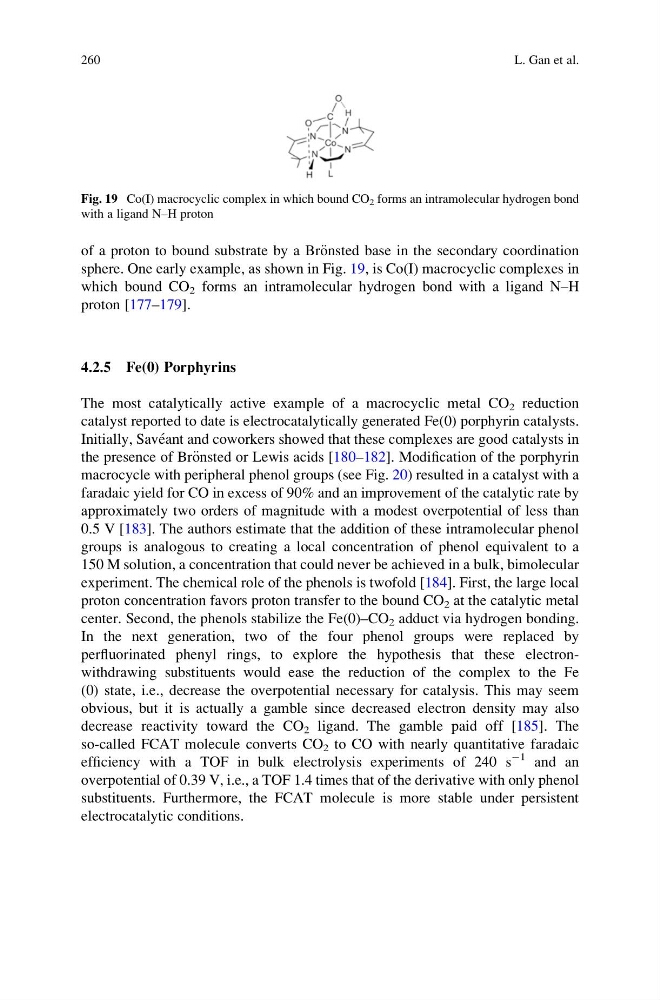
of a proton to bound substrate by a Br€ onsted base in the secondary coordination
sphere. One early example, as shown in Fig. 19, is Co(I) macrocyclic complexes in
which bound CO 2 forms an intramolecular hydrogen bond with a ligand N–H
proton [177–179].
4.2.5 Fe(0) Porphyrins
The most catalytically active example of a macrocyclic metal CO 2 reduction
catalyst reported to date is electrocatalytically generated Fe(0) porphyrin catalysts.
Initially, Save ´ant and coworkers showed that these complexes are good catalysts in
the presence of Br€ onsted or Lewis acids [180–182]. Modification of the porphyrin
macrocycle with peripheral phenol groups (see Fig. 20) resulted in a catalyst with a
faradaic yield for CO in excess of 90% and an improvement of the catalytic rate by
approximately two orders of magnitude with a modest overpotential of less than
0.5 V [183]. The authors estimate that the addition of these intramolecular phenol
groups is analogous to creating a local concentration of phenol equivalent to a
150 M solution, a concentration that could never be achieved in a bulk, bimolecular
experiment. The chemical role of the phenols is twofold [184]. First, the large local
proton concentration favors proton transfer to the bound CO 2 at the catalytic metal
center. Second, the phenols stabilize the Fe(0)–CO 2 adduct via hydrogen bonding.
In the next generation, two of the four phenol groups were replaced by
perfluorinated phenyl rings, to explore the hypothesis that these electronwithdrawing substituents would ease the reduction of the complex to the Fe
(0) state, i.e., decrease the overpotential necessary for catalysis. This may seem
obvious, but it is actually a gamble since decreased electron density may also
decrease reactivity toward the CO 2 ligand. The gamble paid off [185]. The
so-called FCAT molecule converts CO 2 to CO with nearly quantitative faradaic
efficiency with a TOF in bulk electrolysis experiments of 240 s
À1 and an
overpotential of 0.39 V, i.e., a TOF 1.4 times that of the derivative with only phenol
substituents. Furthermore, the FCAT molecule is more stable under persistent
electrocatalytic conditions.
Fig. 19 Co(I) macrocyclic complex in which bound CO 2 forms an intramolecular hydrogen bond
with a ligand N–H proton
260
L. Gan et al.
sphere. One early example, as shown in Fig. 19, is Co(I) macrocyclic complexes in
which bound CO 2 forms an intramolecular hydrogen bond with a ligand N–H
proton [177–179].
4.2.5 Fe(0) Porphyrins
The most catalytically active example of a macrocyclic metal CO 2 reduction
catalyst reported to date is electrocatalytically generated Fe(0) porphyrin catalysts.
Initially, Save ´ant and coworkers showed that these complexes are good catalysts in
the presence of Br€ onsted or Lewis acids [180–182]. Modification of the porphyrin
macrocycle with peripheral phenol groups (see Fig. 20) resulted in a catalyst with a
faradaic yield for CO in excess of 90% and an improvement of the catalytic rate by
approximately two orders of magnitude with a modest overpotential of less than
0.5 V [183]. The authors estimate that the addition of these intramolecular phenol
groups is analogous to creating a local concentration of phenol equivalent to a
150 M solution, a concentration that could never be achieved in a bulk, bimolecular
experiment. The chemical role of the phenols is twofold [184]. First, the large local
proton concentration favors proton transfer to the bound CO 2 at the catalytic metal
center. Second, the phenols stabilize the Fe(0)–CO 2 adduct via hydrogen bonding.
In the next generation, two of the four phenol groups were replaced by
perfluorinated phenyl rings, to explore the hypothesis that these electronwithdrawing substituents would ease the reduction of the complex to the Fe
(0) state, i.e., decrease the overpotential necessary for catalysis. This may seem
obvious, but it is actually a gamble since decreased electron density may also
decrease reactivity toward the CO 2 ligand. The gamble paid off [185]. The
so-called FCAT molecule converts CO 2 to CO with nearly quantitative faradaic
efficiency with a TOF in bulk electrolysis experiments of 240 s
À1 and an
overpotential of 0.39 V, i.e., a TOF 1.4 times that of the derivative with only phenol
substituents. Furthermore, the FCAT molecule is more stable under persistent
electrocatalytic conditions.
Fig. 19 Co(I) macrocyclic complex in which bound CO 2 forms an intramolecular hydrogen bond
with a ligand N–H proton
260
L. Gan et al.