

the metal has low affinity for CO, but this is the rate-determining step for several
complexes involving other metals.
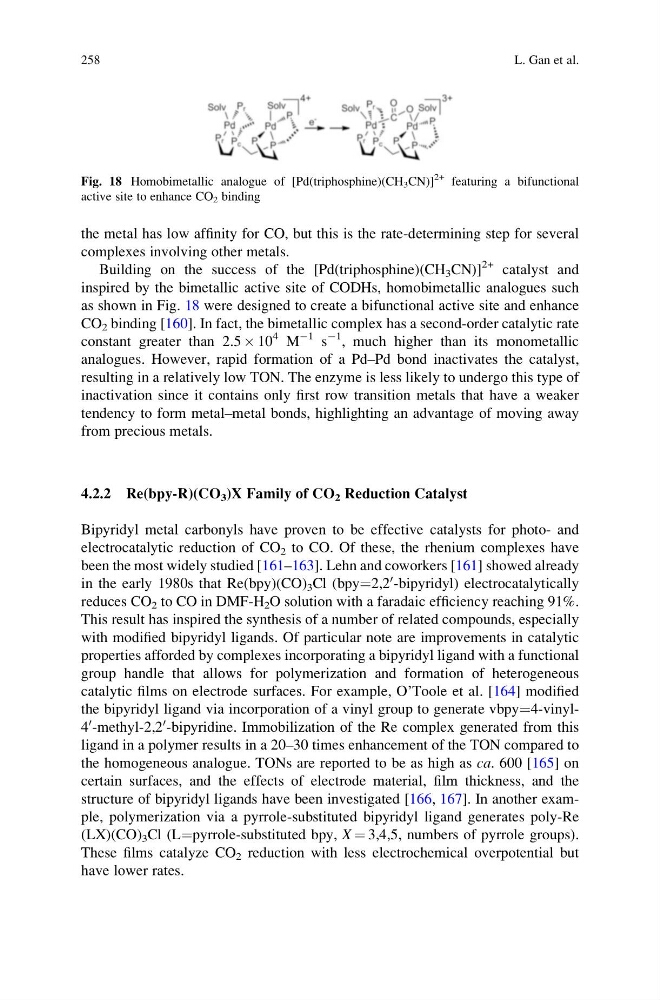
Building on the success of the [Pd(triphosphine)(CH 3 CN)]
2+ catalyst and
inspired by the bimetallic active site of CODHs, homobimetallic analogues such
as shown in Fig. 18 were designed to create a bifunctional active site and enhance
CO 2 binding [160]. In fact, the bimetallic complex has a second-order catalytic rate
constant greater than 2.5 Â 10
4 M
À1 s
À1 , much higher than its monometallic
analogues. However, rapid formation of a Pd–Pd bond inactivates the catalyst,
resulting in a relatively low TON. The enzyme is less likely to undergo this type of
inactivation since it contains only first row transition metals that have a weaker
tendency to form metal–metal bonds, highlighting an advantage of moving away
from precious metals.
4.2.2 Re(bpy-R)(CO 3 )X Family of CO 2 Reduction Catalyst
Bipyridyl metal carbonyls have proven to be effective catalysts for photo- and
electrocatalytic reduction of CO 2 to CO. Of these, the rhenium complexes have
been the most widely studied [161–163]. Lehn and coworkers [161] showed already
in the early 1980s that Re(bpy)(CO) 3 Cl (bpy¼2,2
0 -bipyridyl) electrocatalytically
reduces CO 2 to CO in DMF-H 2 O solution with a faradaic efficiency reaching 91%.
This result has inspired the synthesis of a number of related compounds, especially
with modified bipyridyl ligands. Of particular note are improvements in catalytic
properties afforded by complexes incorporating a bipyridyl ligand with a functional
group handle that allows for polymerization and formation of heterogeneous
catalytic films on electrode surfaces. For example, O’Toole et al. [164] modified
the bipyridyl ligand via incorporation of a vinyl group to generate vbpy¼4-vinyl4
0 -methyl-2,2
0 -bipyridine. Immobilization of the Re complex generated from this
ligand in a polymer results in a 20–30 times enhancement of the TON compared to
the homogeneous analogue. TONs are reported to be as high as ca. 600 [165] on
certain surfaces, and the effects of electrode material, film thickness, and the
structure of bipyridyl ligands have been investigated [166, 167]. In another example, polymerization via a pyrrole-substituted bipyridyl ligand generates poly-Re
(LX)(CO) 3 Cl (L¼pyrrole-substituted bpy, X ¼ 3,4,5, numbers of pyrrole groups).
These films catalyze CO 2 reduction with less electrochemical overpotential but
have lower rates.
Fig. 18 Homobimetallic analogue of [Pd(triphosphine)(CH 3 CN)]
2+ featuring a bifunctional
active site to enhance CO 2 binding
258
L. Gan et al.
complexes involving other metals.
Building on the success of the [Pd(triphosphine)(CH 3 CN)]
2+ catalyst and
inspired by the bimetallic active site of CODHs, homobimetallic analogues such
as shown in Fig. 18 were designed to create a bifunctional active site and enhance
CO 2 binding [160]. In fact, the bimetallic complex has a second-order catalytic rate
constant greater than 2.5 Â 10
4 M
À1 s
À1 , much higher than its monometallic
analogues. However, rapid formation of a Pd–Pd bond inactivates the catalyst,
resulting in a relatively low TON. The enzyme is less likely to undergo this type of
inactivation since it contains only first row transition metals that have a weaker
tendency to form metal–metal bonds, highlighting an advantage of moving away
from precious metals.
4.2.2 Re(bpy-R)(CO 3 )X Family of CO 2 Reduction Catalyst
Bipyridyl metal carbonyls have proven to be effective catalysts for photo- and
electrocatalytic reduction of CO 2 to CO. Of these, the rhenium complexes have
been the most widely studied [161–163]. Lehn and coworkers [161] showed already
in the early 1980s that Re(bpy)(CO) 3 Cl (bpy¼2,2
0 -bipyridyl) electrocatalytically
reduces CO 2 to CO in DMF-H 2 O solution with a faradaic efficiency reaching 91%.
This result has inspired the synthesis of a number of related compounds, especially
with modified bipyridyl ligands. Of particular note are improvements in catalytic
properties afforded by complexes incorporating a bipyridyl ligand with a functional
group handle that allows for polymerization and formation of heterogeneous
catalytic films on electrode surfaces. For example, O’Toole et al. [164] modified
the bipyridyl ligand via incorporation of a vinyl group to generate vbpy¼4-vinyl4
0 -methyl-2,2
0 -bipyridine. Immobilization of the Re complex generated from this
ligand in a polymer results in a 20–30 times enhancement of the TON compared to
the homogeneous analogue. TONs are reported to be as high as ca. 600 [165] on
certain surfaces, and the effects of electrode material, film thickness, and the
structure of bipyridyl ligands have been investigated [166, 167]. In another example, polymerization via a pyrrole-substituted bipyridyl ligand generates poly-Re
(LX)(CO) 3 Cl (L¼pyrrole-substituted bpy, X ¼ 3,4,5, numbers of pyrrole groups).
These films catalyze CO 2 reduction with less electrochemical overpotential but
have lower rates.
Fig. 18 Homobimetallic analogue of [Pd(triphosphine)(CH 3 CN)]
2+ featuring a bifunctional
active site to enhance CO 2 binding
258
L. Gan et al.