

4.2.1 Transition Metal Phosphine Complexes
The history of synthetic metal phosphine complexes as CO 2 reduction catalysts
begins more than three decades ago when Slater and Wagenknecht demonstrated
the stoichiometric electrochemical reduction of CO 2 to formate using a [Rh
(diphosphine) 2 ]
+ complex [156]. This Rh complex is not a catalyst, but it improves
the thermodynamics of reduction of CO 2 by approximately 700 mV. Shortly
thereafter, Darensbourg and coworkers showed that CO 2 could be inserted into
trans-[(H) 2 Ni(PCy 3 ) 2 ] to form trans-[(H)(HCO 2 )Ni(PCy 3 ) 2 ] [157], an important
step in understanding possible intermediates of CO 2 reduction by transition metal
phosphine complexes. Simultaneously, DuBois and coworkers reported a series of
transition metal phosphine complexes based on Fe, Ni, and Pd with weakly bound
solvent molecules; some of these are electrocatalytically active for CO 2 reduction.
The [Pd(triphosphine)(CH 3 CN)](BF 4 ) 2 (triphosphine¼RP(CH 2 CH 2 PR
0
2 ) 2 where R
and R
0 can be alkyl or aryl substituents) complexes are the best catalysts in this class
[158, 159]. They catalyze reduction of CO 2 to CO in acidic solution under 1.0 atm
of CO 2 with TONs up to 130 at an overpotential of only 0.3 V. The mechanism of
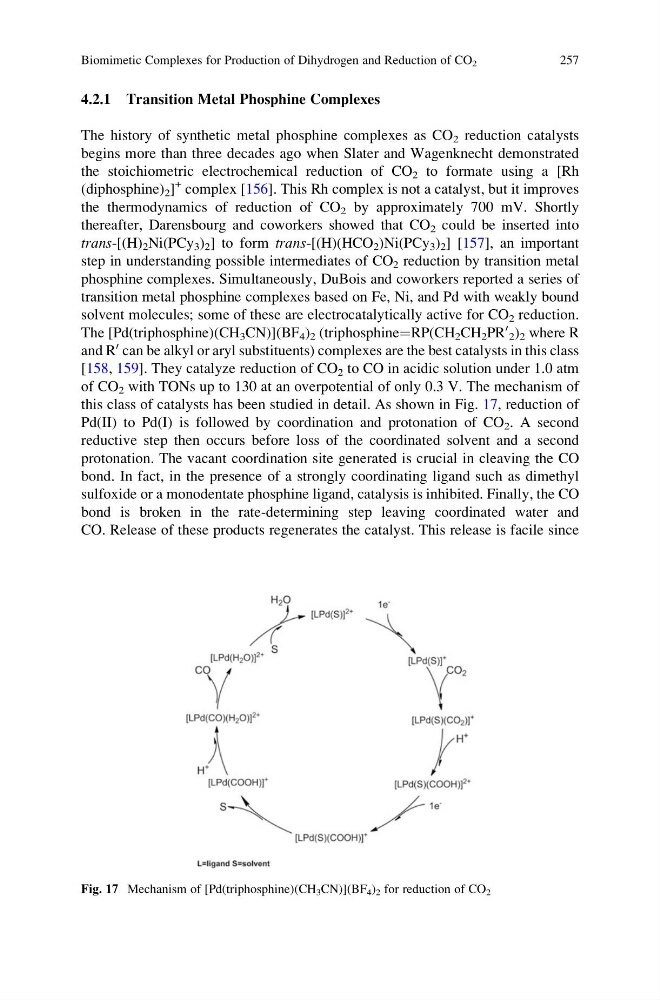
this class of catalysts has been studied in detail. As shown in Fig. 17, reduction of
Pd(II) to Pd(I) is followed by coordination and protonation of CO 2 . A second
reductive step then occurs before loss of the coordinated solvent and a second
protonation. The vacant coordination site generated is crucial in cleaving the CO
bond. In fact, in the presence of a strongly coordinating ligand such as dimethyl
sulfoxide or a monodentate phosphine ligand, catalysis is inhibited. Finally, the CO
bond is broken in the rate-determining step leaving coordinated water and
CO. Release of these products regenerates the catalyst. This release is facile since
Fig. 17 Mechanism of [Pd(triphosphine)(CH 3 CN)](BF 4 ) 2 for reduction of CO 2
Biomimetic Complexes for Production of Dihydrogen and Reduction of CO 2
257
The history of synthetic metal phosphine complexes as CO 2 reduction catalysts
begins more than three decades ago when Slater and Wagenknecht demonstrated
the stoichiometric electrochemical reduction of CO 2 to formate using a [Rh
(diphosphine) 2 ]
+ complex [156]. This Rh complex is not a catalyst, but it improves
the thermodynamics of reduction of CO 2 by approximately 700 mV. Shortly
thereafter, Darensbourg and coworkers showed that CO 2 could be inserted into
trans-[(H) 2 Ni(PCy 3 ) 2 ] to form trans-[(H)(HCO 2 )Ni(PCy 3 ) 2 ] [157], an important
step in understanding possible intermediates of CO 2 reduction by transition metal
phosphine complexes. Simultaneously, DuBois and coworkers reported a series of
transition metal phosphine complexes based on Fe, Ni, and Pd with weakly bound
solvent molecules; some of these are electrocatalytically active for CO 2 reduction.
The [Pd(triphosphine)(CH 3 CN)](BF 4 ) 2 (triphosphine¼RP(CH 2 CH 2 PR
0
2 ) 2 where R
and R
0 can be alkyl or aryl substituents) complexes are the best catalysts in this class
[158, 159]. They catalyze reduction of CO 2 to CO in acidic solution under 1.0 atm
of CO 2 with TONs up to 130 at an overpotential of only 0.3 V. The mechanism of
this class of catalysts has been studied in detail. As shown in Fig. 17, reduction of
Pd(II) to Pd(I) is followed by coordination and protonation of CO 2 . A second
reductive step then occurs before loss of the coordinated solvent and a second
protonation. The vacant coordination site generated is crucial in cleaving the CO
bond. In fact, in the presence of a strongly coordinating ligand such as dimethyl
sulfoxide or a monodentate phosphine ligand, catalysis is inhibited. Finally, the CO
bond is broken in the rate-determining step leaving coordinated water and
CO. Release of these products regenerates the catalyst. This release is facile since
Fig. 17 Mechanism of [Pd(triphosphine)(CH 3 CN)](BF 4 ) 2 for reduction of CO 2
Biomimetic Complexes for Production of Dihydrogen and Reduction of CO 2
257