

40 h with a turnover number of up to 52,000, a factor of 4,000 higher than the same
components simply free in solution [139]. Unfortunately, the TOF is very low with
an initial value of 1 s
À1 . For comparison, Armstrong and coworkers reported that
Desulfomicrobium
baculatum
[NiFeSe]-hydrogenase
immobilized
on
Ru-sensitized TiO 2 particles using triethanolamine as sacrificial electron donor
has a TOF of 50 s
-1 [140]. However, the enzyme system undergoes O 2 -dependent
photodecomposition in air in less than 2 min. For other examples of photocatalytic
systems employing natural hydrogenases, King has recently reviewed constructs for
immobilization of hydrogenases at semiconductor particles [141]. Hybrid systems
are not limited to the diiron family of catalysts. Bren and coworkers demonstrated
that cobalt-microperoxidase 11 is an HER electrocatalyst with a TOF of 6.7 s
À1 at
an overpotential of 850 mV and TON of 25,000 [142]. Ghirlanda and coworkers
extended this result to photocatalysis using Co-protoporphyrin IX embedded in
myoglobin [143], but the TON was unfortunately only 520 and TOF <1 min
À1 .
Thus, to date, the biohybrid iron system remains far superior catalytically.
Although most molecular hydrogen-producing catalysts are not inherently
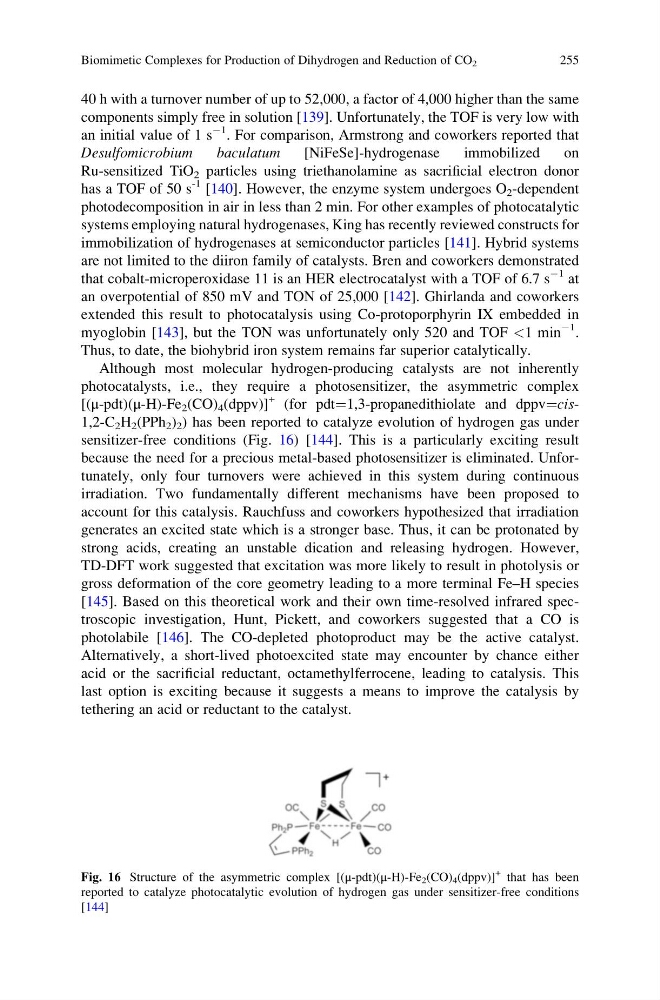
photocatalysts, i.e., they require a photosensitizer, the asymmetric complex
[(μ-pdt)(μ-H)-Fe 2 (CO) 4 (dppv)]
+ (for pdt¼1,3-propanedithiolate and dppv¼cis1,2-C 2 H 2 (PPh 2 ) 2 ) has been reported to catalyze evolution of hydrogen gas under
sensitizer-free conditions (Fig. 16) [144]. This is a particularly exciting result
because the need for a precious metal-based photosensitizer is eliminated. Unfortunately, only four turnovers were achieved in this system during continuous
irradiation. Two fundamentally different mechanisms have been proposed to
account for this catalysis. Rauchfuss and coworkers hypothesized that irradiation
generates an excited state which is a stronger base. Thus, it can be protonated by
strong acids, creating an unstable dication and releasing hydrogen. However,
TD-DFT work suggested that excitation was more likely to result in photolysis or
gross deformation of the core geometry leading to a more terminal Fe–H species
[145]. Based on this theoretical work and their own time-resolved infrared spectroscopic investigation, Hunt, Pickett, and coworkers suggested that a CO is
photolabile [146]. The CO-depleted photoproduct may be the active catalyst.
Alternatively, a short-lived photoexcited state may encounter by chance either
acid or the sacrificial reductant, octamethylferrocene, leading to catalysis. This
last option is exciting because it suggests a means to improve the catalysis by
tethering an acid or reductant to the catalyst.
Fig. 16 Structure of the asymmetric complex [(μ-pdt)(μ-H)-Fe 2 (CO) 4 (dppv)]
+ that has been
reported to catalyze photocatalytic evolution of hydrogen gas under sensitizer-free conditions
[144]
Biomimetic Complexes for Production of Dihydrogen and Reduction of CO 2
255
components simply free in solution [139]. Unfortunately, the TOF is very low with
an initial value of 1 s
À1 . For comparison, Armstrong and coworkers reported that
Desulfomicrobium
baculatum
[NiFeSe]-hydrogenase
immobilized
on
Ru-sensitized TiO 2 particles using triethanolamine as sacrificial electron donor
has a TOF of 50 s
-1 [140]. However, the enzyme system undergoes O 2 -dependent
photodecomposition in air in less than 2 min. For other examples of photocatalytic
systems employing natural hydrogenases, King has recently reviewed constructs for
immobilization of hydrogenases at semiconductor particles [141]. Hybrid systems
are not limited to the diiron family of catalysts. Bren and coworkers demonstrated
that cobalt-microperoxidase 11 is an HER electrocatalyst with a TOF of 6.7 s
À1 at
an overpotential of 850 mV and TON of 25,000 [142]. Ghirlanda and coworkers
extended this result to photocatalysis using Co-protoporphyrin IX embedded in
myoglobin [143], but the TON was unfortunately only 520 and TOF <1 min
À1 .
Thus, to date, the biohybrid iron system remains far superior catalytically.
Although most molecular hydrogen-producing catalysts are not inherently
photocatalysts, i.e., they require a photosensitizer, the asymmetric complex
[(μ-pdt)(μ-H)-Fe 2 (CO) 4 (dppv)]
+ (for pdt¼1,3-propanedithiolate and dppv¼cis1,2-C 2 H 2 (PPh 2 ) 2 ) has been reported to catalyze evolution of hydrogen gas under
sensitizer-free conditions (Fig. 16) [144]. This is a particularly exciting result
because the need for a precious metal-based photosensitizer is eliminated. Unfortunately, only four turnovers were achieved in this system during continuous
irradiation. Two fundamentally different mechanisms have been proposed to
account for this catalysis. Rauchfuss and coworkers hypothesized that irradiation
generates an excited state which is a stronger base. Thus, it can be protonated by
strong acids, creating an unstable dication and releasing hydrogen. However,
TD-DFT work suggested that excitation was more likely to result in photolysis or
gross deformation of the core geometry leading to a more terminal Fe–H species
[145]. Based on this theoretical work and their own time-resolved infrared spectroscopic investigation, Hunt, Pickett, and coworkers suggested that a CO is
photolabile [146]. The CO-depleted photoproduct may be the active catalyst.
Alternatively, a short-lived photoexcited state may encounter by chance either
acid or the sacrificial reductant, octamethylferrocene, leading to catalysis. This
last option is exciting because it suggests a means to improve the catalysis by
tethering an acid or reductant to the catalyst.
Fig. 16 Structure of the asymmetric complex [(μ-pdt)(μ-H)-Fe 2 (CO) 4 (dppv)]
+ that has been
reported to catalyze photocatalytic evolution of hydrogen gas under sensitizer-free conditions
[144]
Biomimetic Complexes for Production of Dihydrogen and Reduction of CO 2
255