

where substrate or other exogenous species can bind. In contrast, small model
complexes usually adopt an “eclipsed” conformation that promotes binding of
ligands in a bridging mode and results in lower catalytic activity.
The redox chemistry of [FeFe]-hydrogenases is extensive. Although only three
oxidation states are strictly necessary for the two-electron reaction catalyzed by
hydrogenases, the presence of six metals creates the possibility of many stable
states, and the enzyme has been isolated with the H-cluster in five distinct redox or
spectroscopic states [14]. Two inactive states have been identified. The first, H ox
inact
[Fe(II)Fe(II)], is formed by oxidative inactivation. The second, H ox –CO [Fe(I)Fe
(II)], forms when CO binds to the vacant site on the distal Fe. There are also two
known active states: H ox [Fe(I)Fe(II)] and H red [Fe(I)Fe(I)]. A fifth state, H sred , [Fe
(I)Fe(I)] with the [4Fe4S] cubane also reduced, has been observed, but the catalytic
relevance of this state is still under debate [15, 16].
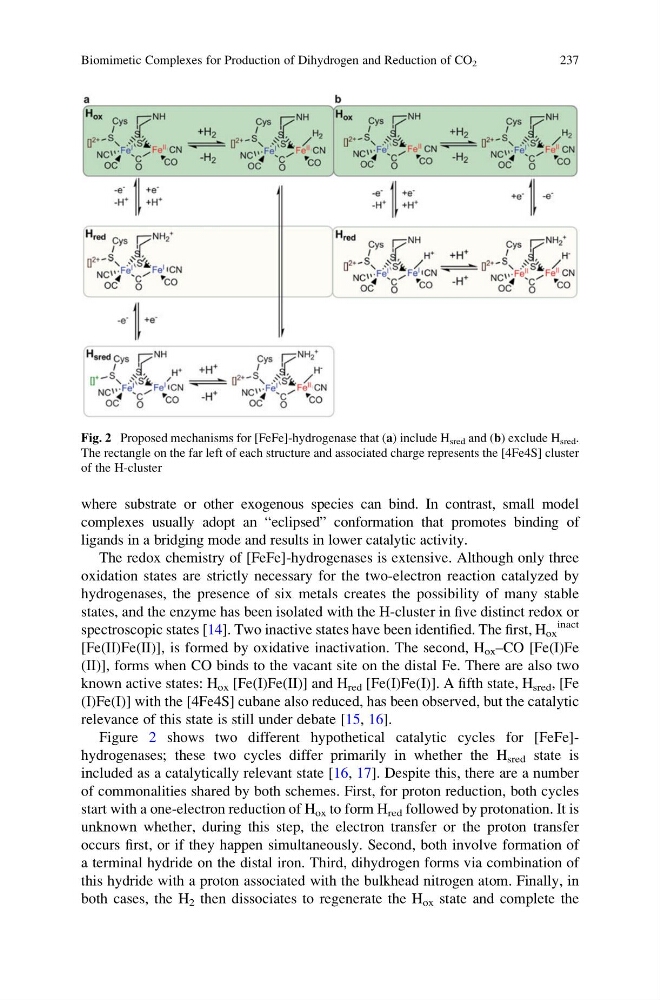
Figure 2 shows two different hypothetical catalytic cycles for [FeFe]hydrogenases; these two cycles differ primarily in whether the H sred state is
included as a catalytically relevant state [16, 17]. Despite this, there are a number
of commonalities shared by both schemes. First, for proton reduction, both cycles
start with a one-electron reduction of H ox to form H red followed by protonation. It is
unknown whether, during this step, the electron transfer or the proton transfer
occurs first, or if they happen simultaneously. Second, both involve formation of
a terminal hydride on the distal iron. Third, dihydrogen forms via combination of
this hydride with a proton associated with the bulkhead nitrogen atom. Finally, in
both cases, the H 2 then dissociates to regenerate the H ox state and complete the
Fig. 2 Proposed mechanisms for [FeFe]-hydrogenase that (a) include H sred and (b) exclude H sred .
The rectangle on the far left of each structure and associated charge represents the [4Fe4S] cluster
of the H-cluster
Biomimetic Complexes for Production of Dihydrogen and Reduction of CO 2
237
complexes usually adopt an “eclipsed” conformation that promotes binding of
ligands in a bridging mode and results in lower catalytic activity.
The redox chemistry of [FeFe]-hydrogenases is extensive. Although only three
oxidation states are strictly necessary for the two-electron reaction catalyzed by
hydrogenases, the presence of six metals creates the possibility of many stable
states, and the enzyme has been isolated with the H-cluster in five distinct redox or
spectroscopic states [14]. Two inactive states have been identified. The first, H ox
inact
[Fe(II)Fe(II)], is formed by oxidative inactivation. The second, H ox –CO [Fe(I)Fe
(II)], forms when CO binds to the vacant site on the distal Fe. There are also two
known active states: H ox [Fe(I)Fe(II)] and H red [Fe(I)Fe(I)]. A fifth state, H sred , [Fe
(I)Fe(I)] with the [4Fe4S] cubane also reduced, has been observed, but the catalytic
relevance of this state is still under debate [15, 16].
Figure 2 shows two different hypothetical catalytic cycles for [FeFe]hydrogenases; these two cycles differ primarily in whether the H sred state is
included as a catalytically relevant state [16, 17]. Despite this, there are a number
of commonalities shared by both schemes. First, for proton reduction, both cycles
start with a one-electron reduction of H ox to form H red followed by protonation. It is
unknown whether, during this step, the electron transfer or the proton transfer
occurs first, or if they happen simultaneously. Second, both involve formation of
a terminal hydride on the distal iron. Third, dihydrogen forms via combination of
this hydride with a proton associated with the bulkhead nitrogen atom. Finally, in
both cases, the H 2 then dissociates to regenerate the H ox state and complete the
Fig. 2 Proposed mechanisms for [FeFe]-hydrogenase that (a) include H sred and (b) exclude H sred .
The rectangle on the far left of each structure and associated charge represents the [4Fe4S] cluster
of the H-cluster
Biomimetic Complexes for Production of Dihydrogen and Reduction of CO 2
237