

shown in Eq. (1). In the following sections, these two bimetallic types of hydrogenases will be introduced with particular attention paid to structural and mechanistic features relevant to the design of functional models.
2H
þ
þ 2e
À
Ð H 2
ð1Þ
2.1.1 [FeFe]-Hydrogenases
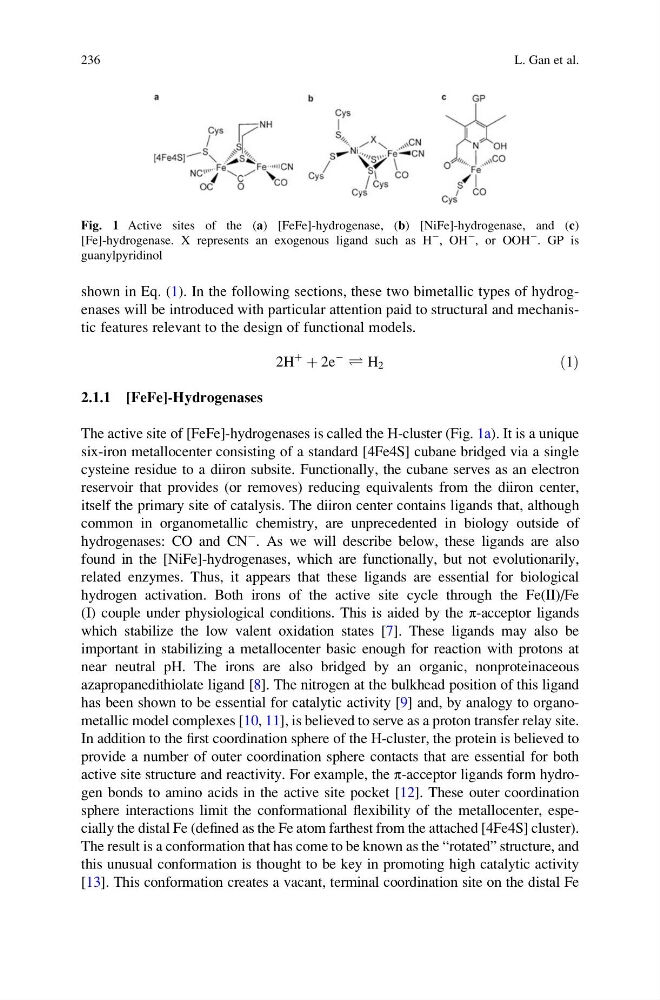
The active site of [FeFe]-hydrogenases is called the H-cluster (Fig. 1a). It is a unique
six-iron metallocenter consisting of a standard [4Fe4S] cubane bridged via a single
cysteine residue to a diiron subsite. Functionally, the cubane serves as an electron
reservoir that provides (or removes) reducing equivalents from the diiron center,
itself the primary site of catalysis. The diiron center contains ligands that, although
common in organometallic chemistry, are unprecedented in biology outside of
hydrogenases: CO and CN
À . As we will describe below, these ligands are also
found in the [NiFe]-hydrogenases, which are functionally, but not evolutionarily,
related enzymes. Thus, it appears that these ligands are essential for biological
hydrogen activation. Both irons of the active site cycle through the Fe(II)/Fe
(I) couple under physiological conditions. This is aided by the π-acceptor ligands
which stabilize the low valent oxidation states [7]. These ligands may also be
important in stabilizing a metallocenter basic enough for reaction with protons at
near neutral pH. The irons are also bridged by an organic, nonproteinaceous
azapropanedithiolate ligand [8]. The nitrogen at the bulkhead position of this ligand
has been shown to be essential for catalytic activity [9] and, by analogy to organometallic model complexes [10, 11], is believed to serve as a proton transfer relay site.
In addition to the first coordination sphere of the H-cluster, the protein is believed to
provide a number of outer coordination sphere contacts that are essential for both
active site structure and reactivity. For example, the π-acceptor ligands form hydrogen bonds to amino acids in the active site pocket [12]. These outer coordination
sphere interactions limit the conformational flexibility of the metallocenter, especially the distal Fe (defined as the Fe atom farthest from the attached [4Fe4S] cluster).
The result is a conformation that has come to be known as the “rotated” structure, and
this unusual conformation is thought to be key in promoting high catalytic activity
[13]. This conformation creates a vacant, terminal coordination site on the distal Fe
Fig. 1 Active sites of the (a) [FeFe]-hydrogenase, (b) [NiFe]-hydrogenase, and (c)
[Fe]-hydrogenase. X represents an exogenous ligand such as H
À
, OH
À
, or OOH
À
. GP is
guanylpyridinol
236
L. Gan et al.
2H
þ
þ 2e
À
Ð H 2
ð1Þ
2.1.1 [FeFe]-Hydrogenases
The active site of [FeFe]-hydrogenases is called the H-cluster (Fig. 1a). It is a unique
six-iron metallocenter consisting of a standard [4Fe4S] cubane bridged via a single
cysteine residue to a diiron subsite. Functionally, the cubane serves as an electron
reservoir that provides (or removes) reducing equivalents from the diiron center,
itself the primary site of catalysis. The diiron center contains ligands that, although
common in organometallic chemistry, are unprecedented in biology outside of
hydrogenases: CO and CN
À . As we will describe below, these ligands are also
found in the [NiFe]-hydrogenases, which are functionally, but not evolutionarily,
related enzymes. Thus, it appears that these ligands are essential for biological
hydrogen activation. Both irons of the active site cycle through the Fe(II)/Fe
(I) couple under physiological conditions. This is aided by the π-acceptor ligands
which stabilize the low valent oxidation states [7]. These ligands may also be
important in stabilizing a metallocenter basic enough for reaction with protons at
near neutral pH. The irons are also bridged by an organic, nonproteinaceous
azapropanedithiolate ligand [8]. The nitrogen at the bulkhead position of this ligand
has been shown to be essential for catalytic activity [9] and, by analogy to organometallic model complexes [10, 11], is believed to serve as a proton transfer relay site.
In addition to the first coordination sphere of the H-cluster, the protein is believed to
provide a number of outer coordination sphere contacts that are essential for both
active site structure and reactivity. For example, the π-acceptor ligands form hydrogen bonds to amino acids in the active site pocket [12]. These outer coordination
sphere interactions limit the conformational flexibility of the metallocenter, especially the distal Fe (defined as the Fe atom farthest from the attached [4Fe4S] cluster).
The result is a conformation that has come to be known as the “rotated” structure, and
this unusual conformation is thought to be key in promoting high catalytic activity
[13]. This conformation creates a vacant, terminal coordination site on the distal Fe
Fig. 1 Active sites of the (a) [FeFe]-hydrogenase, (b) [NiFe]-hydrogenase, and (c)
[Fe]-hydrogenase. X represents an exogenous ligand such as H
À
, OH
À
, or OOH
À
. GP is
guanylpyridinol
236
L. Gan et al.