

2 Connectivity of Catalytic Reaction Networks
This section will review the connectivity of some catalytic reaction networks
starting from isolated one-product unicyclic mechanisms, connected unicyclic
mechanisms showing selectivities (regio-, chemo- and stereoselectivities) and
systems possessing more than one uncoupled unicyclic mechanisms. All of these
systems exhibit various forms of linear rate increases versus metal loading.
Subsequently, mechanisms exhibiting quadratic, linear–quadratic, bilinear and
linear–bilinear rate dependences will be explored. CBER systems can exhibit any
one of these four complex rate dependences.
2.1 Variations on Unicyclic Mechanisms
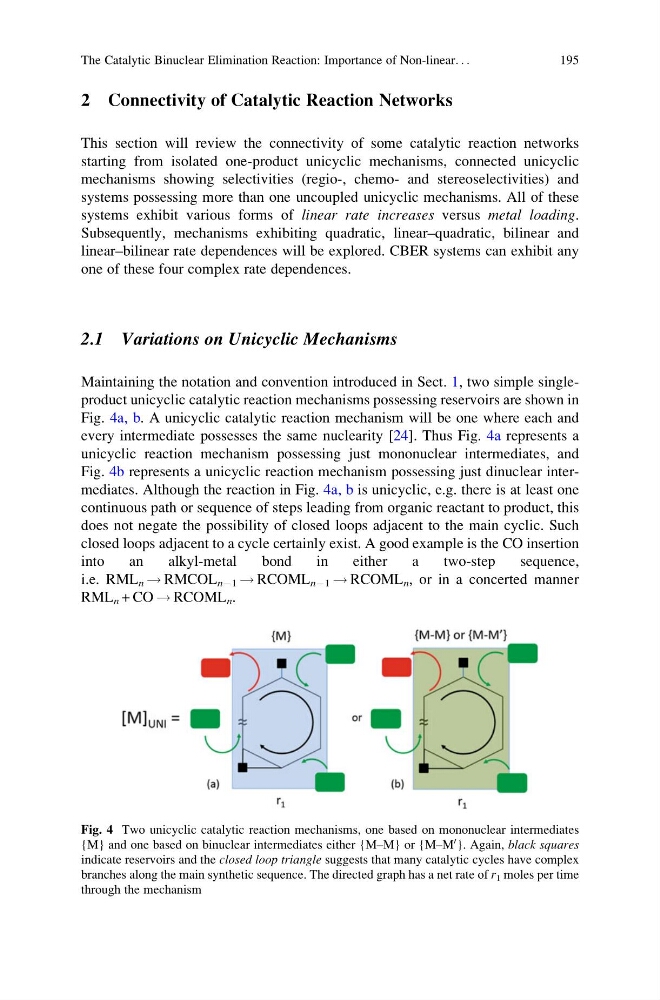
Maintaining the notation and convention introduced in Sect. 1, two simple singleproduct unicyclic catalytic reaction mechanisms possessing reservoirs are shown in
Fig. 4a, b. A unicyclic catalytic reaction mechanism will be one where each and
every intermediate possesses the same nuclearity [24]. Thus Fig. 4a represents a
unicyclic reaction mechanism possessing just mononuclear intermediates, and
Fig. 4b represents a unicyclic reaction mechanism possessing just dinuclear intermediates. Although the reaction in Fig. 4a, b is unicyclic, e.g. there is at least one
continuous path or sequence of steps leading from organic reactant to product, this
does not negate the possibility of closed loops adjacent to the main cyclic. Such
closed loops adjacent to a cycle certainly exist. A good example is the CO insertion
into
an
alkyl-metal
bond
in
either
a
two-step
sequence,
i.e. RML n ! RMCOL nÀ1 ! RCOML nÀ1 ! RCOML n , or in a concerted manner
RML n + CO ! RCOML n .
Fig. 4 Two unicyclic catalytic reaction mechanisms, one based on mononuclear intermediates
{M} and one based on binuclear intermediates either {M–M} or {M–M
0 }. Again, black squares
indicate reservoirs and the closed loop triangle suggests that many catalytic cycles have complex
branches along the main synthetic sequence. The directed graph has a net rate of r 1 moles per time
through the mechanism
The Catalytic Binuclear Elimination Reaction: Importance of Non-linear. . .
195
This section will review the connectivity of some catalytic reaction networks
starting from isolated one-product unicyclic mechanisms, connected unicyclic
mechanisms showing selectivities (regio-, chemo- and stereoselectivities) and
systems possessing more than one uncoupled unicyclic mechanisms. All of these
systems exhibit various forms of linear rate increases versus metal loading.
Subsequently, mechanisms exhibiting quadratic, linear–quadratic, bilinear and
linear–bilinear rate dependences will be explored. CBER systems can exhibit any
one of these four complex rate dependences.
2.1 Variations on Unicyclic Mechanisms
Maintaining the notation and convention introduced in Sect. 1, two simple singleproduct unicyclic catalytic reaction mechanisms possessing reservoirs are shown in
Fig. 4a, b. A unicyclic catalytic reaction mechanism will be one where each and
every intermediate possesses the same nuclearity [24]. Thus Fig. 4a represents a
unicyclic reaction mechanism possessing just mononuclear intermediates, and
Fig. 4b represents a unicyclic reaction mechanism possessing just dinuclear intermediates. Although the reaction in Fig. 4a, b is unicyclic, e.g. there is at least one
continuous path or sequence of steps leading from organic reactant to product, this
does not negate the possibility of closed loops adjacent to the main cyclic. Such
closed loops adjacent to a cycle certainly exist. A good example is the CO insertion
into
an
alkyl-metal
bond
in
either
a
two-step
sequence,
i.e. RML n ! RMCOL nÀ1 ! RCOML nÀ1 ! RCOML n , or in a concerted manner
RML n + CO ! RCOML n .
Fig. 4 Two unicyclic catalytic reaction mechanisms, one based on mononuclear intermediates
{M} and one based on binuclear intermediates either {M–M} or {M–M
0 }. Again, black squares
indicate reservoirs and the closed loop triangle suggests that many catalytic cycles have complex
branches along the main synthetic sequence. The directed graph has a net rate of r 1 moles per time
through the mechanism
The Catalytic Binuclear Elimination Reaction: Importance of Non-linear. . .
195