

Graph theoretic representations form the basis for evaluating individual fluxes,
but moreover generating relationships for the overall flow through the graph or
network [21]. Indeed, the most important global theorem for electrical flows
through arbitrarily complex electrical networks is the Tellegen theorem [22]. The
Tellegen theorem not only encompasses all known steady-state electrical engineering laws (Kirchhoff voltage law and Kirchhoff current law) but also captures the
transient behaviour of all parts of the network. Recently, it has been shown that
stoichiometric chemical reaction networks and even catalytic reactions can be
appropriately represented in equivalent graph theoretic terms such that the Tellegen
theorem can be applied [23]. One of the major applications of this new and exciting
development is to verify that individual steps are self-consistent with the overall
flux generated by the overall organic transformation (in other words, verify that the
hypothesized catalytic reaction mechanism is indeed realistic). In the future, complex non-linear, cooperative/synergistic metal-mediated homogeneous systems will
require sophisticated tools in order to verify individual steps and to verify consistency with the overall proposed reaction mechanisms (here, in situ spectroscopic
information will be invaluable). This will probably lead to a better understanding of
what cooperativity and synergism really mean. Work is currently going on in our
laboratory to characterize the response of generic CBER networks, in terms of
individual and overall fluxes, and to establish further characteristics of such systems
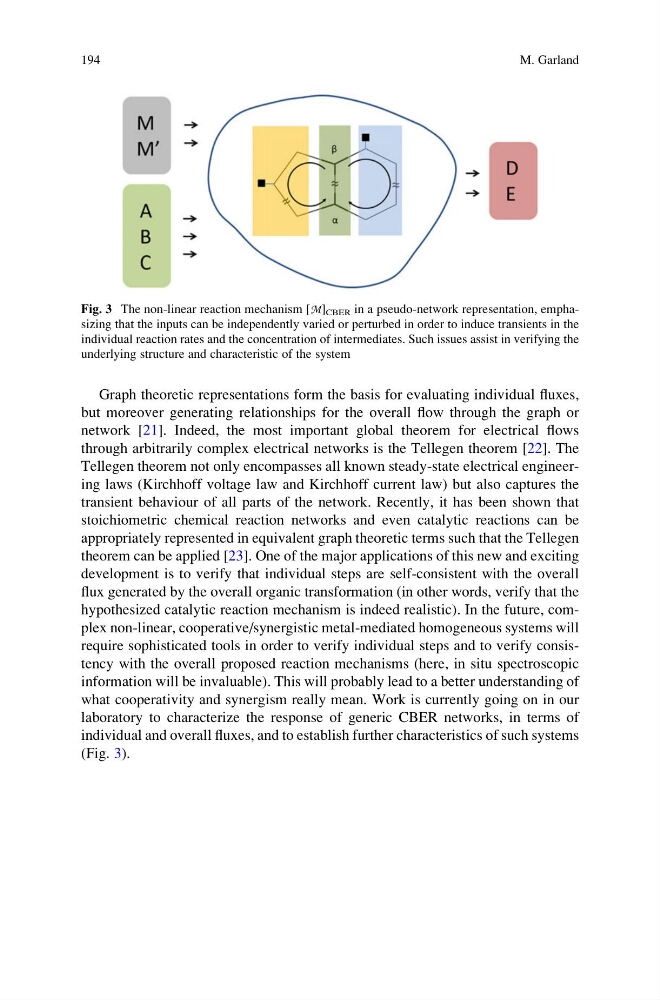
(Fig. 3).
Fig. 3 The non-linear reaction mechanism [M] CBER in a pseudo-network representation, emphasizing that the inputs can be independently varied or perturbed in order to induce transients in the
individual reaction rates and the concentration of intermediates. Such issues assist in verifying the
underlying structure and characteristic of the system
194
M. Garland
but moreover generating relationships for the overall flow through the graph or
network [21]. Indeed, the most important global theorem for electrical flows
through arbitrarily complex electrical networks is the Tellegen theorem [22]. The
Tellegen theorem not only encompasses all known steady-state electrical engineering laws (Kirchhoff voltage law and Kirchhoff current law) but also captures the
transient behaviour of all parts of the network. Recently, it has been shown that
stoichiometric chemical reaction networks and even catalytic reactions can be
appropriately represented in equivalent graph theoretic terms such that the Tellegen
theorem can be applied [23]. One of the major applications of this new and exciting
development is to verify that individual steps are self-consistent with the overall
flux generated by the overall organic transformation (in other words, verify that the
hypothesized catalytic reaction mechanism is indeed realistic). In the future, complex non-linear, cooperative/synergistic metal-mediated homogeneous systems will
require sophisticated tools in order to verify individual steps and to verify consistency with the overall proposed reaction mechanisms (here, in situ spectroscopic
information will be invaluable). This will probably lead to a better understanding of
what cooperativity and synergism really mean. Work is currently going on in our
laboratory to characterize the response of generic CBER networks, in terms of
individual and overall fluxes, and to establish further characteristics of such systems
(Fig. 3).
Fig. 3 The non-linear reaction mechanism [M] CBER in a pseudo-network representation, emphasizing that the inputs can be independently varied or perturbed in order to induce transients in the
individual reaction rates and the concentration of intermediates. Such issues assist in verifying the
underlying structure and characteristic of the system
194
M. Garland