

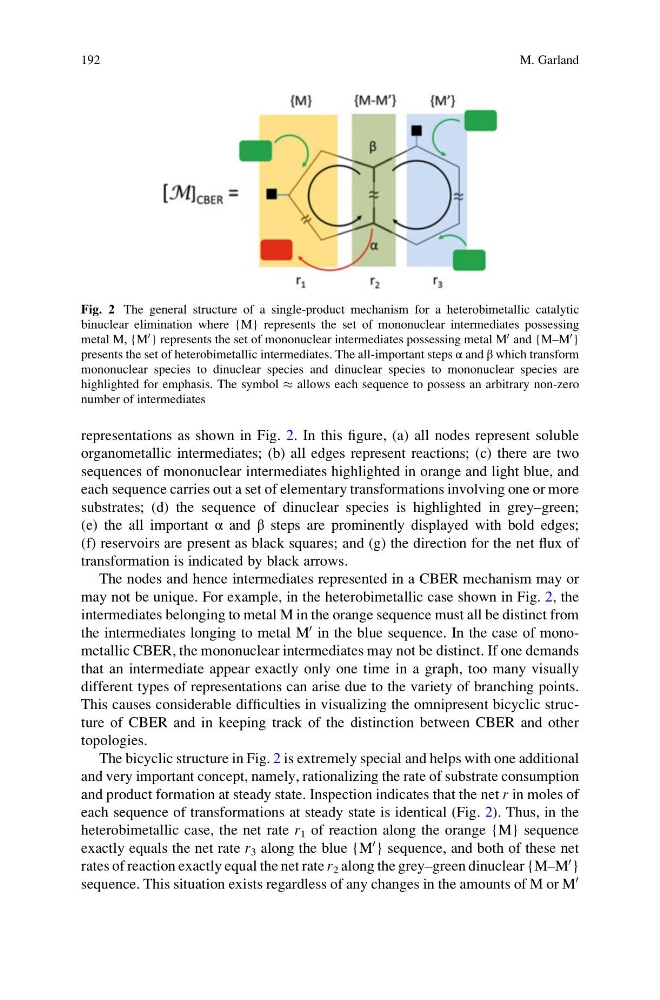
representations as shown in Fig. 2. In this figure, (a) all nodes represent soluble
organometallic intermediates; (b) all edges represent reactions; (c) there are two
sequences of mononuclear intermediates highlighted in orange and light blue, and
each sequence carries out a set of elementary transformations involving one or more
substrates; (d) the sequence of dinuclear species is highlighted in grey–green;
(e) the all important α and β steps are prominently displayed with bold edges;
(f) reservoirs are present as black squares; and (g) the direction for the net flux of
transformation is indicated by black arrows.
The nodes and hence intermediates represented in a CBER mechanism may or
may not be unique. For example, in the heterobimetallic case shown in Fig. 2, the
intermediates belonging to metal M in the orange sequence must all be distinct from
the intermediates longing to metal M
0 in the blue sequence. In the case of monometallic CBER, the mononuclear intermediates may not be distinct. If one demands
that an intermediate appear exactly only one time in a graph, too many visually
different types of representations can arise due to the variety of branching points.
This causes considerable difficulties in visualizing the omnipresent bicyclic structure of CBER and in keeping track of the distinction between CBER and other
topologies.
The bicyclic structure in Fig. 2 is extremely special and helps with one additional
and very important concept, namely, rationalizing the rate of substrate consumption
and product formation at steady state. Inspection indicates that the net r in moles of
each sequence of transformations at steady state is identical (Fig. 2). Thus, in the
heterobimetallic case, the net rate r 1 of reaction along the orange {M} sequence
exactly equals the net rate r 3 along the blue {M
0 } sequence, and both of these net
rates of reaction exactly equal the net rate r 2 along the grey–green dinuclear {M–M
0 }
sequence. This situation exists regardless of any changes in the amounts of M or M
0
Fig. 2 The general structure of a single-product mechanism for a heterobimetallic catalytic
binuclear elimination where {M} represents the set of mononuclear intermediates possessing
metal M, {M
0 } represents the set of mononuclear intermediates possessing metal M
0 and {M–M
0 }
presents the set of heterobimetallic intermediates. The all-important steps α and β which transform
mononuclear species to dinuclear species and dinuclear species to mononuclear species are
highlighted for emphasis. The symbol % allows each sequence to possess an arbitrary non-zero
number of intermediates
192
M. Garland
organometallic intermediates; (b) all edges represent reactions; (c) there are two
sequences of mononuclear intermediates highlighted in orange and light blue, and
each sequence carries out a set of elementary transformations involving one or more
substrates; (d) the sequence of dinuclear species is highlighted in grey–green;
(e) the all important α and β steps are prominently displayed with bold edges;
(f) reservoirs are present as black squares; and (g) the direction for the net flux of
transformation is indicated by black arrows.
The nodes and hence intermediates represented in a CBER mechanism may or
may not be unique. For example, in the heterobimetallic case shown in Fig. 2, the
intermediates belonging to metal M in the orange sequence must all be distinct from
the intermediates longing to metal M
0 in the blue sequence. In the case of monometallic CBER, the mononuclear intermediates may not be distinct. If one demands
that an intermediate appear exactly only one time in a graph, too many visually
different types of representations can arise due to the variety of branching points.
This causes considerable difficulties in visualizing the omnipresent bicyclic structure of CBER and in keeping track of the distinction between CBER and other
topologies.
The bicyclic structure in Fig. 2 is extremely special and helps with one additional
and very important concept, namely, rationalizing the rate of substrate consumption
and product formation at steady state. Inspection indicates that the net r in moles of
each sequence of transformations at steady state is identical (Fig. 2). Thus, in the
heterobimetallic case, the net rate r 1 of reaction along the orange {M} sequence
exactly equals the net rate r 3 along the blue {M
0 } sequence, and both of these net
rates of reaction exactly equal the net rate r 2 along the grey–green dinuclear {M–M
0 }
sequence. This situation exists regardless of any changes in the amounts of M or M
0
Fig. 2 The general structure of a single-product mechanism for a heterobimetallic catalytic
binuclear elimination where {M} represents the set of mononuclear intermediates possessing
metal M, {M
0 } represents the set of mononuclear intermediates possessing metal M
0 and {M–M
0 }
presents the set of heterobimetallic intermediates. The all-important steps α and β which transform
mononuclear species to dinuclear species and dinuclear species to mononuclear species are
highlighted for emphasis. The symbol % allows each sequence to possess an arbitrary non-zero
number of intermediates
192
M. Garland