

immediately apparent at which step the bimolecular reaction really takes place. The
genuine elementary α step might be the reaction of HCo(CO) 4 with coordinately
unsaturated CH 3 COCo(CO) 3 :
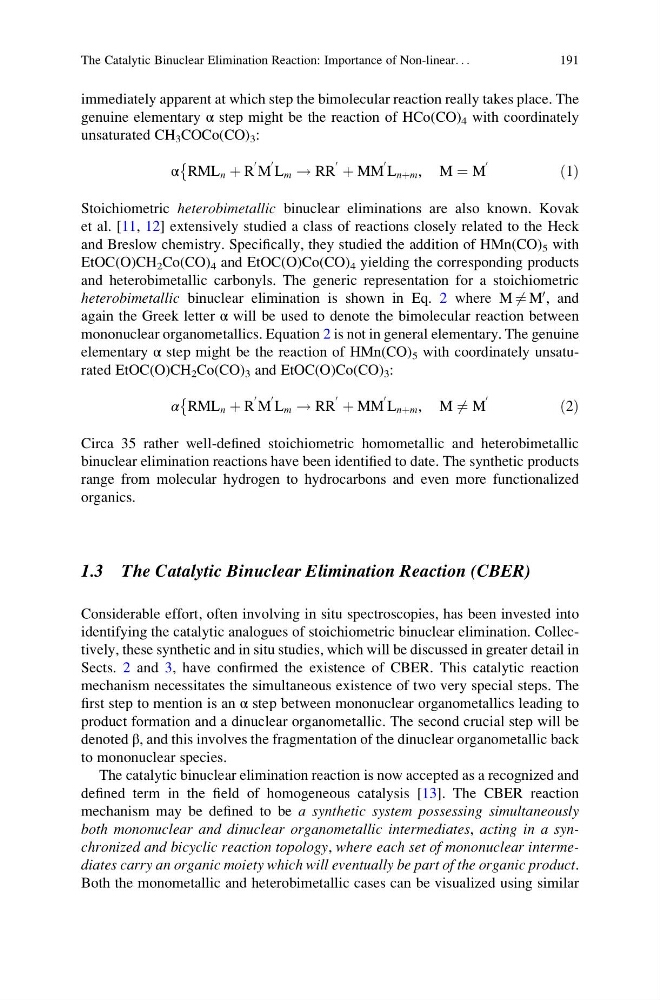
α
È
RML n þ R
0 M
0 L m ! RR
0 þ MM
0 L nþm , M ¼ M
0
ð1Þ
Stoichiometric heterobimetallic binuclear eliminations are also known. Kovak
et al. [11, 12] extensively studied a class of reactions closely related to the Heck
and Breslow chemistry. Specifically, they studied the addition of HMn(CO) 5 with
EtOC(O)CH 2 Co(CO) 4 and EtOC(O)Co(CO) 4 yielding the corresponding products
and heterobimetallic carbonyls. The generic representation for a stoichiometric
heterobimetallic binuclear elimination is shown in Eq. 2 where M 6 ¼ M
0 , and
again the Greek letter α will be used to denote the bimolecular reaction between
mononuclear organometallics. Equation 2 is not in general elementary. The genuine
elementary α step might be the reaction of HMn(CO) 5 with coordinately unsaturated EtOC(O)CH 2 Co(CO) 3 and EtOC(O)Co(CO) 3 :
α
È
RML n þ R
0 M
0 L m ! RR
0 þ MM
0 L nþm , M 6 ¼ M
0
ð2Þ
Circa 35 rather well-defined stoichiometric homometallic and heterobimetallic
binuclear elimination reactions have been identified to date. The synthetic products
range from molecular hydrogen to hydrocarbons and even more functionalized
organics.
1.3 The Catalytic Binuclear Elimination Reaction (CBER)
Considerable effort, often involving in situ spectroscopies, has been invested into
identifying the catalytic analogues of stoichiometric binuclear elimination. Collectively, these synthetic and in situ studies, which will be discussed in greater detail in
Sects. 2 and 3, have confirmed the existence of CBER. This catalytic reaction
mechanism necessitates the simultaneous existence of two very special steps. The
first step to mention is an α step between mononuclear organometallics leading to
product formation and a dinuclear organometallic. The second crucial step will be
denoted β, and this involves the fragmentation of the dinuclear organometallic back
to mononuclear species.
The catalytic binuclear elimination reaction is now accepted as a recognized and
defined term in the field of homogeneous catalysis [13]. The CBER reaction
mechanism may be defined to be a synthetic system possessing simultaneously
both mononuclear and dinuclear organometallic intermediates, acting in a synchronized and bicyclic reaction topology, where each set of mononuclear intermediates carry an organic moiety which will eventually be part of the organic product.
Both the monometallic and heterobimetallic cases can be visualized using similar
The Catalytic Binuclear Elimination Reaction: Importance of Non-linear. . .
191
genuine elementary α step might be the reaction of HCo(CO) 4 with coordinately
unsaturated CH 3 COCo(CO) 3 :
α
È
RML n þ R
0 M
0 L m ! RR
0 þ MM
0 L nþm , M ¼ M
0
ð1Þ
Stoichiometric heterobimetallic binuclear eliminations are also known. Kovak
et al. [11, 12] extensively studied a class of reactions closely related to the Heck
and Breslow chemistry. Specifically, they studied the addition of HMn(CO) 5 with
EtOC(O)CH 2 Co(CO) 4 and EtOC(O)Co(CO) 4 yielding the corresponding products
and heterobimetallic carbonyls. The generic representation for a stoichiometric
heterobimetallic binuclear elimination is shown in Eq. 2 where M 6 ¼ M
0 , and
again the Greek letter α will be used to denote the bimolecular reaction between
mononuclear organometallics. Equation 2 is not in general elementary. The genuine
elementary α step might be the reaction of HMn(CO) 5 with coordinately unsaturated EtOC(O)CH 2 Co(CO) 3 and EtOC(O)Co(CO) 3 :
α
È
RML n þ R
0 M
0 L m ! RR
0 þ MM
0 L nþm , M 6 ¼ M
0
ð2Þ
Circa 35 rather well-defined stoichiometric homometallic and heterobimetallic
binuclear elimination reactions have been identified to date. The synthetic products
range from molecular hydrogen to hydrocarbons and even more functionalized
organics.
1.3 The Catalytic Binuclear Elimination Reaction (CBER)
Considerable effort, often involving in situ spectroscopies, has been invested into
identifying the catalytic analogues of stoichiometric binuclear elimination. Collectively, these synthetic and in situ studies, which will be discussed in greater detail in
Sects. 2 and 3, have confirmed the existence of CBER. This catalytic reaction
mechanism necessitates the simultaneous existence of two very special steps. The
first step to mention is an α step between mononuclear organometallics leading to
product formation and a dinuclear organometallic. The second crucial step will be
denoted β, and this involves the fragmentation of the dinuclear organometallic back
to mononuclear species.
The catalytic binuclear elimination reaction is now accepted as a recognized and
defined term in the field of homogeneous catalysis [13]. The CBER reaction
mechanism may be defined to be a synthetic system possessing simultaneously
both mononuclear and dinuclear organometallic intermediates, acting in a synchronized and bicyclic reaction topology, where each set of mononuclear intermediates carry an organic moiety which will eventually be part of the organic product.
Both the monometallic and heterobimetallic cases can be visualized using similar
The Catalytic Binuclear Elimination Reaction: Importance of Non-linear. . .
191