

The role of the second metal may be not to interact directly with the substrates
but rather to stabilize or restore the oxidation state of the active metal species.
That’s the case in the well-known Wacker process, in which PdCl 2 promotes
catalytic oxidation of ethylene and cupric chloride with oxygen is used for
reoxidizing the produced Pd(0) species and maintaining the catalytic cycle of the
oxidation [70, 71]. The number of catalyst combinations and of way of cooperating
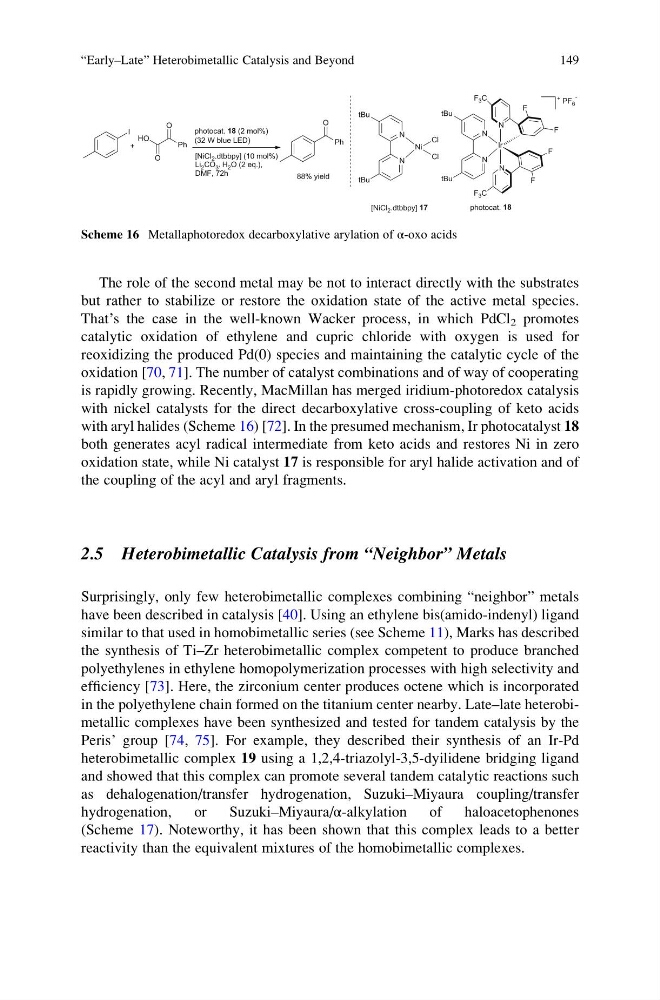
is rapidly growing. Recently, MacMillan has merged iridium-photoredox catalysis
with nickel catalysts for the direct decarboxylative cross-coupling of keto acids
with aryl halides (Scheme 16) [72]. In the presumed mechanism, Ir photocatalyst 18
both generates acyl radical intermediate from keto acids and restores Ni in zero
oxidation state, while Ni catalyst 17 is responsible for aryl halide activation and of
the coupling of the acyl and aryl fragments.
2.5 Heterobimetallic Catalysis from “Neighbor” Metals
Surprisingly, only few heterobimetallic complexes combining “neighbor” metals
have been described in catalysis [40]. Using an ethylene bis(amido-indenyl) ligand
similar to that used in homobimetallic series (see Scheme 11), Marks has described
the synthesis of Ti–Zr heterobimetallic complex competent to produce branched
polyethylenes in ethylene homopolymerization processes with high selectivity and
efficiency [73]. Here, the zirconium center produces octene which is incorporated
in the polyethylene chain formed on the titanium center nearby. Late–late heterobimetallic complexes have been synthesized and tested for tandem catalysis by the
Peris’ group [74, 75]. For example, they described their synthesis of an Ir-Pd
heterobimetallic complex 19 using a 1,2,4-triazolyl-3,5-dyilidene bridging ligand
and showed that this complex can promote several tandem catalytic reactions such
as dehalogenation/transfer hydrogenation, Suzuki–Miyaura coupling/transfer
hydrogenation,
or
Suzuki–Miyaura/α-alkylation
of
haloacetophenones
(Scheme 17). Noteworthy, it has been shown that this complex leads to a better
reactivity than the equivalent mixtures of the homobimetallic complexes.
I
+
Ph
HO
O
O
photocat. 18 (2 mol%)
(32 W blue LED)
[NiCl 2 .dtbbpy] (10 mol%)
Li 2 CO 3 , H 2 O (2 eq.),
DMF, 72h
Ph
O
N
N
tBu
tBu
Ni
Cl
Cl
N
N
tBu
tBu
Ir
N
F
F
N
F 3 C
F 3 C
F
F
+ PF 6
-
88% yield
photocat. 18
[NiCl 2 .dtbbpy] 17
Scheme 16 Metallaphotoredox decarboxylative arylation of α-oxo acids
“Early–Late” Heterobimetallic Catalysis and Beyond
149
but rather to stabilize or restore the oxidation state of the active metal species.
That’s the case in the well-known Wacker process, in which PdCl 2 promotes
catalytic oxidation of ethylene and cupric chloride with oxygen is used for
reoxidizing the produced Pd(0) species and maintaining the catalytic cycle of the
oxidation [70, 71]. The number of catalyst combinations and of way of cooperating
is rapidly growing. Recently, MacMillan has merged iridium-photoredox catalysis
with nickel catalysts for the direct decarboxylative cross-coupling of keto acids
with aryl halides (Scheme 16) [72]. In the presumed mechanism, Ir photocatalyst 18
both generates acyl radical intermediate from keto acids and restores Ni in zero
oxidation state, while Ni catalyst 17 is responsible for aryl halide activation and of
the coupling of the acyl and aryl fragments.
2.5 Heterobimetallic Catalysis from “Neighbor” Metals
Surprisingly, only few heterobimetallic complexes combining “neighbor” metals
have been described in catalysis [40]. Using an ethylene bis(amido-indenyl) ligand
similar to that used in homobimetallic series (see Scheme 11), Marks has described
the synthesis of Ti–Zr heterobimetallic complex competent to produce branched
polyethylenes in ethylene homopolymerization processes with high selectivity and
efficiency [73]. Here, the zirconium center produces octene which is incorporated
in the polyethylene chain formed on the titanium center nearby. Late–late heterobimetallic complexes have been synthesized and tested for tandem catalysis by the
Peris’ group [74, 75]. For example, they described their synthesis of an Ir-Pd
heterobimetallic complex 19 using a 1,2,4-triazolyl-3,5-dyilidene bridging ligand
and showed that this complex can promote several tandem catalytic reactions such
as dehalogenation/transfer hydrogenation, Suzuki–Miyaura coupling/transfer
hydrogenation,
or
Suzuki–Miyaura/α-alkylation
of
haloacetophenones
(Scheme 17). Noteworthy, it has been shown that this complex leads to a better
reactivity than the equivalent mixtures of the homobimetallic complexes.
I
+
Ph
HO
O
O
photocat. 18 (2 mol%)
(32 W blue LED)
[NiCl 2 .dtbbpy] (10 mol%)
Li 2 CO 3 , H 2 O (2 eq.),
DMF, 72h
Ph
O
N
N
tBu
tBu
Ni
Cl
Cl
N
N
tBu
tBu
Ir
N
F
F
N
F 3 C
F 3 C
F
F
+ PF 6
-
88% yield
photocat. 18
[NiCl 2 .dtbbpy] 17
Scheme 16 Metallaphotoredox decarboxylative arylation of α-oxo acids
“Early–Late” Heterobimetallic Catalysis and Beyond
149