

1 Introduction: Hydroformylation and Polymetallic
Cooperativity
Hydroformylation is the process for reacting alkenes, typically 1-alkenes, with H 2
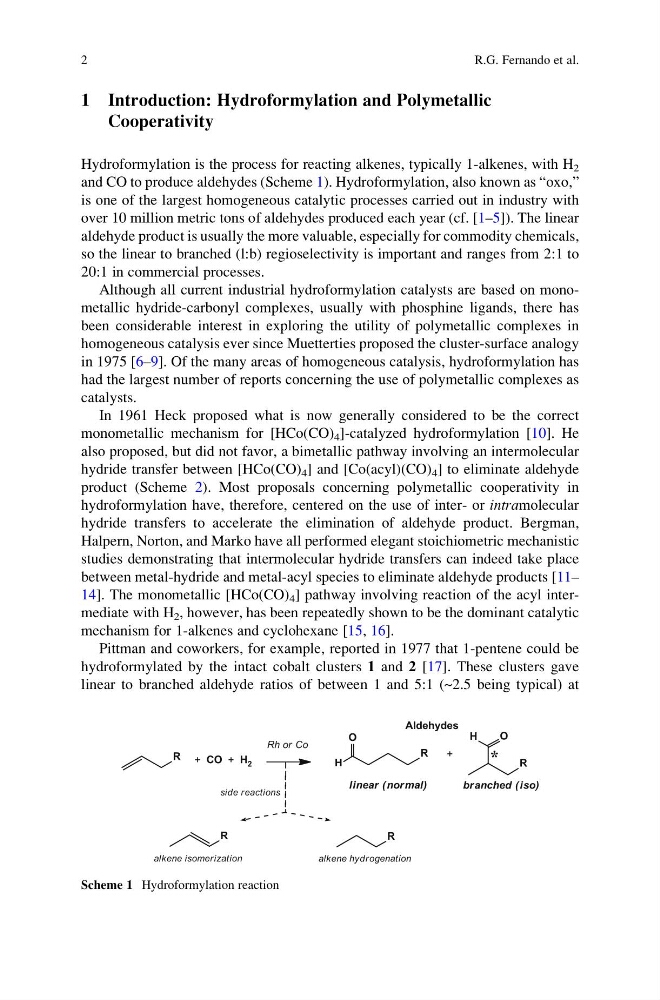
and CO to produce aldehydes (Scheme 1). Hydroformylation, also known as “oxo,”
is one of the largest homogeneous catalytic processes carried out in industry with
over 10 million metric tons of aldehydes produced each year (cf. [1–5]). The linear
aldehyde product is usually the more valuable, especially for commodity chemicals,
so the linear to branched (l:b) regioselectivity is important and ranges from 2:1 to
20:1 in commercial processes.
Although all current industrial hydroformylation catalysts are based on monometallic hydride-carbonyl complexes, usually with phosphine ligands, there has
been considerable interest in exploring the utility of polymetallic complexes in
homogeneous catalysis ever since Muetterties proposed the cluster-surface analogy
in 1975 [6–9]. Of the many areas of homogeneous catalysis, hydroformylation has
had the largest number of reports concerning the use of polymetallic complexes as
catalysts.
In 1961 Heck proposed what is now generally considered to be the correct
monometallic mechanism for [HCo(CO) 4 ]-catalyzed hydroformylation [10]. He
also proposed, but did not favor, a bimetallic pathway involving an intermolecular
hydride transfer between [HCo(CO) 4 ] and [Co(acyl)(CO) 4 ] to eliminate aldehyde
product (Scheme 2). Most proposals concerning polymetallic cooperativity in
hydroformylation have, therefore, centered on the use of inter- or intramolecular
hydride transfers to accelerate the elimination of aldehyde product. Bergman,
Halpern, Norton, and Marko have all performed elegant stoichiometric mechanistic
studies demonstrating that intermolecular hydride transfers can indeed take place
between metal-hydride and metal-acyl species to eliminate aldehyde products [11–
14]. The monometallic [HCo(CO) 4 ] pathway involving reaction of the acyl intermediate with H 2 , however, has been repeatedly shown to be the dominant catalytic
mechanism for 1-alkenes and cyclohexane [15, 16].
Pittman and coworkers, for example, reported in 1977 that 1-pentene could be
hydroformylated by the intact cobalt clusters 1 and 2 [17]. These clusters gave
linear to branched aldehyde ratios of between 1 and 5:1 (~2.5 being typical) at
+ CO + H 2
H
O
+
O
H
linear ( normal)
branched ( iso)
Rh or Co
R
R
R
Aldehydes
R
alkene isomerization
alkene hydrogenation
R
side reactions
*
Scheme 1 Hydroformylation reaction
2
R.G. Fernando et al.
Cooperativity
Hydroformylation is the process for reacting alkenes, typically 1-alkenes, with H 2
and CO to produce aldehydes (Scheme 1). Hydroformylation, also known as “oxo,”
is one of the largest homogeneous catalytic processes carried out in industry with
over 10 million metric tons of aldehydes produced each year (cf. [1–5]). The linear
aldehyde product is usually the more valuable, especially for commodity chemicals,
so the linear to branched (l:b) regioselectivity is important and ranges from 2:1 to
20:1 in commercial processes.
Although all current industrial hydroformylation catalysts are based on monometallic hydride-carbonyl complexes, usually with phosphine ligands, there has
been considerable interest in exploring the utility of polymetallic complexes in
homogeneous catalysis ever since Muetterties proposed the cluster-surface analogy
in 1975 [6–9]. Of the many areas of homogeneous catalysis, hydroformylation has
had the largest number of reports concerning the use of polymetallic complexes as
catalysts.
In 1961 Heck proposed what is now generally considered to be the correct
monometallic mechanism for [HCo(CO) 4 ]-catalyzed hydroformylation [10]. He
also proposed, but did not favor, a bimetallic pathway involving an intermolecular
hydride transfer between [HCo(CO) 4 ] and [Co(acyl)(CO) 4 ] to eliminate aldehyde
product (Scheme 2). Most proposals concerning polymetallic cooperativity in
hydroformylation have, therefore, centered on the use of inter- or intramolecular
hydride transfers to accelerate the elimination of aldehyde product. Bergman,
Halpern, Norton, and Marko have all performed elegant stoichiometric mechanistic
studies demonstrating that intermolecular hydride transfers can indeed take place
between metal-hydride and metal-acyl species to eliminate aldehyde products [11–
14]. The monometallic [HCo(CO) 4 ] pathway involving reaction of the acyl intermediate with H 2 , however, has been repeatedly shown to be the dominant catalytic
mechanism for 1-alkenes and cyclohexane [15, 16].
Pittman and coworkers, for example, reported in 1977 that 1-pentene could be
hydroformylated by the intact cobalt clusters 1 and 2 [17]. These clusters gave
linear to branched aldehyde ratios of between 1 and 5:1 (~2.5 being typical) at
+ CO + H 2
H
O
+
O
H
linear ( normal)
branched ( iso)
Rh or Co
R
R
R
Aldehydes
R
alkene isomerization
alkene hydrogenation
R
side reactions
*
Scheme 1 Hydroformylation reaction
2
R.G. Fernando et al.