

stark contrast to the excellent bimetallic rate enhancements obtained with 46 and
highlights how small changes in catalyst structure can greatly impact the degree of
bimetallic synergism that is obtained.
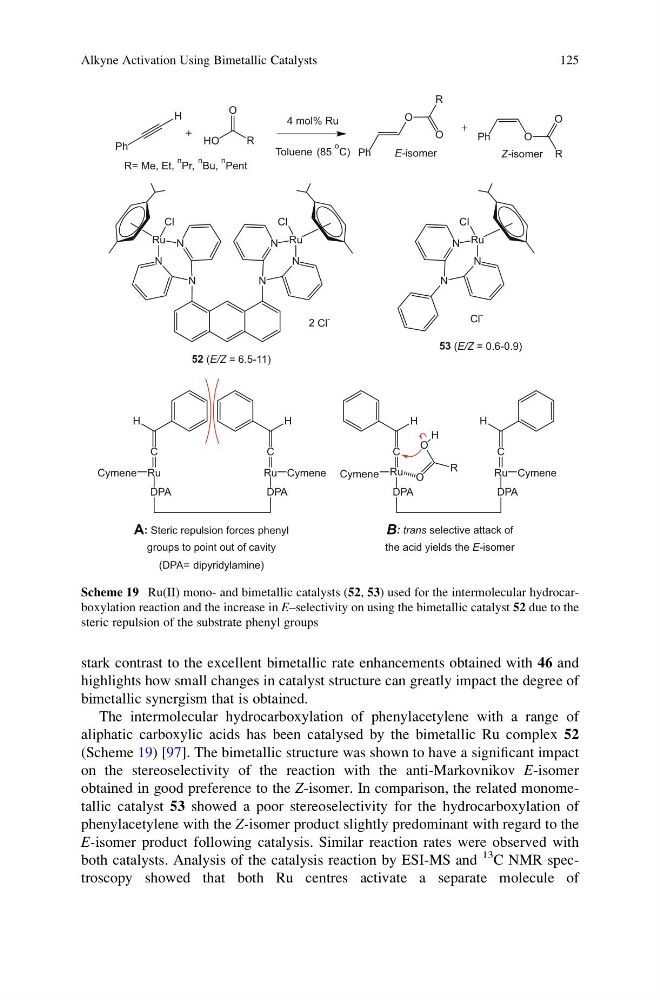
The intermolecular hydrocarboxylation of phenylacetylene with a range of
aliphatic carboxylic acids has been catalysed by the bimetallic Ru complex 52
(Scheme 19) [97]. The bimetallic structure was shown to have a significant impact
on the stereoselectivity of the reaction with the anti-Markovnikov E-isomer
obtained in good preference to the Z-isomer. In comparison, the related monometallic catalyst 53 showed a poor stereoselectivity for the hydrocarboxylation of
phenylacetylene with the Z-isomer product slightly predominant with regard to the
E-isomer product following catalysis. Similar reaction rates were observed with
both catalysts. Analysis of the catalysis reaction by ESI-MS and
13 C NMR spectroscopy showed that both Ru centres activate a separate molecule of
Ph
H
R
HO
O
52 (E/Z = 6.5-11)
+
Ph
O
R
O
Ph
O
R
O
+
E-isomer
Z-isomer
R= Me, Et,
n Pr,
n Bu,
n
Pent
N
N
N Ru
Cl
N
N
N
Ru
Cl
N
N
N Ru
Cl
2 Cl
-
Cl
-
53 (E/Z = 0.6-0.9)
DPA
DPA
Ru
Ru
Cymene
C
C
Cymene
H
H
DPA
DPA
Ru
Ru
Cymene
C
C
Cymene
H
H
O
O
R
H
A: Steric repulsion forces phenyl
groups to point out of cavity
(DPA= dipyridylamine)
B: trans selective attack of
the acid yields the E-isomer
4 mol% Ru
Toluene (85
o
C)
Scheme 19 Ru(II) mono- and bimetallic catalysts (52, 53) used for the intermolecular hydrocarboxylation reaction and the increase in E–selectivity on using the bimetallic catalyst 52 due to the
steric repulsion of the substrate phenyl groups
Alkyne Activation Using Bimetallic Catalysts
125
highlights how small changes in catalyst structure can greatly impact the degree of
bimetallic synergism that is obtained.
The intermolecular hydrocarboxylation of phenylacetylene with a range of
aliphatic carboxylic acids has been catalysed by the bimetallic Ru complex 52
(Scheme 19) [97]. The bimetallic structure was shown to have a significant impact
on the stereoselectivity of the reaction with the anti-Markovnikov E-isomer
obtained in good preference to the Z-isomer. In comparison, the related monometallic catalyst 53 showed a poor stereoselectivity for the hydrocarboxylation of
phenylacetylene with the Z-isomer product slightly predominant with regard to the
E-isomer product following catalysis. Similar reaction rates were observed with
both catalysts. Analysis of the catalysis reaction by ESI-MS and
13 C NMR spectroscopy showed that both Ru centres activate a separate molecule of
Ph
H
R
HO
O
52 (E/Z = 6.5-11)
+
Ph
O
R
O
Ph
O
R
O
+
E-isomer
Z-isomer
R= Me, Et,
n Pr,
n Bu,
n
Pent
N
N
N Ru
Cl
N
N
N
Ru
Cl
N
N
N Ru
Cl
2 Cl
-
Cl
-
53 (E/Z = 0.6-0.9)
DPA
DPA
Ru
Ru
Cymene
C
C
Cymene
H
H
DPA
DPA
Ru
Ru
Cymene
C
C
Cymene
H
H
O
O
R
H
A: Steric repulsion forces phenyl
groups to point out of cavity
(DPA= dipyridylamine)
B: trans selective attack of
the acid yields the E-isomer
4 mol% Ru
Toluene (85
o
C)
Scheme 19 Ru(II) mono- and bimetallic catalysts (52, 53) used for the intermolecular hydrocarboxylation reaction and the increase in E–selectivity on using the bimetallic catalyst 52 due to the
steric repulsion of the substrate phenyl groups
Alkyne Activation Using Bimetallic Catalysts
125