

5.3 Hydrocarboxylation of Alkynes
The hydrocarboxylation of alkynes involves the addition of a carboxylic acid group
across the C C triple bond to yield an enol ester group. While it is superficially
similar to the hydroalkoxylation reaction, in that both reactions involve the addition
of an O–H bond to the alkyne, the catalysed reaction mechanisms of hydrocarboxylation and hydroalkoxylation can differ substantially [92–94]. The intramolecular hydrocarboxylation also provides access to oxygen heterocycles such as
lactones, which are commonly found in flavour and fragrance molecules [95]. To
expand on the chemistry of the highly effective bimetallic dihydroalkoxylation
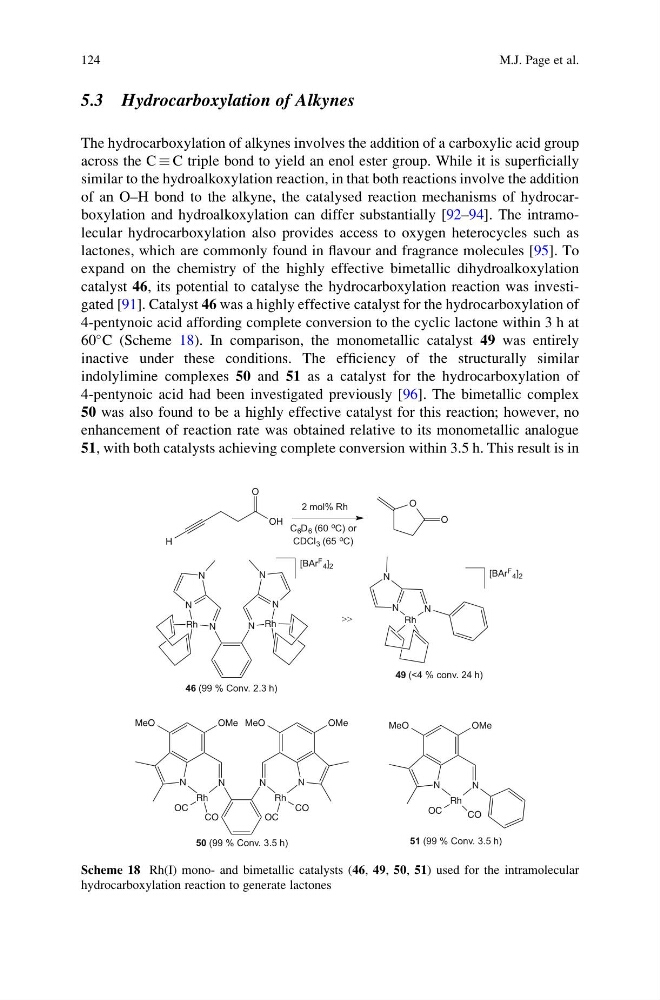
catalyst 46, its potential to catalyse the hydrocarboxylation reaction was investigated [91]. Catalyst 46 was a highly effective catalyst for the hydrocarboxylation of
4-pentynoic acid affording complete conversion to the cyclic lactone within 3 h at
60
C (Scheme 18). In comparison, the monometallic catalyst 49 was entirely
inactive under these conditions. The efficiency of the structurally similar
indolylimine complexes 50 and 51 as a catalyst for the hydrocarboxylation of
4-pentynoic acid had been investigated previously [96]. The bimetallic complex
50 was also found to be a highly effective catalyst for this reaction; however, no
enhancement of reaction rate was obtained relative to its monometallic analogue
51, with both catalysts achieving complete conversion within 3.5 h. This result is in
H
OH
2 mol% Rh
C 6 D 6 (60 o C) or
CDCl 3 (65 o C)
[BAr F
4 ] 2
46 (99 % Conv. 2.3 h)
N Rh
N
N
N
Rh
N
N
O
O
O
>>
N
Rh
N
N
49 (<4 % conv. 24 h)
[BAr F
4 ] 2
N
N
MeO
OMe
Rh
OC
CO
N
N
OMe
MeO
Rh
CO
OC
N
N
MeO
OMe
Rh
OC
CO
50 (99 % Conv. 3.5 h)
51 (99 % Conv. 3.5 h)
Scheme 18 Rh(I) mono- and bimetallic catalysts (46, 49, 50, 51) used for the intramolecular
hydrocarboxylation reaction to generate lactones
124
M.J. Page et al.
The hydrocarboxylation of alkynes involves the addition of a carboxylic acid group
across the C C triple bond to yield an enol ester group. While it is superficially
similar to the hydroalkoxylation reaction, in that both reactions involve the addition
of an O–H bond to the alkyne, the catalysed reaction mechanisms of hydrocarboxylation and hydroalkoxylation can differ substantially [92–94]. The intramolecular hydrocarboxylation also provides access to oxygen heterocycles such as
lactones, which are commonly found in flavour and fragrance molecules [95]. To
expand on the chemistry of the highly effective bimetallic dihydroalkoxylation
catalyst 46, its potential to catalyse the hydrocarboxylation reaction was investigated [91]. Catalyst 46 was a highly effective catalyst for the hydrocarboxylation of
4-pentynoic acid affording complete conversion to the cyclic lactone within 3 h at
60
C (Scheme 18). In comparison, the monometallic catalyst 49 was entirely
inactive under these conditions. The efficiency of the structurally similar
indolylimine complexes 50 and 51 as a catalyst for the hydrocarboxylation of
4-pentynoic acid had been investigated previously [96]. The bimetallic complex
50 was also found to be a highly effective catalyst for this reaction; however, no
enhancement of reaction rate was obtained relative to its monometallic analogue
51, with both catalysts achieving complete conversion within 3.5 h. This result is in
H
OH
2 mol% Rh
C 6 D 6 (60 o C) or
CDCl 3 (65 o C)
[BAr F
4 ] 2
46 (99 % Conv. 2.3 h)
N Rh
N
N
N
Rh
N
N
O
O
O
>>
N
Rh
N
N
49 (<4 % conv. 24 h)
[BAr F
4 ] 2
N
N
MeO
OMe
Rh
OC
CO
N
N
OMe
MeO
Rh
CO
OC
N
N
MeO
OMe
Rh
OC
CO
50 (99 % Conv. 3.5 h)
51 (99 % Conv. 3.5 h)
Scheme 18 Rh(I) mono- and bimetallic catalysts (46, 49, 50, 51) used for the intramolecular
hydrocarboxylation reaction to generate lactones
124
M.J. Page et al.