

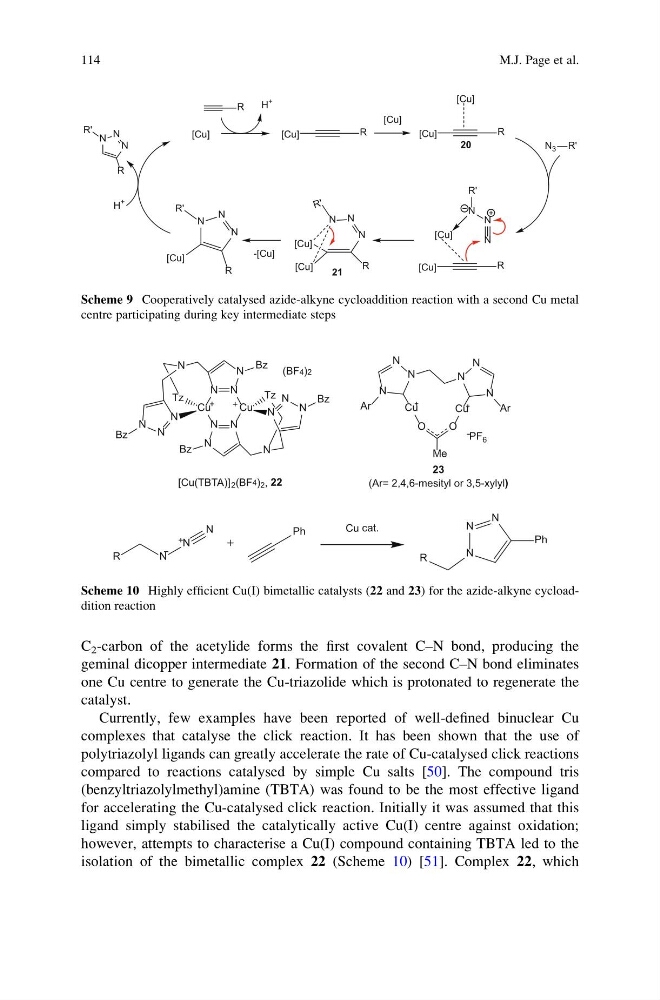
C 2 -carbon of the acetylide forms the first covalent C–N bond, producing the
geminal dicopper intermediate 21. Formation of the second C–N bond eliminates
one Cu centre to generate the Cu-triazolide which is protonated to regenerate the
catalyst.
Currently, few examples have been reported of well-defined binuclear Cu
complexes that catalyse the click reaction. It has been shown that the use of
polytriazolyl ligands can greatly accelerate the rate of Cu-catalysed click reactions
compared to reactions catalysed by simple Cu salts [50]. The compound tris
(benzyltriazolylmethyl)amine (TBTA) was found to be the most effective ligand
for accelerating the Cu-catalysed click reaction. Initially it was assumed that this
ligand simply stabilised the catalytically active Cu(I) centre against oxidation;
however, attempts to characterise a Cu(I) compound containing TBTA led to the
isolation of the bimetallic complex 22 (Scheme 10) [51]. Complex 22, which
[Cu]
[Cu]
R
[Cu]
R
[Cu]
[Cu]
R
[Cu]
N
N
N
R'
[Cu]
R
[Cu]
N
N
N
R '
N
N
N
R
R'
[Cu]
R
H
+
[Cu]
N 3 R'
H
+
N
N
N
R
R'
20
21
-[Cu]
Scheme 9 Cooperatively catalysed azide-alkyne cycloaddition reaction with a second Cu metal
centre participating during key intermediate steps
Tz
N
N
N
Bz
N
N
N
Bz
Cu
N
N
Cu
N
Bz
N
N
Tz
N
N
N
Bz
[Cu(TBTA)] 2 (BF4) 2 , 22
(BF4)2
Cu
Cu
N
N
N
N
N
N
Ar
Ar
PF 6
O
O
Me
23
(Ar= 2,4,6-mesityl or 3,5-xylyl)
N
N
N
R
Ph
N
N
N
Ph
R
Cu cat.
+
Scheme 10 Highly efficient Cu(I) bimetallic catalysts (22 and 23) for the azide-alkyne cycloaddition reaction
114
M.J. Page et al.
geminal dicopper intermediate 21. Formation of the second C–N bond eliminates
one Cu centre to generate the Cu-triazolide which is protonated to regenerate the
catalyst.
Currently, few examples have been reported of well-defined binuclear Cu
complexes that catalyse the click reaction. It has been shown that the use of
polytriazolyl ligands can greatly accelerate the rate of Cu-catalysed click reactions
compared to reactions catalysed by simple Cu salts [50]. The compound tris
(benzyltriazolylmethyl)amine (TBTA) was found to be the most effective ligand
for accelerating the Cu-catalysed click reaction. Initially it was assumed that this
ligand simply stabilised the catalytically active Cu(I) centre against oxidation;
however, attempts to characterise a Cu(I) compound containing TBTA led to the
isolation of the bimetallic complex 22 (Scheme 10) [51]. Complex 22, which
[Cu]
[Cu]
R
[Cu]
R
[Cu]
[Cu]
R
[Cu]
N
N
N
R'
[Cu]
R
[Cu]
N
N
N
R '
N
N
N
R
R'
[Cu]
R
H
+
[Cu]
N 3 R'
H
+
N
N
N
R
R'
20
21
-[Cu]
Scheme 9 Cooperatively catalysed azide-alkyne cycloaddition reaction with a second Cu metal
centre participating during key intermediate steps
Tz
N
N
N
Bz
N
N
N
Bz
Cu
N
N
Cu
N
Bz
N
N
Tz
N
N
N
Bz
[Cu(TBTA)] 2 (BF4) 2 , 22
(BF4)2
Cu
Cu
N
N
N
N
N
N
Ar
Ar
PF 6
O
O
Me
23
(Ar= 2,4,6-mesityl or 3,5-xylyl)
N
N
N
R
Ph
N
N
N
Ph
R
Cu cat.
+
Scheme 10 Highly efficient Cu(I) bimetallic catalysts (22 and 23) for the azide-alkyne cycloaddition reaction
114
M.J. Page et al.