

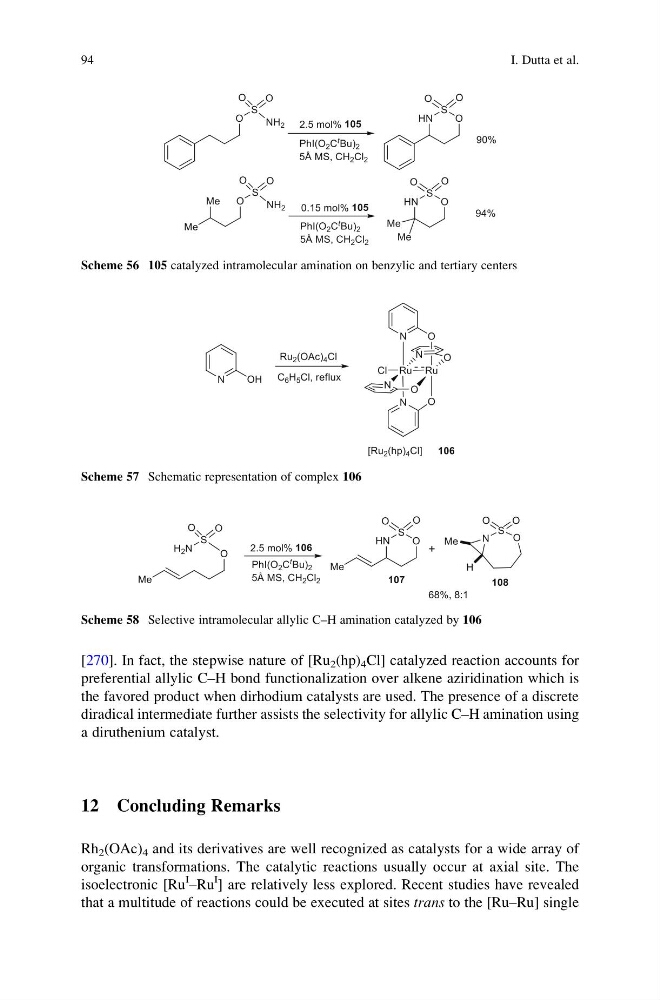
[270]. In fact, the stepwise nature of [Ru 2 (hp) 4 Cl] catalyzed reaction accounts for
preferential allylic C–H bond functionalization over alkene aziridination which is
the favored product when dirhodium catalysts are used. The presence of a discrete
diradical intermediate further assists the selectivity for allylic C–H amination using
a diruthenium catalyst.
12 Concluding Remarks
Rh 2 (OAc) 4 and its derivatives are well recognized as catalysts for a wide array of
organic transformations. The catalytic reactions usually occur at axial site. The
isoelectronic [Ru
I –Ru
I ] are relatively less explored. Recent studies have revealed
that a multitude of reactions could be executed at sites trans to the [Ru–Ru] single
Scheme 56 105 catalyzed intramolecular amination on benzylic and tertiary centers
Scheme 57 Schematic representation of complex 106
Scheme 58 Selective intramolecular allylic C–H amination catalyzed by 106
94
I. Dutta et al.
preferential allylic C–H bond functionalization over alkene aziridination which is
the favored product when dirhodium catalysts are used. The presence of a discrete
diradical intermediate further assists the selectivity for allylic C–H amination using
a diruthenium catalyst.
12 Concluding Remarks
Rh 2 (OAc) 4 and its derivatives are well recognized as catalysts for a wide array of
organic transformations. The catalytic reactions usually occur at axial site. The
isoelectronic [Ru
I –Ru
I ] are relatively less explored. Recent studies have revealed
that a multitude of reactions could be executed at sites trans to the [Ru–Ru] single
Scheme 56 105 catalyzed intramolecular amination on benzylic and tertiary centers
Scheme 57 Schematic representation of complex 106
Scheme 58 Selective intramolecular allylic C–H amination catalyzed by 106
94
I. Dutta et al.