

from nucleophilic attack at the carbenoid carbon. Diruthenium catalysts 2, 3, and 7
exhibit a shift toward vinylogous reactivity affording more than 80% products. It
should be noted here that the yields are lower than the Rh counterparts, but vinylogous reactivity is more pronounced. The diruthenium catalysts gave a 4:1 ratio of
product favoring vinylogous reactivity, whereas Rh-catalyzed reaction under the
same conditions gave exclusively carbenoid reaction products.
The preferential vinylogous reactivity of diruthenium complexes were also
observed for C–C bond-forming reactions. Reaction of methyl vinyldiazoacetate
with cyclopentadiene may give rise to product 90 (terminal vinyl reactivity) or 91
(carbenoid reactivity) (Scheme 48). Compound 37 gave major carbenoid products.
But diruthenium catalysts gave predominantly bicyclic product although the yields
are lower than dirhodium systems. Notably using trifluoroacetate complex
Rh 2 (TFA) 4 (92), the selectivity toward vinylogous product was improved [234].
10 Multiply Bonded Diruthenium Systems
Ru 2 (II,II) complexes are known to catalyze hydrogenation of alkenes and alkynes
[235], cross-metathesis of alkenes [198], and intermolecular insertion of diazo
compounds into O–H bond [236]. Ru 2 (II,III) complexes catalyze the oxidative
transformation of secondary amines to imines [237], aerobic oxidations of alcohols
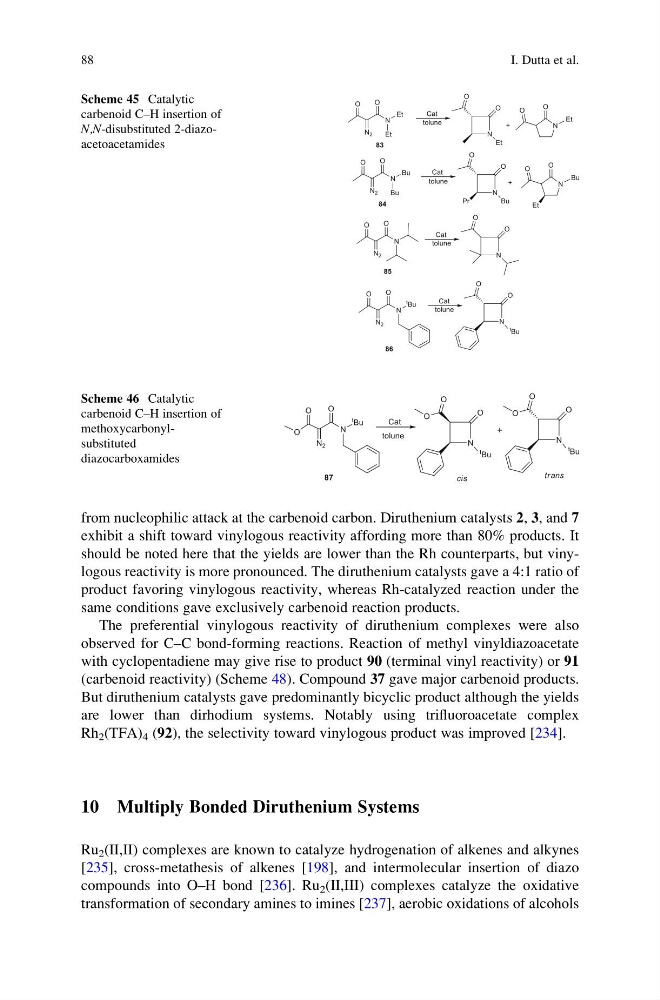
Scheme 45 Catalytic
carbenoid C–H insertion of
N,N-disubstituted 2-diazoacetoacetamides
Scheme 46 Catalytic
carbenoid C–H insertion of
methoxycarbonylsubstituted
diazocarboxamides
88
I. Dutta et al.
exhibit a shift toward vinylogous reactivity affording more than 80% products. It
should be noted here that the yields are lower than the Rh counterparts, but vinylogous reactivity is more pronounced. The diruthenium catalysts gave a 4:1 ratio of
product favoring vinylogous reactivity, whereas Rh-catalyzed reaction under the
same conditions gave exclusively carbenoid reaction products.
The preferential vinylogous reactivity of diruthenium complexes were also
observed for C–C bond-forming reactions. Reaction of methyl vinyldiazoacetate
with cyclopentadiene may give rise to product 90 (terminal vinyl reactivity) or 91
(carbenoid reactivity) (Scheme 48). Compound 37 gave major carbenoid products.
But diruthenium catalysts gave predominantly bicyclic product although the yields
are lower than dirhodium systems. Notably using trifluoroacetate complex
Rh 2 (TFA) 4 (92), the selectivity toward vinylogous product was improved [234].
10 Multiply Bonded Diruthenium Systems
Ru 2 (II,II) complexes are known to catalyze hydrogenation of alkenes and alkynes
[235], cross-metathesis of alkenes [198], and intermolecular insertion of diazo
compounds into O–H bond [236]. Ru 2 (II,III) complexes catalyze the oxidative
transformation of secondary amines to imines [237], aerobic oxidations of alcohols
Scheme 45 Catalytic
carbenoid C–H insertion of
N,N-disubstituted 2-diazoacetoacetamides
Scheme 46 Catalytic
carbenoid C–H insertion of
methoxycarbonylsubstituted
diazocarboxamides
88
I. Dutta et al.