

The structure of the argument in this interplay is interesting. The sovereign state
accepts contractual ADR by neutral thirds if and when state control is enabled before
such decisions utilise the state monopoly on violence. In order to enable enforcement
at a later stage, ADR applications must follow certain due process requirements. In
addition to the political agenda of a nation-state to expand its power, the state control
on due process is defended by references to the state’s responsibility towards its
citizens. By means of this manoeuvre, the modern nation-state has been able to avoid
the potential crisis that the emergence of the ADR movement could have signified.
Through highlighting the relation between the nation-state and protection of individuals on the one hand and the possibility of coexistence between litigation and ADR
on the other, a potential re-evaluation was averted. In other words, the emergence of
ADR in 1980s was an irritant to the legal system but the operation of the law
immunised the system and incorporated the phenomenon into its communication.
Nonetheless, the traditional model depicts how justification may be theorised
within the current doctrine of procedural law. The question is whether or not
dispute resolution is able to apply similar justificatory argument to private enforcement. In private enforcement, the interplay between state sovereignty and private
providers of dispute resolution services changes.
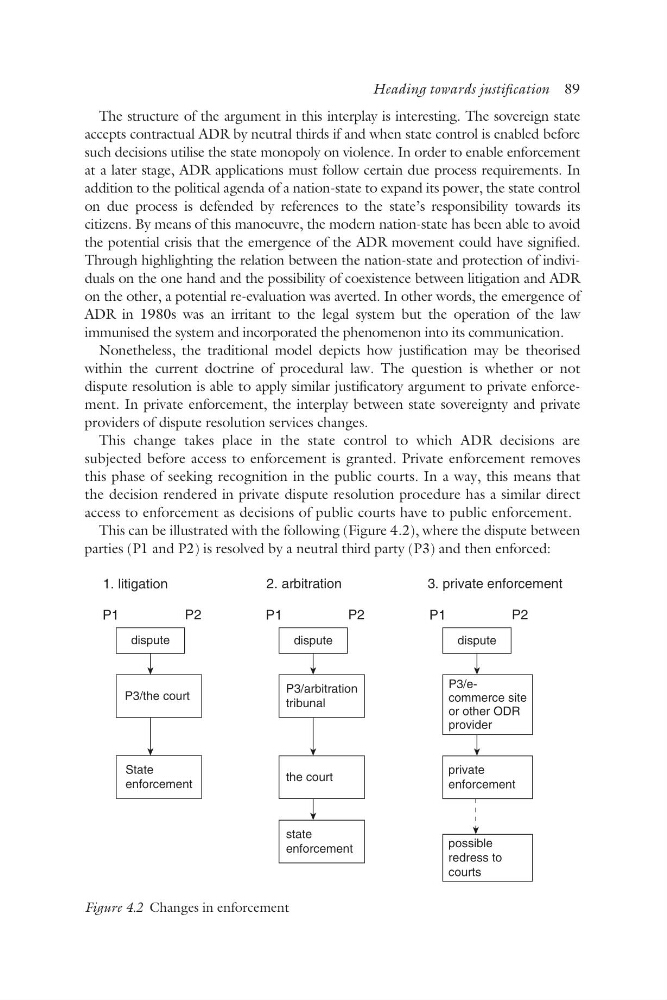
This change takes place in the state control to which ADR decisions are
subjected before access to enforcement is granted. Private enforcement removes
this phase of seeking recognition in the public courts. In a way, this means that
the decision rendered in private dispute resolution procedure has a similar direct
access to enforcement as decisions of public courts have to public enforcement.
This can be illustrated with the following (Figure 4.2), where the dispute between
parties (P1 and P2) is resolved by a neutral third party (P3) and then enforced:
1. litigation
2. arbitration
3. private enforcement
P1
dispute
P3/the court
the court
private
enforcement
possible
redress to
courts
state
enforcement
P3/arbitration
tribunal
State
enforcement
P3/ecommerce site
or other ODR
provider
P2
P1
P2
P1
P2
dispute
dispute
Figure 4.2 Changes in enforcement
Heading towards justification 89
accepts contractual ADR by neutral thirds if and when state control is enabled before
such decisions utilise the state monopoly on violence. In order to enable enforcement
at a later stage, ADR applications must follow certain due process requirements. In
addition to the political agenda of a nation-state to expand its power, the state control
on due process is defended by references to the state’s responsibility towards its
citizens. By means of this manoeuvre, the modern nation-state has been able to avoid
the potential crisis that the emergence of the ADR movement could have signified.
Through highlighting the relation between the nation-state and protection of individuals on the one hand and the possibility of coexistence between litigation and ADR
on the other, a potential re-evaluation was averted. In other words, the emergence of
ADR in 1980s was an irritant to the legal system but the operation of the law
immunised the system and incorporated the phenomenon into its communication.
Nonetheless, the traditional model depicts how justification may be theorised
within the current doctrine of procedural law. The question is whether or not
dispute resolution is able to apply similar justificatory argument to private enforcement. In private enforcement, the interplay between state sovereignty and private
providers of dispute resolution services changes.
This change takes place in the state control to which ADR decisions are
subjected before access to enforcement is granted. Private enforcement removes
this phase of seeking recognition in the public courts. In a way, this means that
the decision rendered in private dispute resolution procedure has a similar direct
access to enforcement as decisions of public courts have to public enforcement.
This can be illustrated with the following (Figure 4.2), where the dispute between
parties (P1 and P2) is resolved by a neutral third party (P3) and then enforced:
1. litigation
2. arbitration
3. private enforcement
P1
dispute
P3/the court
the court
private
enforcement
possible
redress to
courts
state
enforcement
P3/arbitration
tribunal
State
enforcement
P3/ecommerce site
or other ODR
provider
P2
P1
P2
P1
P2
dispute
dispute
Figure 4.2 Changes in enforcement
Heading towards justification 89