

changed significantly after the introduction of ADR in the 1980s. Instead, ADR
methods have been incorporated into the traditional model of understanding the
state as the gatekeeper of enforcement, creating an intricate cooperation system
between the private and the public dispute resolution mechanisms.
The emergence of the nation-state in the aftermath of the Thirty Years’ War
was also a milestone for dispute resolution in national courts. The Peace of
Westphalia in 1648 introduced respect for national boundaries and the principle
of non-interference in domestic affairs. However, from the perspective of dispute
resolution, its most significant provision was that of territorial jurisdiction.
Territorial jurisdiction formulates the basis of international procedural law even
today and promotes the state agenda in dispute resolution. A monopoly on
violence is the most visible signifier of the state’s jurisdiction.
Later on, the 1980s brought in their wake the ADR movement and the
justification of dispute resolution had to be revisited. Instead of territorial
jurisdiction, ADR derived its foundation from the agreement of the parties, in
other words from the principle of contractual freedom. The differences were
reconciled by accepting the coexistence of both litigation and ADR. This
reconciliation preserved the state’s primary role, at least in theory. The coexistence meant that, from the perspective of the state, ADR was tolerated as
delegation of power, its role ancillary to help overcome the caseload of the
public courts. However, the key element of the territorial jurisdiction remained
the sole domain of the courts. The decisions of public courts have direct access
to enforcement but ADR decisions are not granted a similar easy access. Instead
they are subordinated to an examination by the public courts before accessing
enforcement. As no other mechanism of enforcement existed, ADR procedures
still needed to resort to the state’s enforcement mechanism, which subjugated it
to ex ante state control before granting such access to its monopoly on
violence.
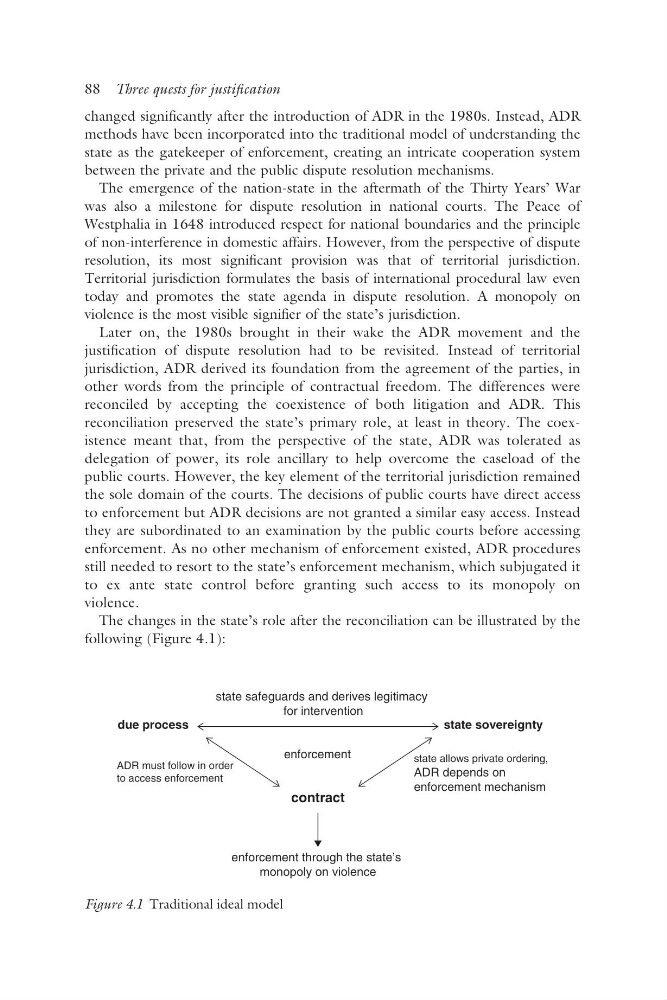
The changes in the state’s role after the reconciliation can be illustrated by the
following (Figure 4.1):
state safeguards and derives legitimacy
for intervention
due process
state sovereignty
enforcement
ADR must follow in order
to access enforcement
state allows private ordering,
ADR depends on
enforcement mechanism
contract
enforcement through the state’s
monopoly on violence
Figure 4.1 Traditional ideal model
88 Three quests for justification
methods have been incorporated into the traditional model of understanding the
state as the gatekeeper of enforcement, creating an intricate cooperation system
between the private and the public dispute resolution mechanisms.
The emergence of the nation-state in the aftermath of the Thirty Years’ War
was also a milestone for dispute resolution in national courts. The Peace of
Westphalia in 1648 introduced respect for national boundaries and the principle
of non-interference in domestic affairs. However, from the perspective of dispute
resolution, its most significant provision was that of territorial jurisdiction.
Territorial jurisdiction formulates the basis of international procedural law even
today and promotes the state agenda in dispute resolution. A monopoly on
violence is the most visible signifier of the state’s jurisdiction.
Later on, the 1980s brought in their wake the ADR movement and the
justification of dispute resolution had to be revisited. Instead of territorial
jurisdiction, ADR derived its foundation from the agreement of the parties, in
other words from the principle of contractual freedom. The differences were
reconciled by accepting the coexistence of both litigation and ADR. This
reconciliation preserved the state’s primary role, at least in theory. The coexistence meant that, from the perspective of the state, ADR was tolerated as
delegation of power, its role ancillary to help overcome the caseload of the
public courts. However, the key element of the territorial jurisdiction remained
the sole domain of the courts. The decisions of public courts have direct access
to enforcement but ADR decisions are not granted a similar easy access. Instead
they are subordinated to an examination by the public courts before accessing
enforcement. As no other mechanism of enforcement existed, ADR procedures
still needed to resort to the state’s enforcement mechanism, which subjugated it
to ex ante state control before granting such access to its monopoly on
violence.
The changes in the state’s role after the reconciliation can be illustrated by the
following (Figure 4.1):
state safeguards and derives legitimacy
for intervention
due process
state sovereignty
enforcement
ADR must follow in order
to access enforcement
state allows private ordering,
ADR depends on
enforcement mechanism
contract
enforcement through the state’s
monopoly on violence
Figure 4.1 Traditional ideal model
88 Three quests for justification