

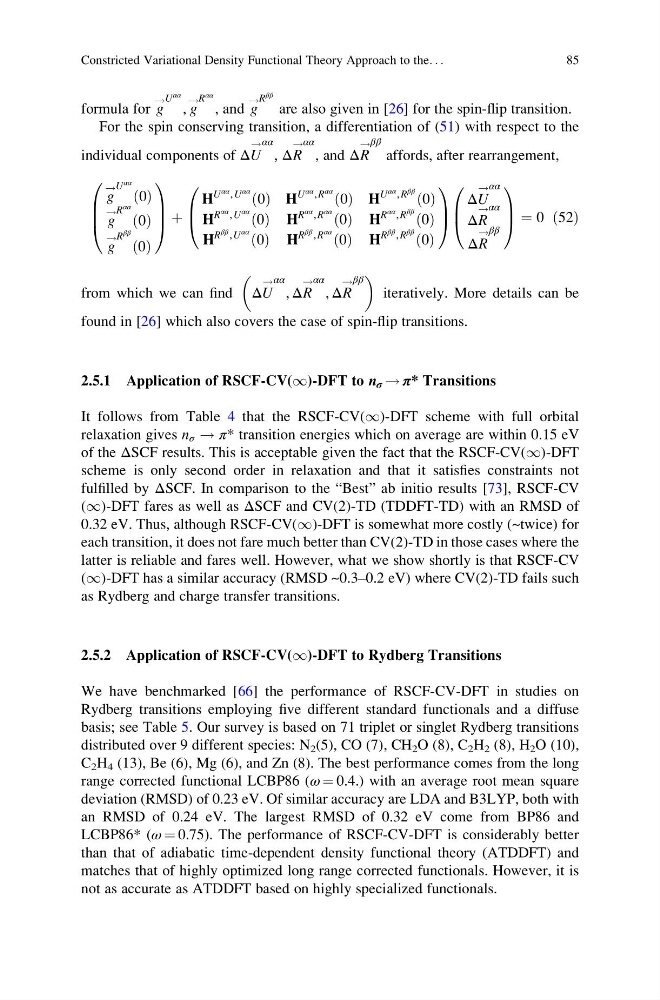
formula for g
! U
αα
, g
! R
αα
, and g
! R
ββ
are also given in [26] for the spin-flip transition.
For the spin conserving transition, a differentiation of (51) with respect to the
individual components of ΔU
! αα
, ΔR
! αα
, and ΔR
! ββ
affords, after rearrangement,
g
! U
αα
0
ð Þ
g
! R
αα
0
ð Þ
g
! R
ββ
0
ð Þ
0
B
B
@
1
C
C
A þ
H
U
αα , U
αα 0
ð Þ H
U
αα , R
αα 0
ð Þ H
U
αα , R
ββ 0
ð Þ
H
R
αα , U
αα 0
ð Þ H
R
αα , R
αα 0
ð Þ H
R
αα , R
ββ 0
ð Þ
H
R
ββ , U
αα 0
ð Þ H
R
ββ , R
αα 0
ð Þ H
R
ββ , R
ββ 0
ð Þ
0
B
@
1
C
A
ΔU
! αα
ΔR
! αα
ΔR
! ββ
0
B
@
1
C
A ¼ 0 ð52Þ
from which we can find ΔU
! αα
, ΔR
! αα
, ΔR
! ββ
iteratively. More details can be
found in [26] which also covers the case of spin-flip transitions.
2.5.1 Application of RSCF-CV(1)-DFT to n σ ! π* Transitions
It follows from Table 4 that the RSCF-CV(1)-DFT scheme with full orbital
relaxation gives n σ ! π* transition energies which on average are within 0.15 eV
of the ΔSCF results. This is acceptable given the fact that the RSCF-CV(1)-DFT
scheme is only second order in relaxation and that it satisfies constraints not
fulfilled by ΔSCF. In comparison to the “Best” ab initio results [73], RSCF-CV
(1)-DFT fares as well as ΔSCF and CV(2)-TD (TDDFT-TD) with an RMSD of
0.32 eV. Thus, although RSCF-CV(1)-DFT is somewhat more costly (~twice) for
each transition, it does not fare much better than CV(2)-TD in those cases where the
latter is reliable and fares well. However, what we show shortly is that RSCF-CV
(1)-DFT has a similar accuracy (RMSD ~0.3–0.2 eV) where CV(2)-TD fails such
as Rydberg and charge transfer transitions.
2.5.2 Application of RSCF-CV(1)-DFT to Rydberg Transitions
We have benchmarked [66] the performance of RSCF-CV-DFT in studies on
Rydberg transitions employing five different standard functionals and a diffuse
basis; see Table 5. Our survey is based on 71 triplet or singlet Rydberg transitions
distributed over 9 different species: N 2 (5), CO (7), CH 2 O (8), C 2 H 2 (8), H 2 O (10),
C 2 H 4 (13), Be (6), Mg (6), and Zn (8). The best performance comes from the long
range corrected functional LCBP86 (ω ¼ 0.4.) with an average root mean square
deviation (RMSD) of 0.23 eV. Of similar accuracy are LDA and B3LYP, both with
an RMSD of 0.24 eV. The largest RMSD of 0.32 eV come from BP86 and
LCBP86* (ω ¼ 0.75). The performance of RSCF-CV-DFT is considerably better
than that of adiabatic time-dependent density functional theory (ATDDFT) and
matches that of highly optimized long range corrected functionals. However, it is
not as accurate as ATDDFT based on highly specialized functionals.
Constricted Variational Density Functional Theory Approach to the. . .
85
! U
αα
, g
! R
αα
, and g
! R
ββ
are also given in [26] for the spin-flip transition.
For the spin conserving transition, a differentiation of (51) with respect to the
individual components of ΔU
! αα
, ΔR
! αα
, and ΔR
! ββ
affords, after rearrangement,
g
! U
αα
0
ð Þ
g
! R
αα
0
ð Þ
g
! R
ββ
0
ð Þ
0
B
B
@
1
C
C
A þ
H
U
αα , U
αα 0
ð Þ H
U
αα , R
αα 0
ð Þ H
U
αα , R
ββ 0
ð Þ
H
R
αα , U
αα 0
ð Þ H
R
αα , R
αα 0
ð Þ H
R
αα , R
ββ 0
ð Þ
H
R
ββ , U
αα 0
ð Þ H
R
ββ , R
αα 0
ð Þ H
R
ββ , R
ββ 0
ð Þ
0
B
@
1
C
A
ΔU
! αα
ΔR
! αα
ΔR
! ββ
0
B
@
1
C
A ¼ 0 ð52Þ
from which we can find ΔU
! αα
, ΔR
! αα
, ΔR
! ββ
iteratively. More details can be
found in [26] which also covers the case of spin-flip transitions.
2.5.1 Application of RSCF-CV(1)-DFT to n σ ! π* Transitions
It follows from Table 4 that the RSCF-CV(1)-DFT scheme with full orbital
relaxation gives n σ ! π* transition energies which on average are within 0.15 eV
of the ΔSCF results. This is acceptable given the fact that the RSCF-CV(1)-DFT
scheme is only second order in relaxation and that it satisfies constraints not
fulfilled by ΔSCF. In comparison to the “Best” ab initio results [73], RSCF-CV
(1)-DFT fares as well as ΔSCF and CV(2)-TD (TDDFT-TD) with an RMSD of
0.32 eV. Thus, although RSCF-CV(1)-DFT is somewhat more costly (~twice) for
each transition, it does not fare much better than CV(2)-TD in those cases where the
latter is reliable and fares well. However, what we show shortly is that RSCF-CV
(1)-DFT has a similar accuracy (RMSD ~0.3–0.2 eV) where CV(2)-TD fails such
as Rydberg and charge transfer transitions.
2.5.2 Application of RSCF-CV(1)-DFT to Rydberg Transitions
We have benchmarked [66] the performance of RSCF-CV-DFT in studies on
Rydberg transitions employing five different standard functionals and a diffuse
basis; see Table 5. Our survey is based on 71 triplet or singlet Rydberg transitions
distributed over 9 different species: N 2 (5), CO (7), CH 2 O (8), C 2 H 2 (8), H 2 O (10),
C 2 H 4 (13), Be (6), Mg (6), and Zn (8). The best performance comes from the long
range corrected functional LCBP86 (ω ¼ 0.4.) with an average root mean square
deviation (RMSD) of 0.23 eV. Of similar accuracy are LDA and B3LYP, both with
an RMSD of 0.24 eV. The largest RMSD of 0.32 eV come from BP86 and
LCBP86* (ω ¼ 0.75). The performance of RSCF-CV-DFT is considerably better
than that of adiabatic time-dependent density functional theory (ATDDFT) and
matches that of highly optimized long range corrected functionals. However, it is
not as accurate as ATDDFT based on highly specialized functionals.
Constricted Variational Density Functional Theory Approach to the. . .
85