

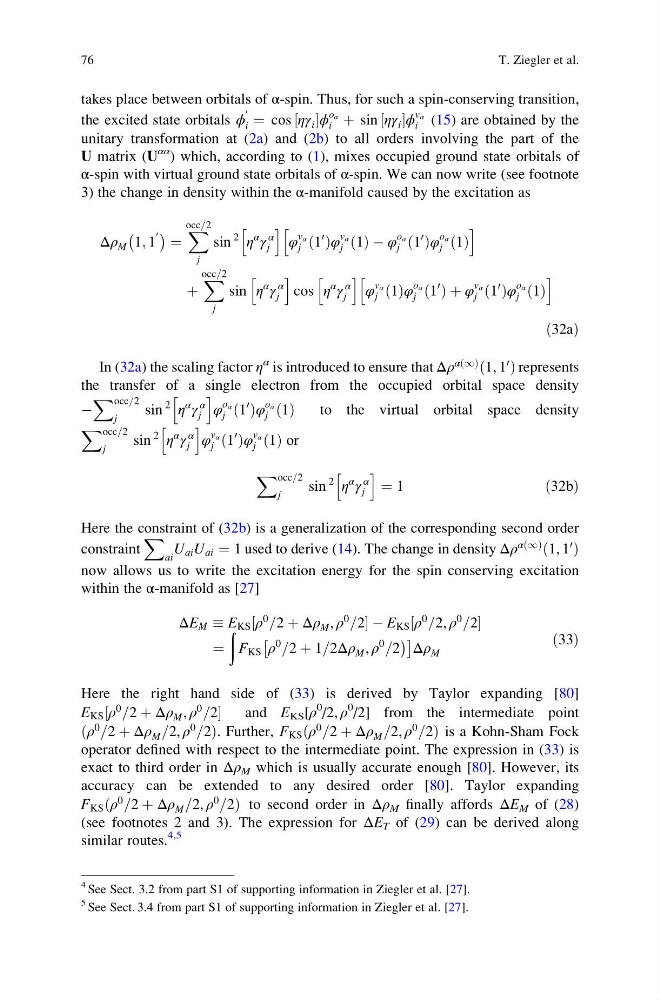
takes place between orbitals of α-spin. Thus, for such a spin-conserving transition,
the excited state orbitals ϕ
0
i ¼ cos ηγ i
½ ϕ
o α
i þ sin ηγ i
½ ϕ
v α
i (15) are obtained by the
unitary transformation at (2a) and (2b) to all orders involving the part of the
U matrix (U
αα ) which, according to (1), mixes occupied ground state orbitals of
α-spin with virtual ground state orbitals of α-spin. We can now write (see footnote
3) the change in density within the α-manifold caused by the excitation as
Δρ M 1; 1
0
À
Á ¼
X
occ=2
j
sin
2
η
α
γ
α
j
h
i
φ
v α
j 1
0
ð Þφ
v α
j 1
ð Þ À φ
o α
j 1
0
ð Þφ
o α
j 1
ð Þ
h
i
þ
X
occ=2
j
sin η
α
γ
α
j
h
i
cos η
α
γ
α
j
h
i
φ
v α
j 1
ð Þφ
o α
j 1
0
ð Þ þ φ
v α
j 1
0
ð Þφ
o α
j 1
ð Þ
h
i
ð32aÞ
In (32a) the scaling factor η
α is introduced to ensure that Δρ
α 1
ð Þ 1, 1
0
ð
Þrepresents
the transfer of a single electron from the occupied orbital space density
À
X occ=2
j
sin
2
η
α
γ
α
j
h
i
φ
o α
j 1
0
ð Þφ
o α
j 1
ð Þ
to the virtual orbital space density
X occ=2
j
sin
2
η
α
γ
α
j
h
i
φ
v α
j 1
0
ð Þφ
v α
j 1
ð Þ or
X occ=2
j
sin
2
η
α
γ
α
j
h
i
¼ 1
ð32bÞ
Here the constraint of (32b) is a generalization of the corresponding second order
constraint
X
ai
U ai U ai ¼ 1 used to derive (14). The change in density Δρ
α 1
ð Þ 1, 1
0
ð
Þ
now allows us to write the excitation energy for the spin conserving excitation
within the α-manifold as [27]
ΔE M E KS ρ
0
=2 þ Δρ M , ρ
0
=2
½
À E KS ρ
0
=2, ρ
0
=2
½
¼
ð
F KS
Â
ρ
0
=2 þ 1=2Δρ M , ρ
0
=2
ÁÃ Δρ M
ð33Þ
Here the right hand side of (33) is derived by Taylor expanding [80]
E KS ρ
0
=2 þ Δρ M , ρ
0
=2
½
and E KS [ρ
0 /2, ρ
0 /2] from the intermediate point
ρ
0
=2 þ Δρ M =2, ρ
0
=2
ð
Þ . Further, F KS ρ
0
=2 þ Δρ M =2, ρ
0
=2
ð
Þ is a Kohn-Sham Fock
operator defined with respect to the intermediate point. The expression in (33) is
exact to third order in Δρ M which is usually accurate enough [80]. However, its
accuracy can be extended to any desired order [80]. Taylor expanding
F KS ρ
0
=2 þ Δρ M =2, ρ
0
=2
ð
Þto second order in Δρ M finally affords ΔE M of (28)
(see footnotes 2 and 3). The expression for ΔE T of (29) can be derived along
similar routes.
4,5
4 See Sect. 3.2 from part S1 of supporting information in Ziegler et al. [27].
5 See Sect. 3.4 from part S1 of supporting information in Ziegler et al. [27].
76
T. Ziegler et al.
the excited state orbitals ϕ
0
i ¼ cos ηγ i
½ ϕ
o α
i þ sin ηγ i
½ ϕ
v α
i (15) are obtained by the
unitary transformation at (2a) and (2b) to all orders involving the part of the
U matrix (U
αα ) which, according to (1), mixes occupied ground state orbitals of
α-spin with virtual ground state orbitals of α-spin. We can now write (see footnote
3) the change in density within the α-manifold caused by the excitation as
Δρ M 1; 1
0
À
Á ¼
X
occ=2
j
sin
2
η
α
γ
α
j
h
i
φ
v α
j 1
0
ð Þφ
v α
j 1
ð Þ À φ
o α
j 1
0
ð Þφ
o α
j 1
ð Þ
h
i
þ
X
occ=2
j
sin η
α
γ
α
j
h
i
cos η
α
γ
α
j
h
i
φ
v α
j 1
ð Þφ
o α
j 1
0
ð Þ þ φ
v α
j 1
0
ð Þφ
o α
j 1
ð Þ
h
i
ð32aÞ
In (32a) the scaling factor η
α is introduced to ensure that Δρ
α 1
ð Þ 1, 1
0
ð
Þrepresents
the transfer of a single electron from the occupied orbital space density
À
X occ=2
j
sin
2
η
α
γ
α
j
h
i
φ
o α
j 1
0
ð Þφ
o α
j 1
ð Þ
to the virtual orbital space density
X occ=2
j
sin
2
η
α
γ
α
j
h
i
φ
v α
j 1
0
ð Þφ
v α
j 1
ð Þ or
X occ=2
j
sin
2
η
α
γ
α
j
h
i
¼ 1
ð32bÞ
Here the constraint of (32b) is a generalization of the corresponding second order
constraint
X
ai
U ai U ai ¼ 1 used to derive (14). The change in density Δρ
α 1
ð Þ 1, 1
0
ð
Þ
now allows us to write the excitation energy for the spin conserving excitation
within the α-manifold as [27]
ΔE M E KS ρ
0
=2 þ Δρ M , ρ
0
=2
½
À E KS ρ
0
=2, ρ
0
=2
½
¼
ð
F KS
Â
ρ
0
=2 þ 1=2Δρ M , ρ
0
=2
ÁÃ Δρ M
ð33Þ
Here the right hand side of (33) is derived by Taylor expanding [80]
E KS ρ
0
=2 þ Δρ M , ρ
0
=2
½
and E KS [ρ
0 /2, ρ
0 /2] from the intermediate point
ρ
0
=2 þ Δρ M =2, ρ
0
=2
ð
Þ . Further, F KS ρ
0
=2 þ Δρ M =2, ρ
0
=2
ð
Þ is a Kohn-Sham Fock
operator defined with respect to the intermediate point. The expression in (33) is
exact to third order in Δρ M which is usually accurate enough [80]. However, its
accuracy can be extended to any desired order [80]. Taylor expanding
F KS ρ
0
=2 þ Δρ M =2, ρ
0
=2
ð
Þto second order in Δρ M finally affords ΔE M of (28)
(see footnotes 2 and 3). The expression for ΔE T of (29) can be derived along
similar routes.
4,5
4 See Sect. 3.2 from part S1 of supporting information in Ziegler et al. [27].
5 See Sect. 3.4 from part S1 of supporting information in Ziegler et al. [27].
76
T. Ziegler et al.