

afford estimates to any desired degree of accuracy. Given the status of Kohn–Sham
density functional theory (KS-DFT) as a ground state theory, the natural path to
excited states in KS-DFT would seem to be the ground state response approach. In
fact, Runge and Gross [3] have formulated a time-dependent density functional
ground state response theory (TDDFT) which in principle should be able to
describe excited state properties without approximations. TDDFT in its exact
form requires knowledge of the “true” ground state functional and of the frequency
dependence of the energy response kernel corresponding to this functional. In
practical calculations, use is made of approximate ground state functionals and
the frequency dependence of the kernel is neglected in what has now become
known as the adiabatic TDDFT approach (ATDDFT) [4–9]. For more than two
decades the ATDDFT approach has remained the method of choice in DFT-based
studies of excited states and both its merits and limitations have been studied in
great detail [10–33]. Progress beyond the adiabatic approximation has, on the other
hand, been slow, although work in this direction is ongoing [34–36].
Long before TDDFT, Slater introduced a variational DFT approach to excited
states called ΔSCF [37, 38]. Excited states are reached in this scheme by promoting
electrons from occupied to virtual ground state levels followed by a KS calculation
on the new electron configuration. The ΔSCF approach has met with considerable
success for those lower excited states which can be represented by a single orbital
replacement (SOR) [39–49]. However, it is plagued by SCF-convergence problems.
Further, as it applies a ground state functional in a variational excited state
calculation, it is considered somewhat ad hoc [50] and without any theoretical
foundation [51–53]. Nevertheless, Van Voorhis et al. [39] have recently put forward some theoretical justifications for ΔSCF and Besley et al. [42, 43] and Park
et al. [44] have addressed the SCF-convergence issue. Apart from ΔSCF, there are a
number of interesting variational DFT approaches to the study of excited states.
They include ensemble DFT [54–59], variation of bifunctionals [60], and excited
state perturbation theory [61]. They are discussed elsewhere in this volume.
The use of a ground state functional in variational excited state calculations
seems intuitively appealing from the point of view that electron correlation should
be quite similar in the ground and excited states, at least in the lower valence region.
In fact, based on this notion we introduced in 2009 the constricted variational DFT
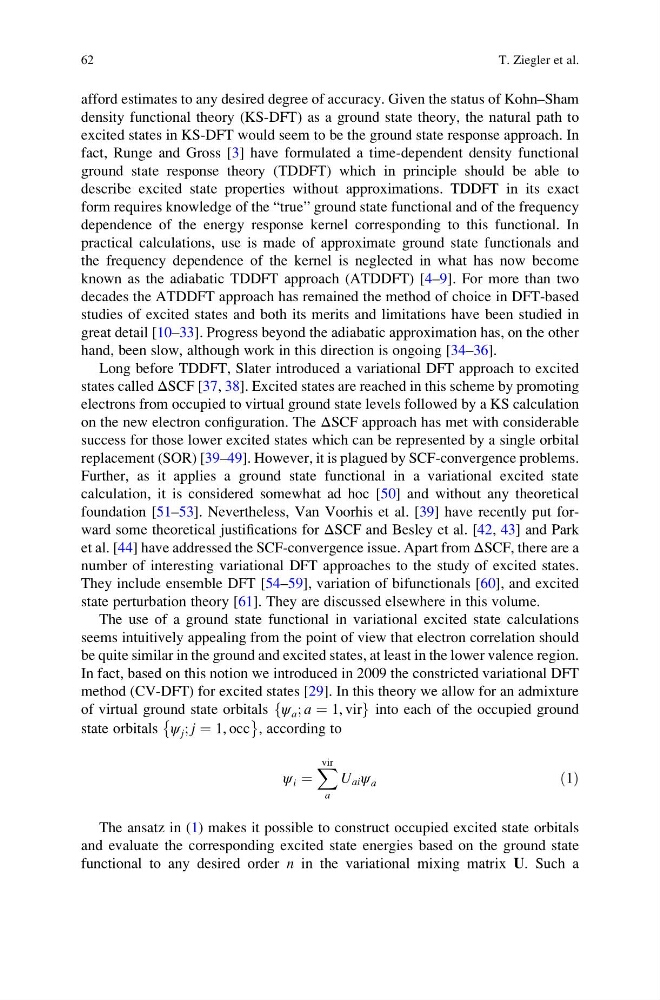
method (CV-DFT) for excited states [29]. In this theory we allow for an admixture
of virtual ground state orbitals ψ a ; a ¼ 1, vir
f
ginto each of the occupied ground
state orbitals ψ j ; j ¼ 1, occ
È
É
, according to
ψ i ¼
X vir
a
U ai ψ a
ð1Þ
The ansatz in (1) makes it possible to construct occupied excited state orbitals
and evaluate the corresponding excited state energies based on the ground state
functional to any desired order n in the variational mixing matrix U. Such a
62
T. Ziegler et al.
density functional theory (KS-DFT) as a ground state theory, the natural path to
excited states in KS-DFT would seem to be the ground state response approach. In
fact, Runge and Gross [3] have formulated a time-dependent density functional
ground state response theory (TDDFT) which in principle should be able to
describe excited state properties without approximations. TDDFT in its exact
form requires knowledge of the “true” ground state functional and of the frequency
dependence of the energy response kernel corresponding to this functional. In
practical calculations, use is made of approximate ground state functionals and
the frequency dependence of the kernel is neglected in what has now become
known as the adiabatic TDDFT approach (ATDDFT) [4–9]. For more than two
decades the ATDDFT approach has remained the method of choice in DFT-based
studies of excited states and both its merits and limitations have been studied in
great detail [10–33]. Progress beyond the adiabatic approximation has, on the other
hand, been slow, although work in this direction is ongoing [34–36].
Long before TDDFT, Slater introduced a variational DFT approach to excited
states called ΔSCF [37, 38]. Excited states are reached in this scheme by promoting
electrons from occupied to virtual ground state levels followed by a KS calculation
on the new electron configuration. The ΔSCF approach has met with considerable
success for those lower excited states which can be represented by a single orbital
replacement (SOR) [39–49]. However, it is plagued by SCF-convergence problems.
Further, as it applies a ground state functional in a variational excited state
calculation, it is considered somewhat ad hoc [50] and without any theoretical
foundation [51–53]. Nevertheless, Van Voorhis et al. [39] have recently put forward some theoretical justifications for ΔSCF and Besley et al. [42, 43] and Park
et al. [44] have addressed the SCF-convergence issue. Apart from ΔSCF, there are a
number of interesting variational DFT approaches to the study of excited states.
They include ensemble DFT [54–59], variation of bifunctionals [60], and excited
state perturbation theory [61]. They are discussed elsewhere in this volume.
The use of a ground state functional in variational excited state calculations
seems intuitively appealing from the point of view that electron correlation should
be quite similar in the ground and excited states, at least in the lower valence region.
In fact, based on this notion we introduced in 2009 the constricted variational DFT
method (CV-DFT) for excited states [29]. In this theory we allow for an admixture
of virtual ground state orbitals ψ a ; a ¼ 1, vir
f
ginto each of the occupied ground
state orbitals ψ j ; j ¼ 1, occ
È
É
, according to
ψ i ¼
X vir
a
U ai ψ a
ð1Þ
The ansatz in (1) makes it possible to construct occupied excited state orbitals
and evaluate the corresponding excited state energies based on the ground state
functional to any desired order n in the variational mixing matrix U. Such a
62
T. Ziegler et al.