

Γ
2
ð Þ
2, 1
h
i
kc, jbia
¼ Àδ ik bc
a j
À
Á þ δ jk bc
ai
À
Á À δ bc ai
k j
À
Á þ δ ac bi
k j
À
Á
Γ
2
ð Þ
2, 1
h
i
ck, jbia
¼ 0 :
ð171Þ
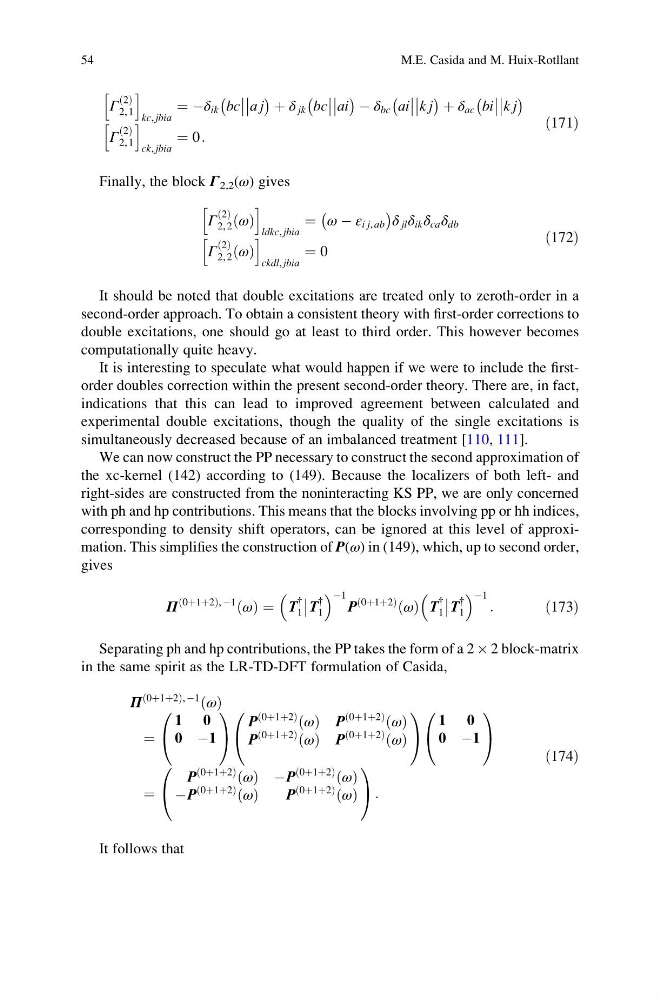
Finally, the block Γ 2,2 (ω) gives
Γ
2
ð Þ
2, 2 ω
ð Þ
h
i
ldkc, jbia
¼ ω À ε i j, ab
À
Á δ jl δ ik δ ca δ db
Γ
2
ð Þ
2, 2 ω
ð Þ
h
i
ckdl, jbia
¼ 0
ð172Þ
It should be noted that double excitations are treated only to zeroth-order in a
second-order approach. To obtain a consistent theory with first-order corrections to
double excitations, one should go at least to third order. This however becomes
computationally quite heavy.
It is interesting to speculate what would happen if we were to include the firstorder doubles correction within the present second-order theory. There are, in fact,
indications that this can lead to improved agreement between calculated and
experimental double excitations, though the quality of the single excitations is
simultaneously decreased because of an imbalanced treatment [110, 111].
We can now construct the PP necessary to construct the second approximation of
the xc-kernel (142) according to (149). Because the localizers of both left- and
right-sides are constructed from the noninteracting KS PP, we are only concerned
with ph and hp contributions. This means that the blocks involving pp or hh indices,
corresponding to density shift operators, can be ignored at this level of approximation. This simplifies the construction of P(ω) in (149), which, up to second order,
gives
Π
0þ1þ2
ð
Þ , À1
ω
ð Þ ¼ T
{
1
T
{
1
À1 P
0þ1þ2
ð
Þ
ω
ð Þ T
{
1
T
{
1
À1 :
ð173Þ
Separating ph and hp contributions, the PP takes the form of a 2 Â 2 block-matrix
in the same spirit as the LR-TD-DFT formulation of Casida,
Π
0þ1þ2
ð
Þ , À1
ω
ð Þ
¼
1 0
0 À1
0
@
1
A
P
0þ1þ2
ð
Þ
ω
ð Þ P
0þ1þ2
ð
Þ
ω
ð Þ
P
0þ1þ2
ð
Þ
ω
ð Þ P
0þ1þ2
ð
Þ
ω
ð Þ
0
@
1
A
1 0
0 À1
0
@
1
A
¼
P
0þ1þ2
ð
Þ
ω
ð Þ ÀP
0þ1þ2
ð
Þ
ω
ð Þ
ÀP
0þ1þ2
ð
Þ
ω
ð Þ
P
0þ1þ2
ð
Þ
ω
ð Þ
0
@
1
A :
ð174Þ
It follows that
54
M.E. Casida and M. Huix-Rotllant
2
ð Þ
2, 1
h
i
kc, jbia
¼ Àδ ik bc
a j
À
Á þ δ jk bc
ai
À
Á À δ bc ai
k j
À
Á þ δ ac bi
k j
À
Á
Γ
2
ð Þ
2, 1
h
i
ck, jbia
¼ 0 :
ð171Þ
Finally, the block Γ 2,2 (ω) gives
Γ
2
ð Þ
2, 2 ω
ð Þ
h
i
ldkc, jbia
¼ ω À ε i j, ab
À
Á δ jl δ ik δ ca δ db
Γ
2
ð Þ
2, 2 ω
ð Þ
h
i
ckdl, jbia
¼ 0
ð172Þ
It should be noted that double excitations are treated only to zeroth-order in a
second-order approach. To obtain a consistent theory with first-order corrections to
double excitations, one should go at least to third order. This however becomes
computationally quite heavy.
It is interesting to speculate what would happen if we were to include the firstorder doubles correction within the present second-order theory. There are, in fact,
indications that this can lead to improved agreement between calculated and
experimental double excitations, though the quality of the single excitations is
simultaneously decreased because of an imbalanced treatment [110, 111].
We can now construct the PP necessary to construct the second approximation of
the xc-kernel (142) according to (149). Because the localizers of both left- and
right-sides are constructed from the noninteracting KS PP, we are only concerned
with ph and hp contributions. This means that the blocks involving pp or hh indices,
corresponding to density shift operators, can be ignored at this level of approximation. This simplifies the construction of P(ω) in (149), which, up to second order,
gives
Π
0þ1þ2
ð
Þ , À1
ω
ð Þ ¼ T
{
1
T
{
1
À1 P
0þ1þ2
ð
Þ
ω
ð Þ T
{
1
T
{
1
À1 :
ð173Þ
Separating ph and hp contributions, the PP takes the form of a 2 Â 2 block-matrix
in the same spirit as the LR-TD-DFT formulation of Casida,
Π
0þ1þ2
ð
Þ , À1
ω
ð Þ
¼
1 0
0 À1
0
@
1
A
P
0þ1þ2
ð
Þ
ω
ð Þ P
0þ1þ2
ð
Þ
ω
ð Þ
P
0þ1þ2
ð
Þ
ω
ð Þ P
0þ1þ2
ð
Þ
ω
ð Þ
0
@
1
A
1 0
0 À1
0
@
1
A
¼
P
0þ1þ2
ð
Þ
ω
ð Þ ÀP
0þ1þ2
ð
Þ
ω
ð Þ
ÀP
0þ1þ2
ð
Þ
ω
ð Þ
P
0þ1þ2
ð
Þ
ω
ð Þ
0
@
1
A :
ð174Þ
It follows that
54
M.E. Casida and M. Huix-Rotllant