

Γ
2
ð Þ
1, 1 ¼ 0
1
ð Þ
T
{
1 ; ω1
^ þ H
^ 0
ð Þ
, T
{
1
! !
0
1
ð Þ
(
)
þ 0
0
ð Þ
T
{
1 ; ω1
^ þ H
^ 0
ð Þ
, T
{
1
! !
0
2
ð Þ
(
)
þ 0
2
ð Þ
T
{
1 ; ω1
^ þ H
^ 0
ð Þ
, T
{
1
! !
0
0
ð Þ
(
)
þ 0
0
ð Þ
T
{ 2
ð Þ
1 ; ω1
^ þ H
^ 0
ð Þ
, T
{
1
! !
0
0
ð Þ
(
)
þ 0
0
ð Þ
T
{
1 ; ω1
^ þ H
^ 0
ð Þ
, T
{ 2
ð Þ
1
! !
0
0
ð Þ
(
)
þ 0
1
ð Þ
Â
T
{
1 , ^
H
1
ð Þ
; T
{
1
h
i
0
0
ð Þ
D
E
þ 0
0
ð Þ
Â
T
{
1 , ^
H
1
ð Þ
; T
{
1
h
i
0
1
ð Þ
D
E
;
ð167Þ
where T
{ ð2Þ
1
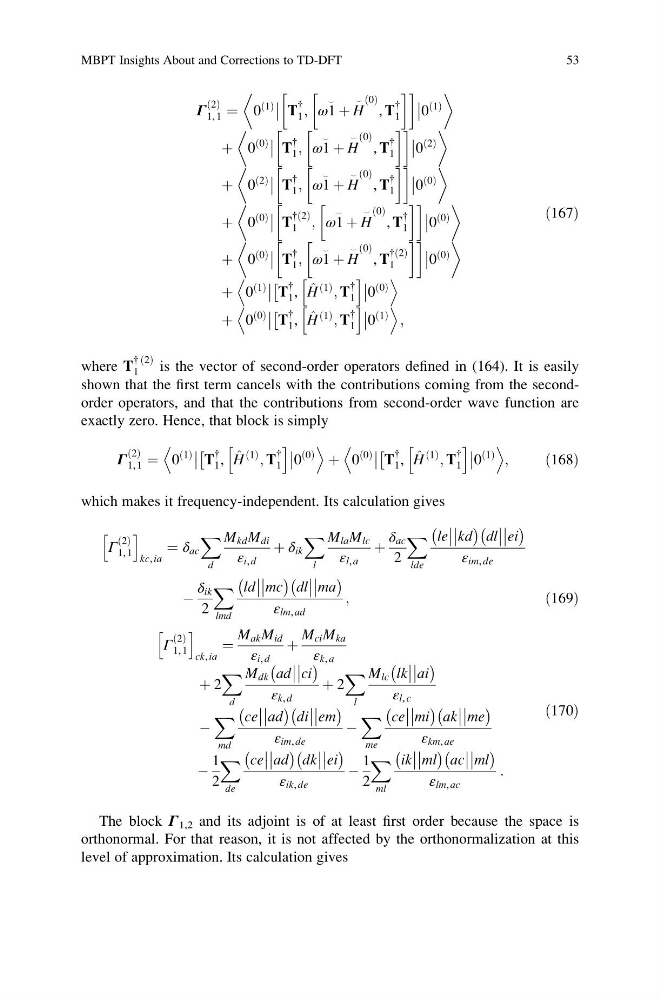
is the vector of second-order operators defined in (164). It is easily
shown that the first term cancels with the contributions coming from the secondorder operators, and that the contributions from second-order wave function are
exactly zero. Hence, that block is simply
Γ
2
ð Þ
1, 1 ¼ 0
1
ð Þ
Â
T
{
1 , ^
H
1
ð Þ
; T
{
1
h
i
0
0
ð Þ
D
E
þ 0
0
ð Þ
Â
T
{
1 , ^
H
1
ð Þ
; T
{
1
h
i
0
1
ð Þ
D
E
;
ð168Þ
which makes it frequency-independent. Its calculation gives
Γ
2
ð Þ
1, 1
h
i
kc, ia
¼ δ ac
X
d
M kd M di
ε i, d
þ δ ik
X
l
M la M lc
ε l, a
þ
δ ac
2
X
lde
le
kd
À
Á
dl
ei
À
Á
ε im, de
À
δ ik
2
X
lmd
ld
mc
À
Á
dl
ma
À
Á
ε lm, ad
;
ð169Þ
Γ
2
ð Þ
1, 1
h
i
ck, ia
¼
M ak M id
ε i, d
þ
M ci M ka
ε k, a
þ 2
X
d
M dk ad
ci
À
Á
ε k, d
þ 2
X
l
M lc lk
ai
À
Á
ε l, c
À
X
md
ce
ad
À
Á
di
em
À
Á
ε im, de
À
X
me
ce
mi
À
Á
ak
me
À
Á
ε km, ae
À
1
2
X
de
ce
ad
À
Á
dk
ei
À
Á
ε ik, de
À
1
2
X
ml
ik
ml
À
Á
ac
ml
À
Á
ε lm, ac
:
ð170Þ
The block Γ 1,2 and its adjoint is of at least first order because the space is
orthonormal. For that reason, it is not affected by the orthonormalization at this
level of approximation. Its calculation gives
MBPT Insights About and Corrections to TD-DFT
53
2
ð Þ
1, 1 ¼ 0
1
ð Þ
T
{
1 ; ω1
^ þ H
^ 0
ð Þ
, T
{
1
! !
0
1
ð Þ
(
)
þ 0
0
ð Þ
T
{
1 ; ω1
^ þ H
^ 0
ð Þ
, T
{
1
! !
0
2
ð Þ
(
)
þ 0
2
ð Þ
T
{
1 ; ω1
^ þ H
^ 0
ð Þ
, T
{
1
! !
0
0
ð Þ
(
)
þ 0
0
ð Þ
T
{ 2
ð Þ
1 ; ω1
^ þ H
^ 0
ð Þ
, T
{
1
! !
0
0
ð Þ
(
)
þ 0
0
ð Þ
T
{
1 ; ω1
^ þ H
^ 0
ð Þ
, T
{ 2
ð Þ
1
! !
0
0
ð Þ
(
)
þ 0
1
ð Þ
Â
T
{
1 , ^
H
1
ð Þ
; T
{
1
h
i
0
0
ð Þ
D
E
þ 0
0
ð Þ
Â
T
{
1 , ^
H
1
ð Þ
; T
{
1
h
i
0
1
ð Þ
D
E
;
ð167Þ
where T
{ ð2Þ
1
is the vector of second-order operators defined in (164). It is easily
shown that the first term cancels with the contributions coming from the secondorder operators, and that the contributions from second-order wave function are
exactly zero. Hence, that block is simply
Γ
2
ð Þ
1, 1 ¼ 0
1
ð Þ
Â
T
{
1 , ^
H
1
ð Þ
; T
{
1
h
i
0
0
ð Þ
D
E
þ 0
0
ð Þ
Â
T
{
1 , ^
H
1
ð Þ
; T
{
1
h
i
0
1
ð Þ
D
E
;
ð168Þ
which makes it frequency-independent. Its calculation gives
Γ
2
ð Þ
1, 1
h
i
kc, ia
¼ δ ac
X
d
M kd M di
ε i, d
þ δ ik
X
l
M la M lc
ε l, a
þ
δ ac
2
X
lde
le
kd
À
Á
dl
ei
À
Á
ε im, de
À
δ ik
2
X
lmd
ld
mc
À
Á
dl
ma
À
Á
ε lm, ad
;
ð169Þ
Γ
2
ð Þ
1, 1
h
i
ck, ia
¼
M ak M id
ε i, d
þ
M ci M ka
ε k, a
þ 2
X
d
M dk ad
ci
À
Á
ε k, d
þ 2
X
l
M lc lk
ai
À
Á
ε l, c
À
X
md
ce
ad
À
Á
di
em
À
Á
ε im, de
À
X
me
ce
mi
À
Á
ak
me
À
Á
ε km, ae
À
1
2
X
de
ce
ad
À
Á
dk
ei
À
Á
ε ik, de
À
1
2
X
ml
ik
ml
À
Á
ac
ml
À
Á
ε lm, ac
:
ð170Þ
The block Γ 1,2 and its adjoint is of at least first order because the space is
orthonormal. For that reason, it is not affected by the orthonormalization at this
level of approximation. Its calculation gives
MBPT Insights About and Corrections to TD-DFT
53