

which is exactly the configuration interaction singles (CIS, i.e., TDHF Tamm–
Dancoff approximation) expression evaluated using Kohn–Sham orbitals. This
agrees with a previous exact result obtained using G€ orling–Levy perturbation
theory [82, 86, 87].
Second-Order Exchange-Correlation Kernel
Having verified some known results, let us go on to do the MBPT necessary to
obtain the pole structure of the xc-kernel through second order in the second
approximation. That is, we need to evaluate Π
À1
s
ω
ð Þ À Π
À1
ω
ð Þ through second
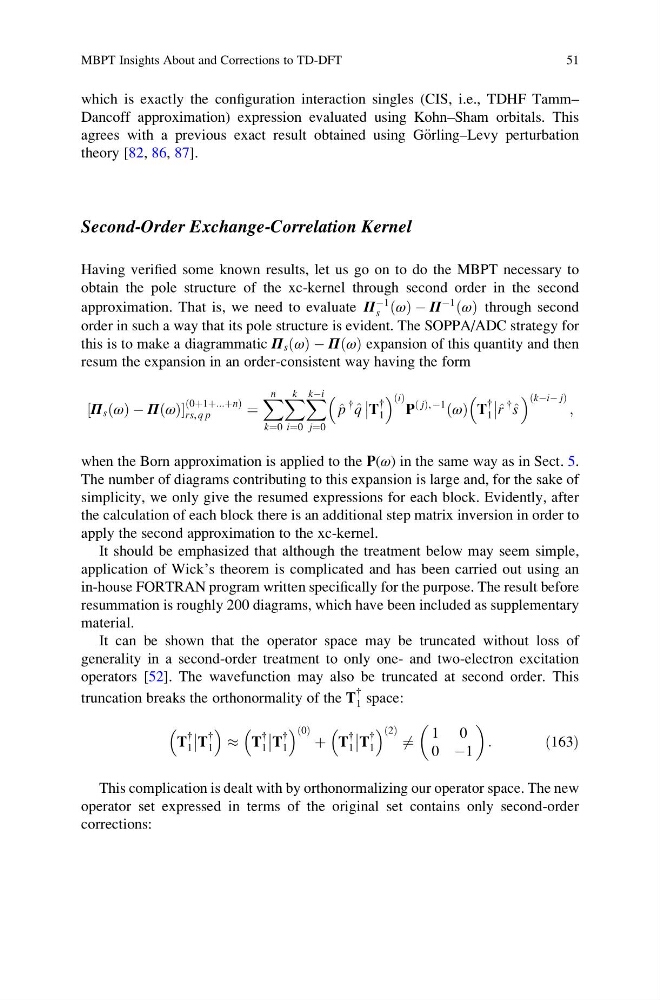
order in such a way that its pole structure is evident. The SOPPA/ADC strategy for
this is to make a diagrammatic Π s ω
ð Þ À Π ω
ð Þ expansion of this quantity and then
resum the expansion in an order-consistent way having the form
Π s ω
ð Þ À Π ω
ð Þ
½
0þ1þ...þn
ð
Þ
rs, q p
¼
X n
k¼0
X k
i¼0
X kÀi
j¼0
^
p
{
^
q
T
{
1
i
ð Þ
P
j
ð Þ, À1
ω
ð Þ T
{
1
^
r
{
^
s
kÀiÀ j
ð
Þ ;
when the Born approximation is applied to the P(ω) in the same way as in Sect. 5.
The number of diagrams contributing to this expansion is large and, for the sake of
simplicity, we only give the resumed expressions for each block. Evidently, after
the calculation of each block there is an additional step matrix inversion in order to
apply the second approximation to the xc-kernel.
It should be emphasized that although the treatment below may seem simple,
application of Wick’s theorem is complicated and has been carried out using an
in-house FORTRAN program written specifically for the purpose. The result before
resummation is roughly 200 diagrams, which have been included as supplementary
material.
It can be shown that the operator space may be truncated without loss of
generality in a second-order treatment to only one- and two-electron excitation
operators [52]. The wavefunction may also be truncated at second order. This
truncation breaks the orthonormality of the T
{
1 space:
T
{
1
T
{
1
% T
{
1
T
{
1
0
ð Þ þ T
{
1
T
{
1
2
ð Þ 6 ¼
1 0
0 À1
:
ð163Þ
This complication is dealt with by orthonormalizing our operator space. The new
operator set expressed in terms of the original set contains only second-order
corrections:
MBPT Insights About and Corrections to TD-DFT
51
Dancoff approximation) expression evaluated using Kohn–Sham orbitals. This
agrees with a previous exact result obtained using G€ orling–Levy perturbation
theory [82, 86, 87].
Second-Order Exchange-Correlation Kernel
Having verified some known results, let us go on to do the MBPT necessary to
obtain the pole structure of the xc-kernel through second order in the second
approximation. That is, we need to evaluate Π
À1
s
ω
ð Þ À Π
À1
ω
ð Þ through second
order in such a way that its pole structure is evident. The SOPPA/ADC strategy for
this is to make a diagrammatic Π s ω
ð Þ À Π ω
ð Þ expansion of this quantity and then
resum the expansion in an order-consistent way having the form
Π s ω
ð Þ À Π ω
ð Þ
½
0þ1þ...þn
ð
Þ
rs, q p
¼
X n
k¼0
X k
i¼0
X kÀi
j¼0
^
p
{
^
q
T
{
1
i
ð Þ
P
j
ð Þ, À1
ω
ð Þ T
{
1
^
r
{
^
s
kÀiÀ j
ð
Þ ;
when the Born approximation is applied to the P(ω) in the same way as in Sect. 5.
The number of diagrams contributing to this expansion is large and, for the sake of
simplicity, we only give the resumed expressions for each block. Evidently, after
the calculation of each block there is an additional step matrix inversion in order to
apply the second approximation to the xc-kernel.
It should be emphasized that although the treatment below may seem simple,
application of Wick’s theorem is complicated and has been carried out using an
in-house FORTRAN program written specifically for the purpose. The result before
resummation is roughly 200 diagrams, which have been included as supplementary
material.
It can be shown that the operator space may be truncated without loss of
generality in a second-order treatment to only one- and two-electron excitation
operators [52]. The wavefunction may also be truncated at second order. This
truncation breaks the orthonormality of the T
{
1 space:
T
{
1
T
{
1
% T
{
1
T
{
1
0
ð Þ þ T
{
1
T
{
1
2
ð Þ 6 ¼
1 0
0 À1
:
ð163Þ
This complication is dealt with by orthonormalizing our operator space. The new
operator set expressed in terms of the original set contains only second-order
corrections:
MBPT Insights About and Corrections to TD-DFT
51