

5 Conclusions and Outlook
In this chapter we have analyzed the ability of practically available computational
schemes based on density functional theory to describe conical intersections and the
ground- and excited-state potential energy surfaces in their vicinity. We have
investigated three DFT-based methods, namely the popular LR-TD-DFT approach
as well as the less common SF-TD-DFT and SI-SA-REKS methods, and have
evaluated their performance by comparing with reference results from standard
MRCISD-WFT calculations.
In accord with previous analysis from the literature [40, 41, 43], we find that the
LR-TD-DFT method is incapable of properly describing the topography of the S 0 /S 1
crossing point, yielding a linear instead of a conical intersection seam (i.e., M À 1
rather than M À 2 dimensionality). In LR-TD-DFT, the excited states are obtained
as the response states and thus do not couple with the ground state (the reference
state), which leads to the observed linear character of the intersection. In addition,
there are generally serious SCF convergence problems near the crossing point in the
conventional DFT calculation, which often result in aborted TD-DFT calculations.
These shortcomings render the LR-TD-DFT method largely useless for modeling
non-adiabatic relaxation processes.
The other two methods considered here, SF-TD-DFT and SI-SA-REKS, do not
suffer from the erratic SCF convergence near the crossing point and yield the
correct dimensionality of the CI seam and the correct shape of the S 0 and S 1 PESs
in its vicinity. Being based on ensemble DFT, the SI-SA-REKS method is capable
of correctly treating the multi-reference character of the nearly degenerate crossing
states. This method has the further advantage of not suffering from the erroneous
spin-contamination which plagues the SF-TD-DFT states. Although the use of the
high-spin (triplet) state as the reference state in SF-TD-DFT removes the SCF
convergence issues near the surface crossing points, the spin contamination inherent in this approach often complicates the identification of proper excited
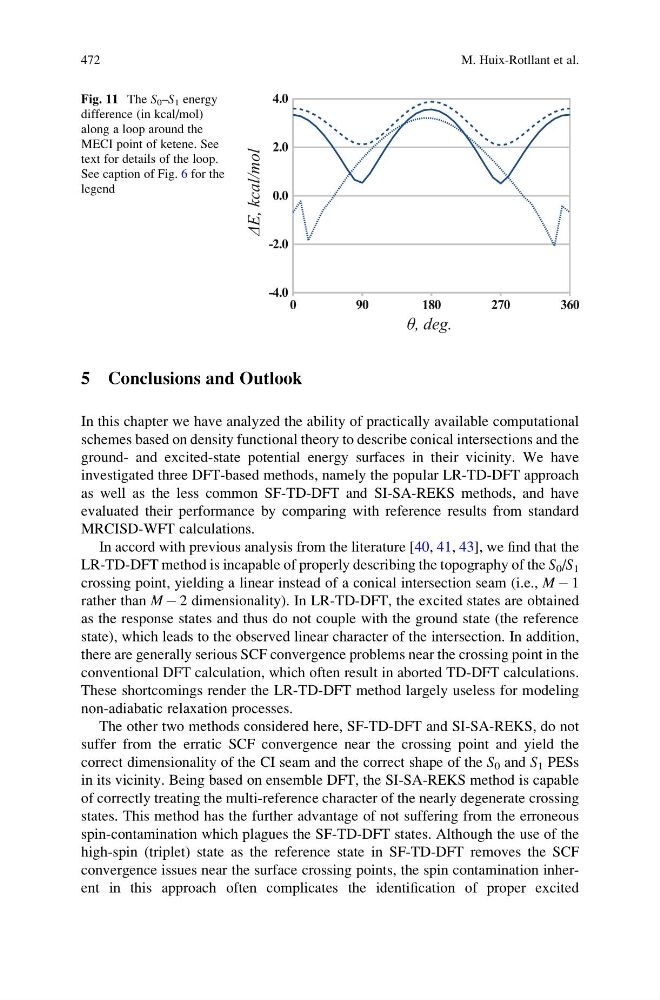
Fig. 11 The S 0 –S 1 energy
difference (in kcal/mol)
along a loop around the
MECI point of ketene. See
text for details of the loop.
See caption of Fig. 6 for the
legend
472
M. Huix-Rotllant et al.
In this chapter we have analyzed the ability of practically available computational
schemes based on density functional theory to describe conical intersections and the
ground- and excited-state potential energy surfaces in their vicinity. We have
investigated three DFT-based methods, namely the popular LR-TD-DFT approach
as well as the less common SF-TD-DFT and SI-SA-REKS methods, and have
evaluated their performance by comparing with reference results from standard
MRCISD-WFT calculations.
In accord with previous analysis from the literature [40, 41, 43], we find that the
LR-TD-DFT method is incapable of properly describing the topography of the S 0 /S 1
crossing point, yielding a linear instead of a conical intersection seam (i.e., M À 1
rather than M À 2 dimensionality). In LR-TD-DFT, the excited states are obtained
as the response states and thus do not couple with the ground state (the reference
state), which leads to the observed linear character of the intersection. In addition,
there are generally serious SCF convergence problems near the crossing point in the
conventional DFT calculation, which often result in aborted TD-DFT calculations.
These shortcomings render the LR-TD-DFT method largely useless for modeling
non-adiabatic relaxation processes.
The other two methods considered here, SF-TD-DFT and SI-SA-REKS, do not
suffer from the erratic SCF convergence near the crossing point and yield the
correct dimensionality of the CI seam and the correct shape of the S 0 and S 1 PESs
in its vicinity. Being based on ensemble DFT, the SI-SA-REKS method is capable
of correctly treating the multi-reference character of the nearly degenerate crossing
states. This method has the further advantage of not suffering from the erroneous
spin-contamination which plagues the SF-TD-DFT states. Although the use of the
high-spin (triplet) state as the reference state in SF-TD-DFT removes the SCF
convergence issues near the surface crossing points, the spin contamination inherent in this approach often complicates the identification of proper excited
Fig. 11 The S 0 –S 1 energy
difference (in kcal/mol)
along a loop around the
MECI point of ketene. See
text for details of the loop.
See caption of Fig. 6 for the
legend
472
M. Huix-Rotllant et al.